Cotton vs Poly Blend on Towels
By The Velocity Wear Team
Cotton absorbs more, feels softer and is what a guest expects from a quality towel. A poly blend shrinks less, dries faster, keeps its colour longer and stands up better to hard laundering. If the towel is a hospitality product judged on feel, choose cotton. If it is working stock washed hot every day, a blend will still look presentable in a year's time.
Which one shrinks, and by how much does that matter?
Cotton shrinks on its first few washes and then settles. That is normal and is allowed for in the cut, but it means a cotton towel measured out of the bag is not the size it will be in service. Blends move much less, which matters if the towel has to fit a fixed space — a rail, a shelf, a hire bag — or if you are topping up stock later and need new pieces to sit flush with the old ones. Fabric terminology worth knowing is collected in our glossary.
What does the blend do to a printed logo?
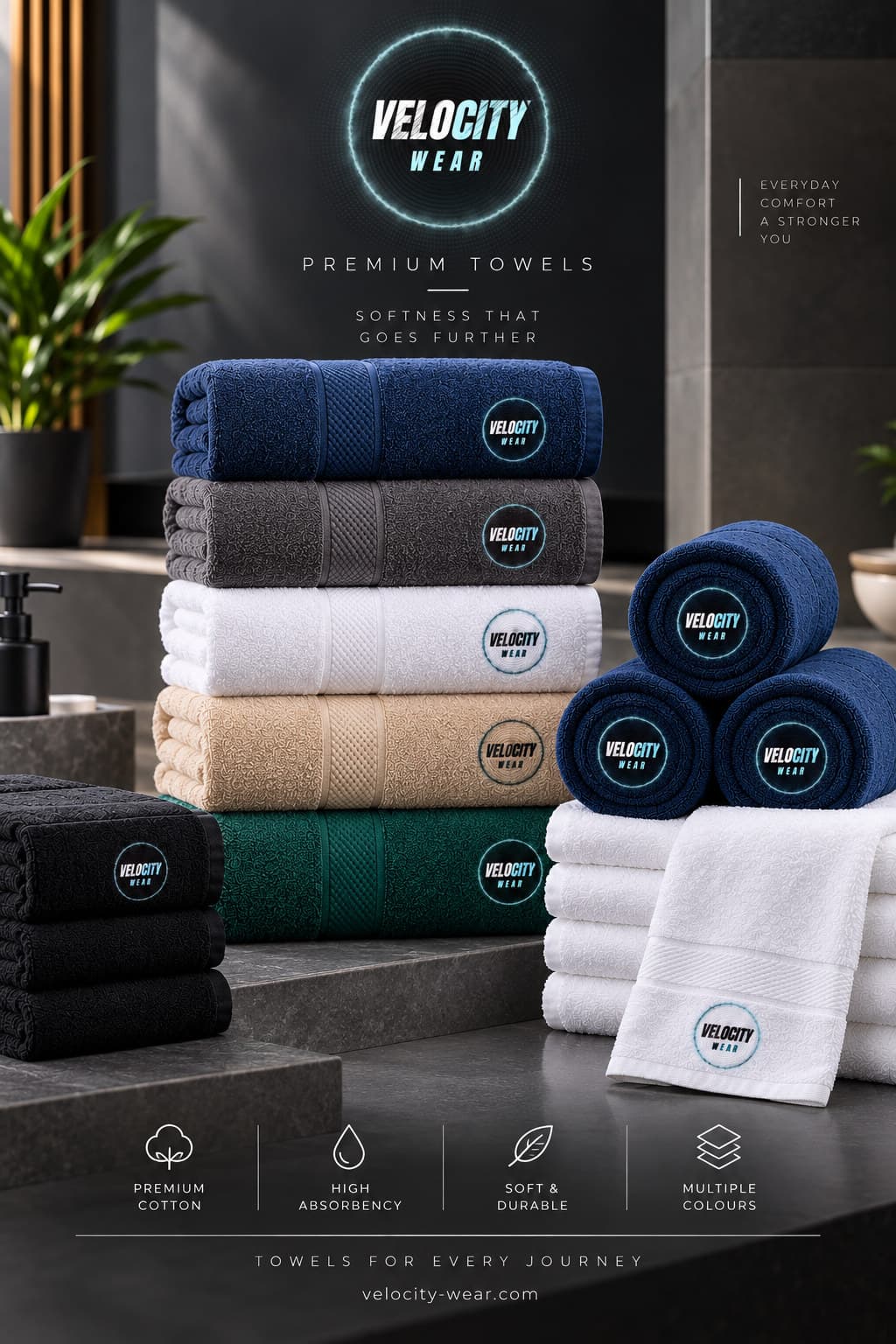
Synthetic content changes how ink and dye behave. Polyester takes a sublimated print that cotton simply cannot hold, which opens up full-coverage designs across the whole towel rather than a mark on the border. Conversely, cotton takes a screen print with a softer hand and a more natural finish. Embroidery does not care much either way — thread is sewn into whatever is underneath it. The practical upshot is that the fabric decision narrows your decoration options, so make it first.
How do the two wear over a year of washes?
Cotton gets softer for a while, then starts to look tired: the pile flattens, saturated colours dull, and hard water plus commercial detergent leaves it stiff. Blends hold their shape and colour longer but never reach the same softness. Neither outcome is a fault — it is the trade you made at the fabric stage. The single biggest variable in either case is the laundry regime, which is why why branded towels go hard and grey is worth reading before you specify anything.
Pick cotton when… pick a blend when…
Pick cotton when the towel is for a spa, hotel or retail product, when absorbency is the point, when the customer will judge it by touch, or when you want a premium item to match a premium price. Pick a blend when the towels go through a commercial laundry, when they are hire stock that must survive being abused, when you want a full-coverage sublimated design, or when dimensional consistency across repeat orders matters more than the feel in the hand. Towels are quoted per job either way, so ask for both on the same spec through the towels page and compare properly. Choosing blanks in general is covered in how to choose blank garments for printing, and the fabric-first approach in choosing fabric for wholesale towels.
There is a middle route that suits a lot of buyers: a predominantly cotton cloth with enough synthetic content to stabilise it. You keep most of the absorbency and most of the feel, and you gain some of the dimensional stability and colour retention. It will not print a full-coverage sublimated design the way a high-polyester cloth does, but for border branding it behaves well and it survives laundering better than pure cotton.
Whichever way you go, describe the wash regime honestly when you ask for a quote. A cloth specified for domestic laundering and then put through an industrial cycle at high temperature will look tired far sooner than it should, and that is a specification problem rather than a quality one. Telling us the machine, the temperature and the frequency at the start is what makes the recommendation useful.
Do not assume the fibre question has one answer across your whole range either. Plenty of operations run cotton where guests meet the product and a blend everywhere behind the scenes, which gets the feel where it counts and the durability where it is needed. Because each is its own design for minimum purposes, that split needs at least 100 pieces in total to work — but it is a better use of the budget than compromising in the middle.