Quality Checks on Bulk Jackets & Outerwear
By The Velocity Wear Team
Inspect a jacket delivery in two passes. First, within minutes of arrival, check the carton count, the sizes and a handful of garments for the obvious: right style, right colour, right logo, right placement. Second, over the following day, pull a sample from every size and check zips, stitching and decoration properly. Raise anything you find straight away, with photographs.
What should be checked in the first ten minutes?
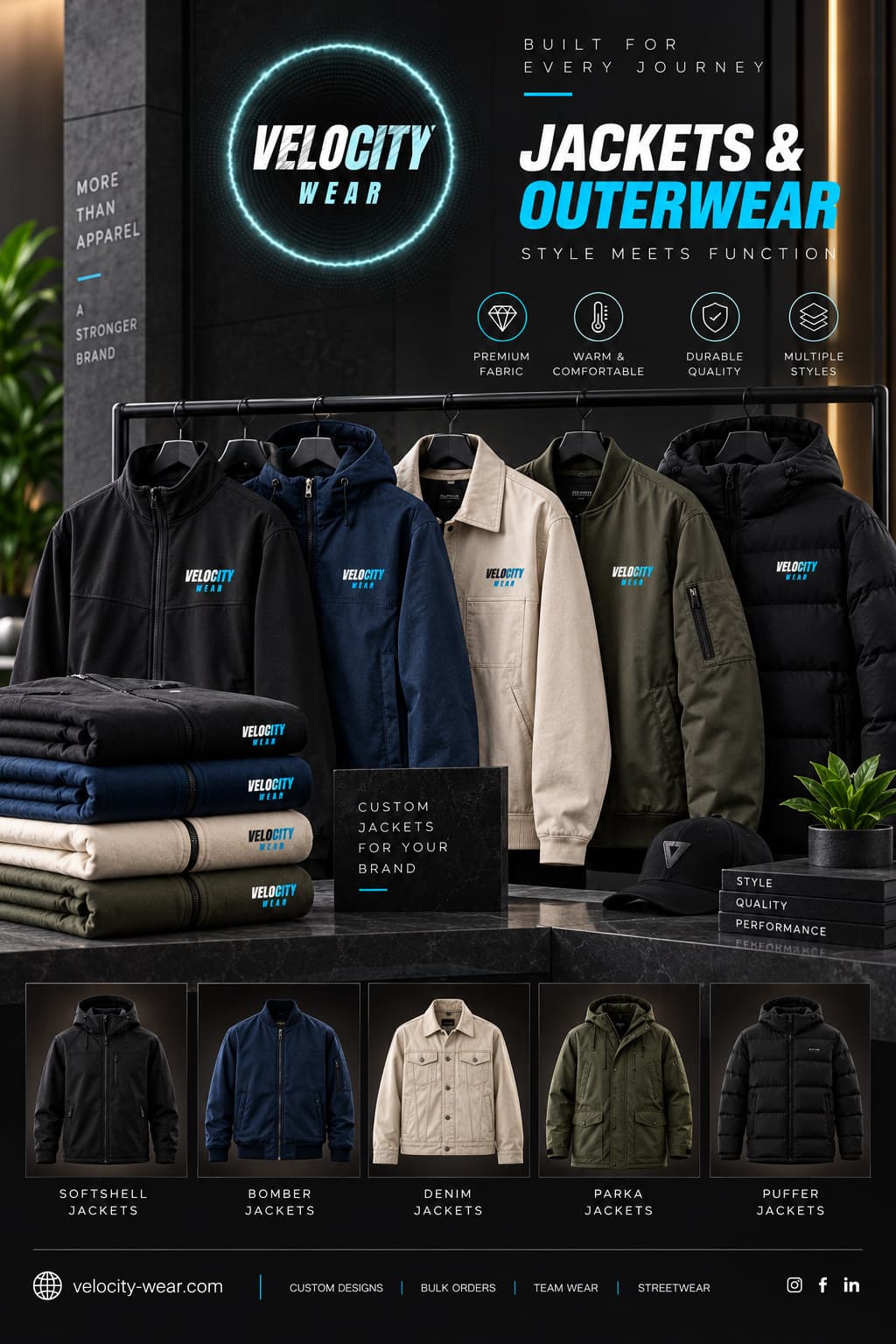
The things that would make the whole order wrong rather than a few pieces wrong. Is it the style you ordered. Is the body colour the shade you approved. Is the logo the current version of your mark, in the agreed position, at the agreed size. Does the size breakdown on the packing list match what you asked for. Those five questions take ten minutes and catch the errors that are expensive to leave undiscovered, because a whole-order problem needs to be flagged before the jackets are distributed. Everything on that list traces back to the approval you signed, which is why the approval is worth keeping.
What counts as a fault on a jacket?
A fault is something outside the agreed specification or outside normal manufacturing tolerance: a zip that does not run, a seam that has skipped stitches, decoration that is cracked or misplaced, a hole, a stain, a missing label. Variation is different. Small differences in shade between garments, a stitch count that differs slightly from a proof, or a size measurement within the stated tolerance are normal in volume manufacturing and are not faults. Knowing which is which before you send an email makes the conversation shorter. The vocabulary used in specifications is defined in our glossary and the styles themselves on the bulk jackets page.
Which checks happen before the order ships?
Production is inspected during and after manufacture, which is where most problems are caught and corrected while the fabric is still on the floor. That does not remove your own check on arrival, because transit damage and packing errors happen after the factory. The one check you can run before production is the approval itself: an approved sample at £150, credited against the bulk order, is a physical reference that both sides can measure the delivery against. Without one, a disagreement about quality becomes a disagreement about memory.
How should a problem be raised so it gets resolved?
Quickly, specifically and with evidence. Photograph the fault, photograph the label inside the garment, state how many pieces are affected and out of what quantity, and send it in one message rather than in a stream of separate notes. Keep the faulty pieces rather than disposing of them. The same discipline applies to any garment and is set out for printed goods in the quality checklist. If the issue is decoration lifting after washing rather than on arrival, the washing itself is often the cause, which is covered in care and washing for jackets.
Keep the paperwork with the delivery. The approved proof, the packing list and the specification you agreed are the three documents that turn a subjective argument into a factual one, and they take no space in a folder. They are also what makes a reorder straightforward months later, when nobody can remember whether the logo was nine centimetres or eleven and the person who approved it has moved on. Filing them takes a minute on the day and saves an hour every time the order repeats.