Care and Washing for Jackets & Outerwear
By The Velocity Wear Team
Branded outerwear wants a cool wash, no fabric conditioner, and no tumble dryer. Heat is what damages decoration and coatings, not water. Wash inside out on a gentle cycle, hang to dry, and press only from the reverse if at all. Every garment also needs a compliant care label sewn in, and on a private label order that label is something you specify rather than inherit.
How should a branded jacket be washed?
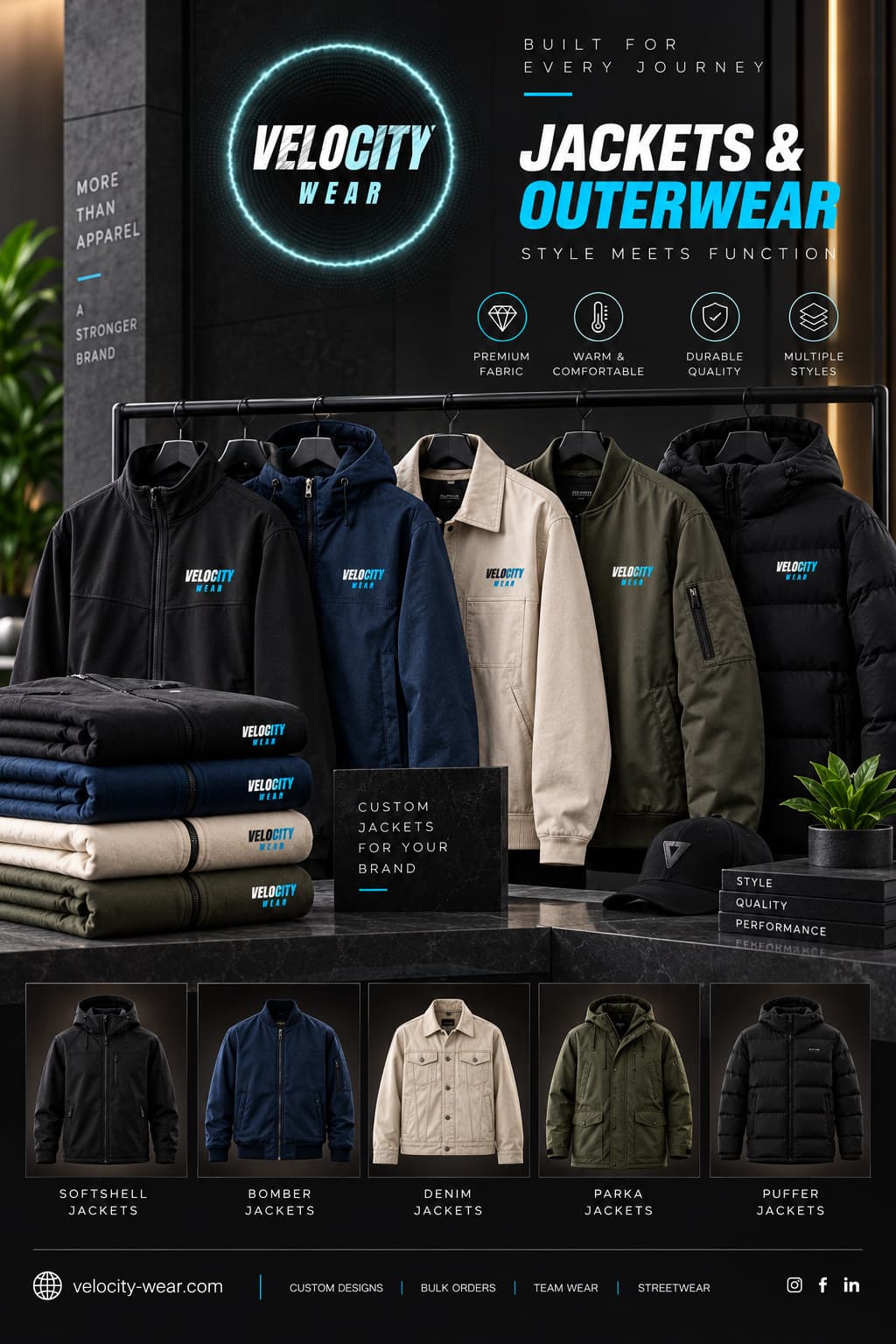
Cool and gentle. Zip it up first, so the zip teeth do not catch other garments or the decoration. Turn it inside out to keep the print off the drum. Skip fabric conditioner, which coats fibres and degrades the water resistance of a shell over time. Skip the dryer entirely: heat is what lifts transfers, shrinks cotton-faced shells and flattens puffer fill. Puffers in particular need drying flat or hanging and then shaking out, because wet fill clumps. None of this is demanding, but it has to be written down somewhere a wearer will read it, which is the label.
What does heat do to each decoration type?
Embroidery is the most durable and shrugs off repeated washing, though the backing can pucker if the garment is dried too hot. Screen printing is robust on flat woven shells and will outlast the jacket if it is never tumble dried. DTF is a transfer bonded with heat, so it is exactly what a hot dryer attacks, and it lifts at the edges first. 3D puff is raised foam under the stitching and flattens under a hot iron. Sublimation is dyed into the fibre and is the least affected by heat, but it is only available on suitable polyester fabrics. The decoration methods we run are listed on the bulk jackets page.
What has to appear on the care label?
Fibre composition, care symbols and the country of origin, plus your brand name if you are private labelling. This is a compliance matter rather than a style choice, and the requirements differ slightly between the UK, the US and the EU, so if you sell across all three the label has to satisfy all three. We can produce custom woven labels, tear-out labels and swing tags as part of a private label order. The rules themselves are summarised in care labels and clothing compliance.
How do you keep a team washing them correctly?
Assume nobody reads the label and tell them once, in writing, when you hand the jackets out. A single line in the email that goes with distribution does more than a printed card. For crews that use a commercial laundry, check the temperature the laundry actually runs, because industrial cycles are hotter than domestic ones and will take a transfer off in weeks. If the jackets have to survive a commercial wash, specify that before artwork approval so the decoration method is chosen accordingly, and consider a sample at £150, credited against the bulk order, to wash-test first. Waterproof shells have extra rules, covered in custom rain jackets.
Storage between seasons matters as much as washing. Put jackets away clean and dry, on hangers or loosely folded rather than compressed under something heavy, because a puffer left crushed for six months takes a long time to recover its loft and a coated shell can crease permanently. Damp is the real enemy in a site cabin or a school store cupboard. The terms that appear on care labels and specification sheets, including composition names and finish descriptions, are set out in the glossary if a wording on the label is unfamiliar.