Wholesale Keychains: lead time
By The Velocity Wear Team
Custom keychains take 10 to 15 working days from artwork approval, with delivery transit after that. Being a small item does not make them quicker: the preparation and finishing follow the same schedule as a garment run. If a keychain is one component of a kit, it should be approved on the same day as everything else so the whole lot lands together.
How long is the wait on custom keychains?
Plan on 15 working days for production, which is three calendar weeks, then add transit. People routinely assume a small accessory can be turned round in days and build a schedule on that assumption, then find the keychains are the item holding back the launch. There is no express lane here; the honest number is the one to plan with.
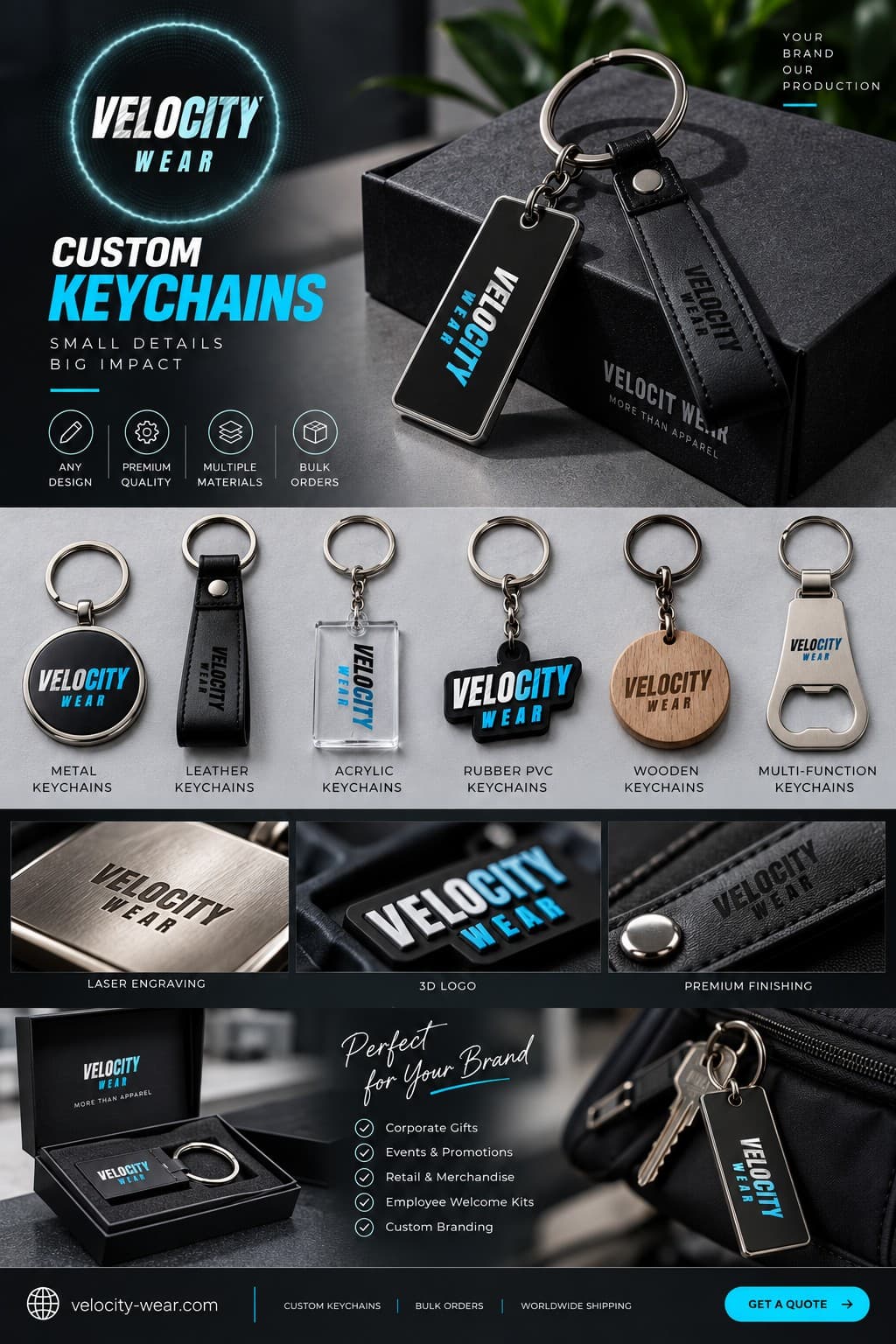
Quantity barely changes it inside normal bulk ranges. What changes it is a specification that is still being decided. Settle the shape and material against the keychains page before asking for dates, and if the keychains are travelling with other items, check the wholesale range so one approval covers the whole order.
When do you need to approve artwork?
Count back from the day you need the keychains in hand, not the day of the event. Subtract transit, then 15 working days, then whatever your own sign-off takes. Whatever date that lands on is your artwork deadline, and it is the only part of the chain you control directly.
Approval is what starts the production clock, so a proof that sits unread for four days costs four days of delivery. The way that dependency plays out across a whole launch is set out in building a launch calendar that does not slip, and it applies to accessories as much as to the headline product.
Does adding keychains slow a clothing order?
Not if they are approved together. Both sit in the same 10 to 15 working day window, so a combined approval produces a combined delivery. What causes delay is adding the keychains as an afterthought a week into a garment run, which effectively restarts the clock for that item and splits the shipment.
If a late addition is unavoidable, ship in two waves rather than holding the garments. The full picture of what pushes an order past its date is covered in understanding lead times: what delays a clothing order.
How does a sample affect the schedule?
It adds a round trip before the production window opens. The £150 sample has its own production and its own transit, and only once you approve it does the bulk run begin. For a first keychain order that is usually time well spent, since a physical piece answers questions about weight and finish that no image will, but it needs booking at the start rather than squeezed in at the end.
For a repeat of a design you have already produced, skip it and go straight to bulk. Your previous run is the reference, and the schedule is three weeks shorter for it.
If the keychain is one line on a larger order, put its approval date in the same calendar entry as the rest of the kit rather than tracking it on its own. Small items are the ones that slip out of a schedule, precisely because they feel trivial next to the garments, and a forgotten accessory holds a delivery up just as effectively as a forgotten hoodie does.
Order early enough that a reprint would still be survivable. The real value of a buffer is not that it absorbs supplier delay, which is rare, but that it leaves room for the one occasion when the artwork turns out to be wrong after the boxes have already landed.