How Charities Buy Jackets & Outerwear Wholesale
By The Velocity Wear Team
A charity buying outerwear is spending donated money, so the question is not what it costs but what it returns. A volunteer jacket that is worn for three winters and recognised on a high street earns its place; one ordered for a single campaign does not. Jackets are quoted per job, with a fifty-piece minimum per design.
How does a jacket order sit against donated income?
Judge it per wear rather than per piece. A shell that costs about what a few dozen printed leaflets cost, but is still visible at collections two years later, is the better spend — provided the design does not date. That means leaving the campaign year, the appeal name and the target figure off the garment, and putting only the charity mark on it.
Registered numbers and straplines belong on the sleeve or nowhere. The charities and fundraising page covers the rest of the kit a volunteer team needs.
How do you size volunteers you have never met?
You do not, so order to a curve instead. Volunteer teams skew towards the larger end and towards people who will wear the jacket over a coat, so weight the fifty that way and keep a handful of the smallest and largest sizes back. Sizes mix freely inside the minimum, which makes this free to get approximately right.
Where a garment has to be issued and returned, keep a sheet. A charity that hands out fifty jackets without recording who has them buys fifty more the following year.
Which style earns its cost over several campaigns?
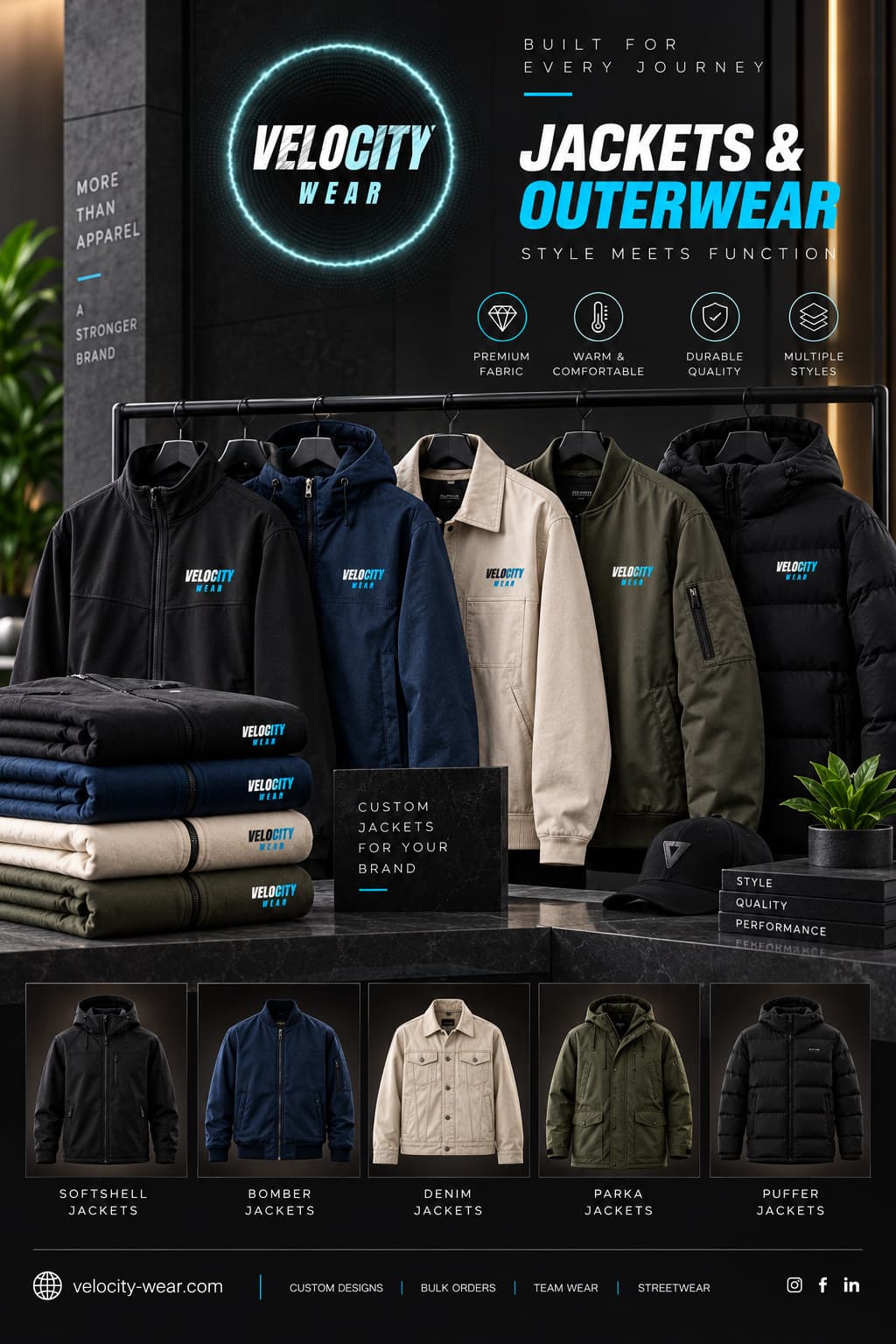
Softshell, usually. It works from October to April, it takes embroidery, and it does not look like an event giveaway. A coach jacket is the cheaper option for a one-season push and prints large on the back, which matters at a street collection. Puffers are warm enough for winter fundraising but cost more to brand well. The four styles sit on the wholesale jackets page.
Apparel for charities and nonprofits covers the wider question of which garments raise money and which only cost it.
Can a charity sell branded outerwear as well as issue it?
Yes, and a jacket at a supporter price is often what makes the fifty viable at all. Split the run: volunteers get the high-visibility back mark, supporters get the plain chest version. If the artwork differs those become two designs and two minimums, so the usual compromise is one design issued to both, with volunteers distinguished by a tabard on the day. Anything sold has to be priced with the tiers in mind, since discounts reach 35% from the fifty-piece price as quantity rises. Apparel gifting that gets worn applies the same test to corporate donors.
How do you handle a jacket across several branches?
One order, several addresses. Branches that each place their own run pay the fifty-piece rate every time, where a single combined order lands higher up the tiers and arrives split to wherever it is needed. The coordination cost is one spreadsheet of sizes per branch, collected against a deadline.
Keep the design common across branches. A branch name on the sleeve feels like a small addition, but it makes each version its own design with its own minimum, which is the fastest way to turn a sensible order into an unaffordable one. Where branches genuinely need distinguishing, a badge or a pin does it without touching the garment.
Agree the replacement policy centrally as well. Volunteer kit that walks off is a cost somebody has to carry, and deciding in advance whose budget that is prevents an awkward conversation later.