Print or Embroider Wholesale Jackets & Outerwear?
By The Velocity Wear Team
Embroider small marks on outerwear and print large ones. A left-chest logo, a sleeve badge or a name above a pocket belongs in thread, because stitch survives weather and reads as workwear. A full-back graphic, a photographic image or anything with fine gradients belongs in screen print, DTF or sublimation. Most jacket orders end up using both, on different parts of the same garment.
What does each method do to a jacket shell?
Thread goes through the fabric, so it needs something stable behind it. On a bonded softshell that is straightforward. On a thin puffer face the needle perforates a panel that is holding fill, so the stitch area has to be kept modest and backed properly. Screen printing lays ink on the surface and suits smooth woven faces, which is why coach jackets are the natural home for it. DTF applies a transfer with heat and pressure, and water-resistant finishes want that heat kept down. Sublimation only works on light polyester, so it belongs to printed panels rather than finished outerwear. The broader method-by-method view is in which printing method should you choose.
Which artwork belongs in thread?
Anything with solid shapes, a limited palette and no text smaller than roughly 5mm tall. Embroidery is a rebuild of your logo in stitch, not a copy of it, so hairline rules disappear, tight gradients become blocks, and a wordmark that works at poster size can turn into a smudge at chest size. If your logo has a lot of fine detail, the honest options are to simplify it for the stitch file, to move it somewhere larger on the garment, or to use an applied badge instead. Appliqué, patches and woven labels covers the badge route, which is often the cleanest answer on a puffer.
Where on the garment can you decorate?
More places than people assume, and each one has a catch. Left chest is the default and is nearly always available. The back panel is the biggest canvas but is broken by a yoke seam on some styles. Sleeves take a small print or a badge, though a lined sleeve is harder to hoop than a flat one. A zip placket kills anything centred on the front, so a print has to sit to one side or split across the opening. Nape prints and inside-neck marks are possible and are worth asking about when the outside of the jacket has to stay clean. Pockets, drawcords and seams all constrain placement, which is why a proof on the real style matters more here than on a t-shirt.
How do you decide with a 50-piece run?
At 50 pieces, setup is the biggest share of the decoration cost, so colour count is what you are really choosing. A one or two colour screen print across fifty jackets stays cheap. A six-colour print does not, because every colour is its own screen. Embroidery prices from stitch count rather than colour count, so a small multi-coloured crest can beat a small multi-coloured print at that quantity. DTF has no screen setup at all, which makes it the practical choice for a short run with a complicated image. As the quantity climbs those setup costs spread out, and the pricing tiers take up to 35% off the 50-piece rate by the time you reach the top band.
What should you brief the supplier?
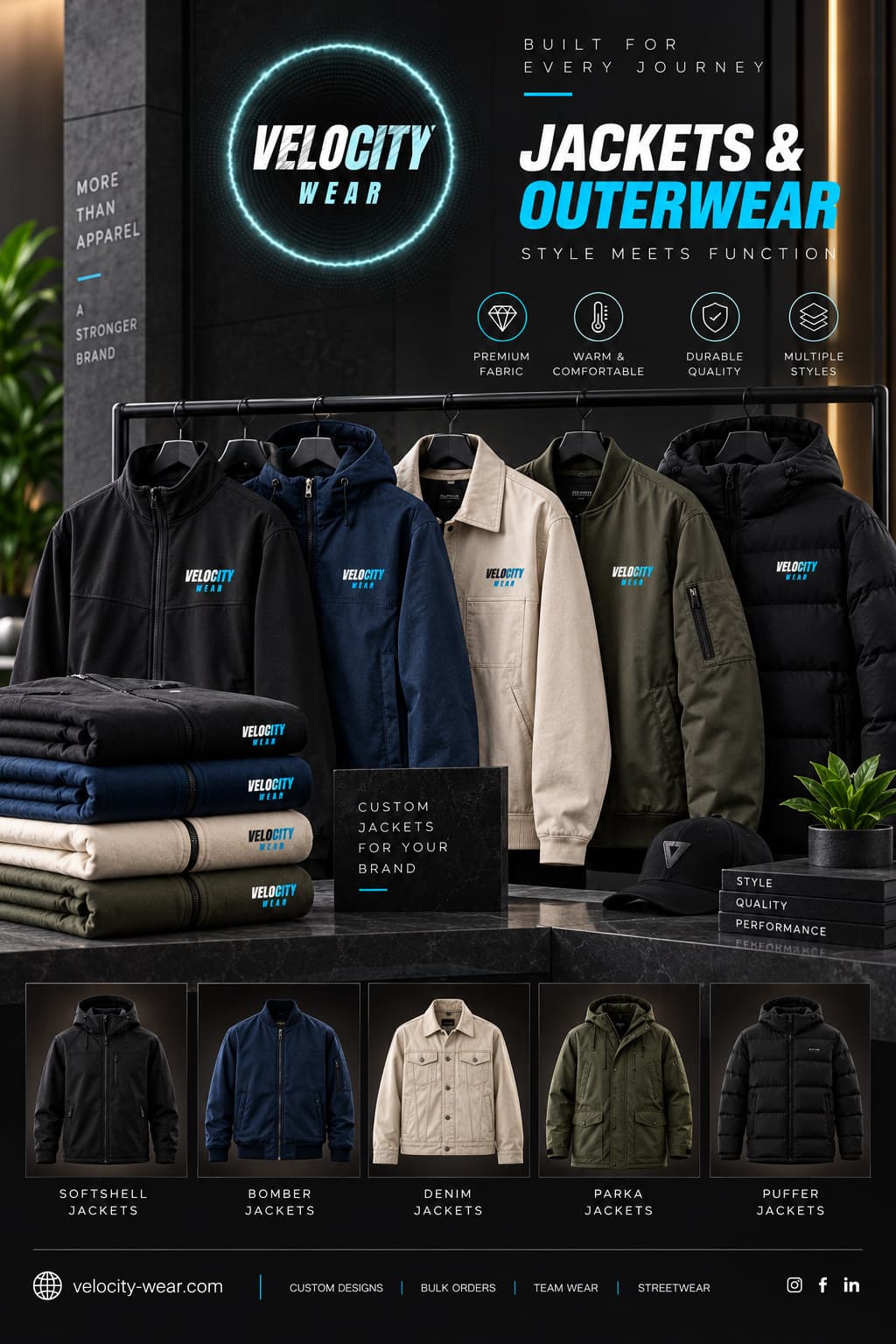
Say which style you want, where each mark goes, and how big each one should be in millimetres rather than in adjectives. Send vector artwork with the fonts outlined. Say whether the colours must match a specific reference or whether close is fine. That is enough to quote and enough to proof, and it takes the guesswork out of the first round. The jackets and outerwear range covers softshell, puffer, coach and varsity styles, and the decoration is quoted with the garment rather than bolted on afterwards.