
Printing Your Logo on Polythene Bags: Artwork Rules
By The Velocity Wear Team
Need this made?Get pricing for this product— free, no obligation, 50 pieces minimum.
To print your logo on polythene bags you do not need equipment of your own: you send vector artwork, it is placed on the bag face and returned to you as a proof, and production starts when you approve it. Velocity Wear prints logos on frosted zip-seal garment bags from 50 per design, with 10 to 15 working days of production after approval.
Should you print polythene bags yourself or order them printed?
For a brand, ordering printed bags is almost always the better route. Printing on film is factory work: the logo has to land in the same place on every bag and read cleanly against the film, and that consistency is hard to reach by hand. Stickers applied to plain bags are the usual stopgap, and they peel, sit crooked and add a step to every pack. The printed garment bags we make arrive with the logo already on the face, so the only job left is putting the garment inside.
How does a logo read on frosted film?
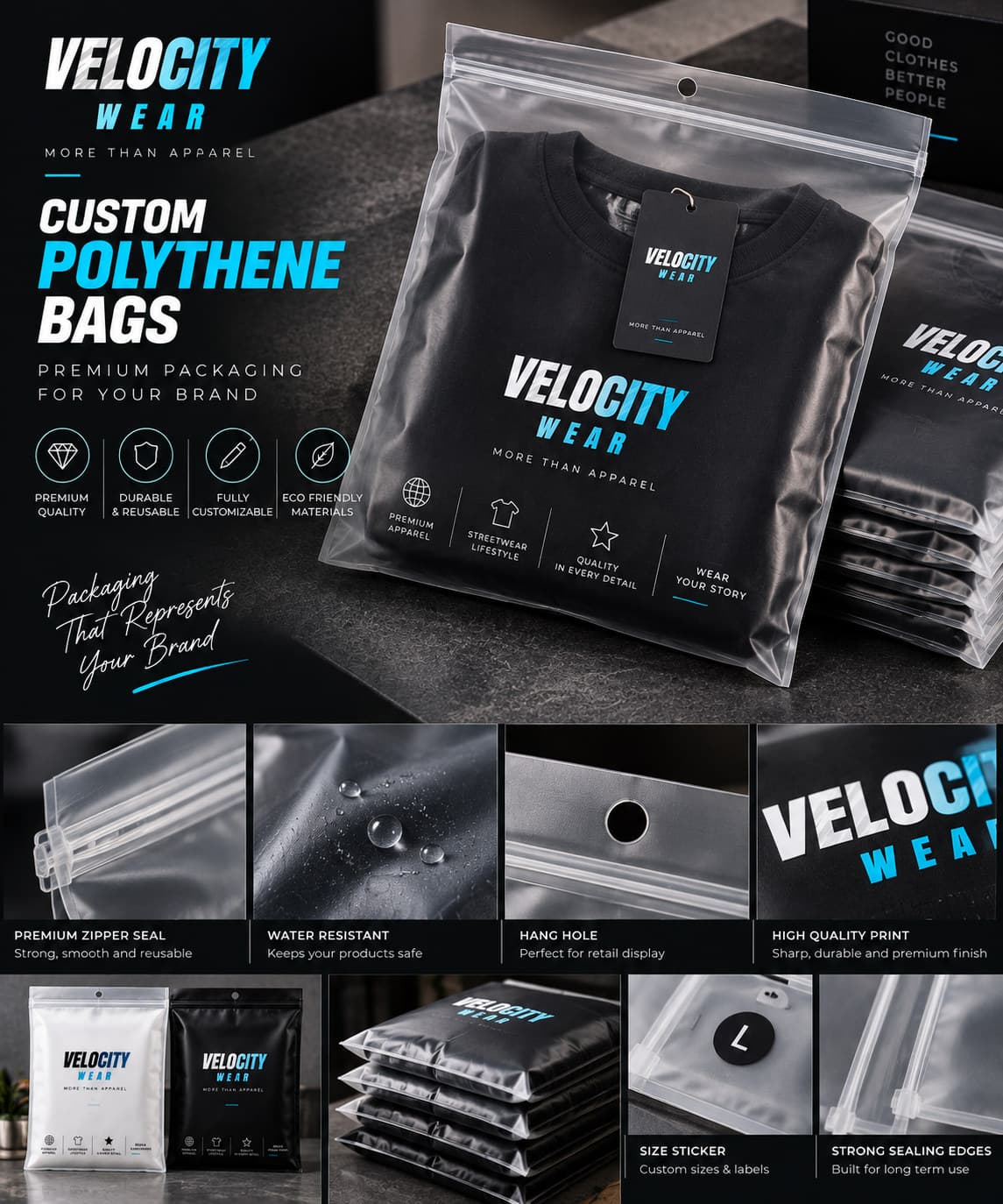
Frosted film is translucent, so the background to your logo is partly the film and partly whatever garment is inside. A white or light mark reads strongly over a black tee; the same mark nearly disappears over a white one. A dark mark does the reverse. If one bag design will hold garments in several colours, choose a version of your logo that works over both, or ask to see each case on the proof. The finish itself is compared in frosted and clear bags.
Where should the logo sit on the bag?
Below the zip seal and clear of the hang hole, roughly centred on the part of the bag the folded garment fills. The top band carries the zip track and the punched hole, so artwork placed there is cut through or lost behind the closure. Leave space for the size sticker too, so it does not land on your logo, and keep text away from the side edges where the film is sealed. What the sticker itself can carry is covered in size stickers and labels.
| Check | Why it matters | What to do |
|---|---|---|
| File type | Vector artwork scales without blurring | Send AI, EPS, SVG or a vector PDF; a PNG only as reference |
| Contrast | The film and the garment behind it both affect legibility | Supply a light and a dark version if bag contents vary |
| Line weight | Hairlines and tiny type can fade or vanish on film | Keep thin strokes and small text bold enough to read at arm's length |
| Placement | The zip track and hang hole take the top band | Position the logo below the seal and away from the side edges |
| Sticker space | Size stickers go on the bag face | Mark where the sticker should sit so it avoids the artwork |
| Colour references | Screen colours vary between devices | Give Pantone or other colour references for brand colours |
Which files should you send?
Vector files are the standard: AI, EPS, SVG, or a PDF saved from a design program with the artwork kept as vectors. Outline any fonts, or send them with the file. A high-resolution PNG is useful to show intent but is harder to work from if the logo has fine detail. If all you have is a JPEG taken from a website, say so in the enquiry so it can be discussed before the proof. Artwork setup is covered in more depth in artwork for wholesale polythene bags.
What happens at proof approval?
The proof shows your logo at its size and position on the bag, along with any size sticker or custom label. Check the spelling, the position relative to the zip and hang hole, the colours and the sticker content line by line. Approval is what starts the 10 to 15 working days of production, so a quick, careful check is the fastest route to delivery, and it is also the last easy moment to change anything.
Starting your artwork order
Send your logo file, the garments the bags will hold and their colours, the number of bags per design, and the delivery country and date. A quote with pricing usually follows within hours on working days. The rest of the bag is on the printed polythene bag page, and the overview of printed polythene bags covers sizing and the minimum.