Screen Printing vs Embroidery on Jackets & Outerwear
By The Velocity Wear Team
Screen printing wins on large graphics, flat woven shells and long runs of few colours. Embroidery wins on small marks, on anything worn in weather, and wherever the jacket needs to read as proper kit. On a 50-piece order the costs land closer together than buyers expect, because screens are charged per colour while stitch is charged by density.
What does each cost across the tiers?
At the 50-piece minimum, setup dominates both. A one-colour print needs a single screen, which spreads across fifty jackets easily; a four-colour print needs four, and the per-piece figure climbs sharply. Embroidery ignores colour count entirely and charges for stitches, so a small dense crest can cost more than a large simple one. Push the same job to 500 pieces and both curves flatten, because the setup is already paid for and only the run time is left. That is the mechanism behind the tiers on the pricing page, which reach 35% off the 50-piece rate at the top band.
Which survives a winter of wear?
Embroidery, comfortably. Thread is part of the garment and does not crack, lift or fade the way a surface layer eventually can, which is why site jackets and uniform outerwear default to it. A well-cured screen print on a smooth coach jacket lasts a long time too, but it is doing a harder job: it sits on top of a shell that gets rained on, rubbed against van doors and washed with zips. If the jacket is being worn daily for a year in bad weather, stitch is the safer specification. If it is a promotional piece for a season, the print is fine.
Which artwork suits screens, which suits needles?
Screens want flat spot colours with clean edges and no more of them than you can justify. Big blocky back graphics, type at scale and two-tone logos all separate beautifully. Needles want simple shapes and no fine detail, because every line is rebuilt in thread and anything under a few millimetres closes up. A logo with a thin outline and small tagline text can be printed exactly as drawn and will have to be simplified to be stitched. Whichever you choose, the file requirements are the same, and preparing artwork files sets those out.
Does the jacket style decide it for you?
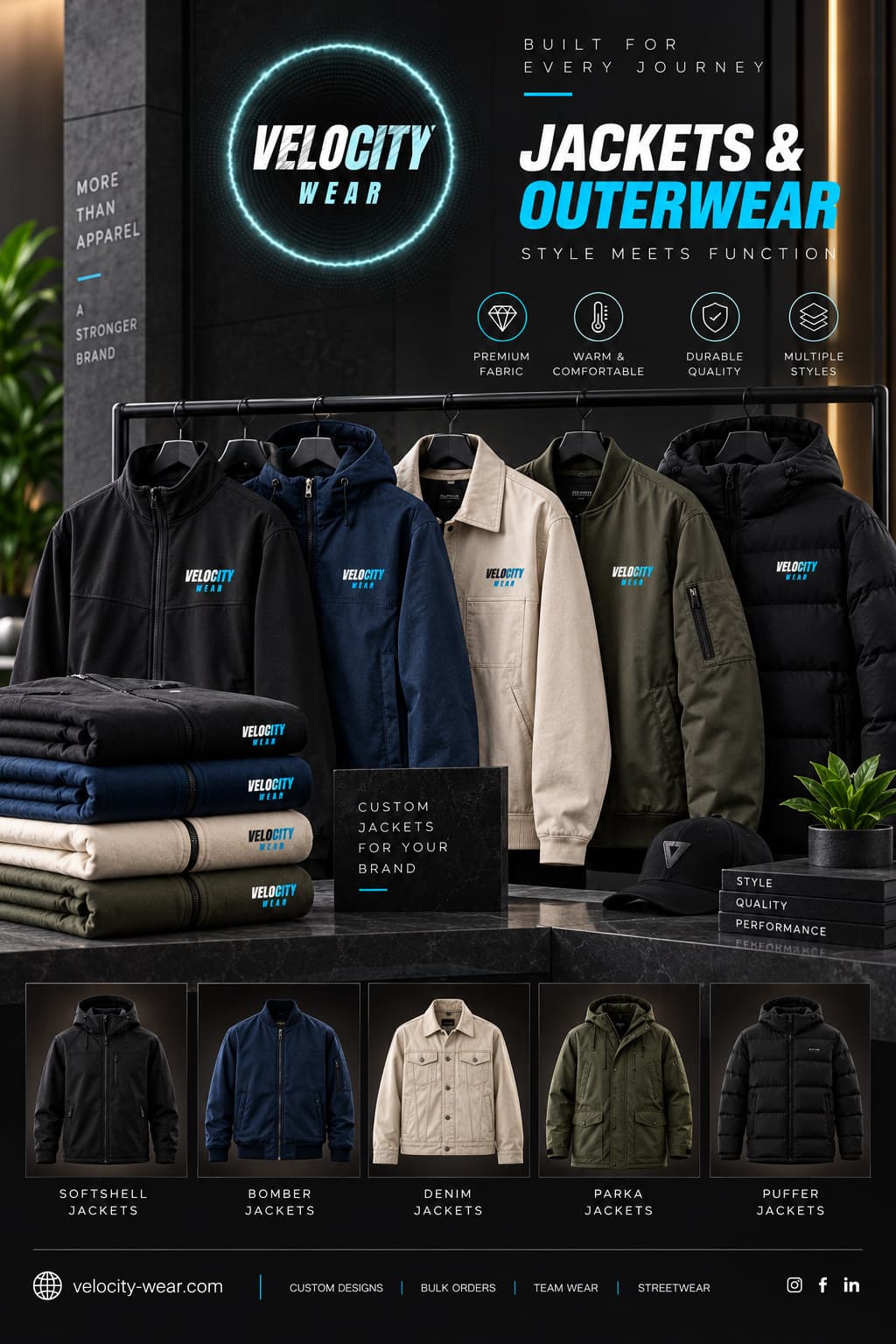
Often, yes. A coach jacket has a smooth flat face and no quilting, which makes it the easiest outerwear surface to screen print. A softshell handles embroidery cleanly because the bonded construction gives the needle something stable to work into. A puffer resists both to some degree: the panel is thin and the fill moves, so large stitch areas risk puckering and heat has to be controlled on anything applied. Varsity bodies traditionally carry appliqué and chenille rather than either method. The styles are listed on the wholesale jackets page, and the comparison pages line the decoration methods up against each other in one view.
Pick screen printing on a jacket when…
The graphic is large, the colour count is low, the shell is flat and the quantity is high. A single-colour back print across 500 coach jackets is the case screen printing was designed for, and nothing else produces that result at that price. It is also the right call when the artwork has to be reproduced exactly as drawn, with no simplification.
Pick embroidery on a jacket when…
The mark is small, the jacket is outerwear in the proper sense, and the wearer is going to have it for years. Left chest logos, sleeve badges and nape marks on softshells are the natural territory. It is also the answer when the jacket is a uniform rather than merchandise, because stitch reads as considered where a print can read as temporary. If you want a raised version of the same mark, embroidery versus puff embroidery covers that comparison.