Jackets & Outerwear for Offices: cost
By The Velocity Wear Team
Office outerwear is quoted per job rather than carrying a published from-price, because a lightweight coach jacket and an insulated puffer have very little in common beyond the word jacket. The structure around the number is fixed: fifty pieces per design, sizes mixed freely, and a per-piece price that falls by up to 35% against the fifty-piece rate as the quantity rises through the tiers.
How is an office jacket priced if there is no list price?
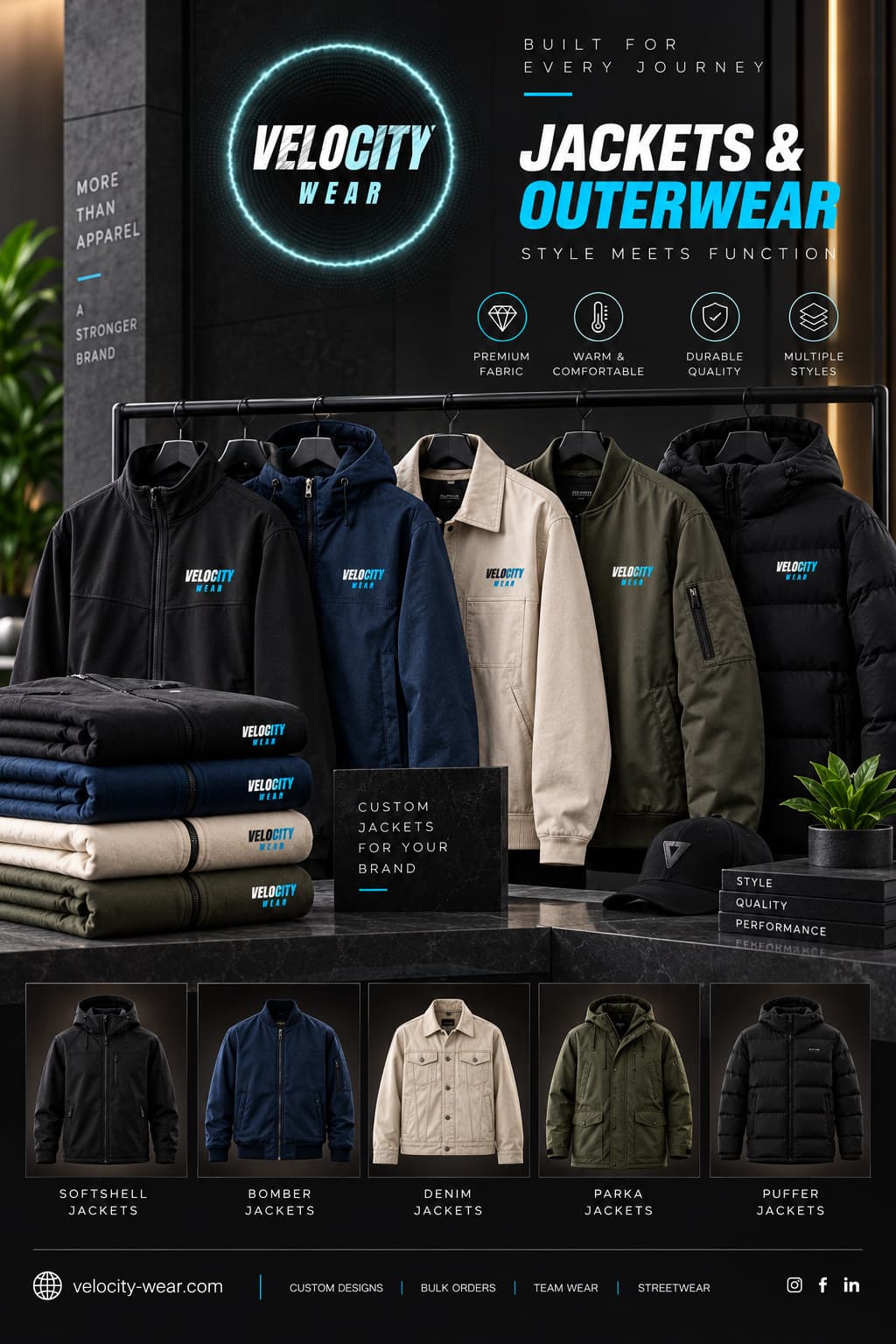
The quote is built from four inputs. The garment itself, which is the largest share and the one that varies most between a shell and a padded style. The decoration, where a small embroidered chest mark and a full back print are different amounts of work. The quantity, which sets the tier. And the finishing, if you want your own labelling or individual bagging. Send the style, the quantity and the artwork and the figure comes back as one per-piece number, not a stack of surcharges. The current range is on our jackets page, and typical office specifications are described on the corporate and offices page.
What moves the per-piece figure up or down?
Quantity moves it most, and nothing else comes close. The tiers step at 50 to 99, 100 to 249, 250 to 499, 500 to 999 and 1,000 or more, and each step is a genuine reduction rather than a rounding. After that, garment weight: insulation and a technical membrane cost more than a cotton-faced coach jacket, every time. Decoration size has a smaller effect than people expect, because the setup is the work and a slightly larger logo is not. What does add cost is the number of separate positions, since each one is handled individually on each garment.
What does not move the price is how complicated your logo looks. A detailed crest and a plain wordmark are the same job once the artwork is digitised, so there is no saving in simplifying a logo for budget reasons alone.
Is it cheaper to order once a year or twice?
Once, almost always. Two runs of fifty are both priced at the fifty-piece rate. One run of a hundred sits in the next tier and arrives from one dye lot, which removes the colour drift question between deliveries. The counter-argument is cash and cupboard space, and outerwear takes up a lot of the latter. A programme that runs cleanly on a single annual order is described in building a corporate apparel programme, which is worth reading before a budget is set rather than after.
What else belongs in the budget?
Two things people leave out. A sample at £150, credited back against the bulk order, which on a garment this visible is money well spent. And delivery, which is separate from the per-piece figure and depends on where the boxes go. We ship to the UK, the USA and Europe and invoice in seven currencies, so a business with offices in more than one country can be billed in the one that suits its accounts rather than converting after the fact.
Compare quotes on the same specification or you are not comparing anything. A figure that looks lower is usually a lighter garment, a smaller logo or a single decoration position rather than a better deal, and the difference becomes obvious the first time somebody wears it in February. Ask every supplier for the garment weight, the decoration method, the number of positions and what the finishing includes. Written out against each other on one line, those four things explain almost every price gap you will see.