Jackets & Outerwear for Trades: print or embroidery
By The Velocity Wear Team
On trades outerwear, embroidery wins on softshell and coach jackets, and DTF wins on puffers and anything quilted. The reason is the surface: a dense woven face takes a needle without distorting, while a baffled, air-filled panel puckers around a stitch. Both start at our fifty-piece minimum, and jackets are quoted per job rather than sold from a fixed list price.
Does embroidery or print last longer on a site jacket?
Embroidery lasts longer, because the mark is thread rather than a layer sitting on top of the fabric. On a softshell or a coach jacket it will outlive the garment. The trade-off is detail: a very fine line closes up once it is stitched, and a logo with thin serifs or a gradient has to be simplified before it goes anywhere near a machine. DTF holds that detail exactly as drawn and needs no needle hole through a weatherproof face, but it is a film, and a film takes more abuse on a sleeve that rubs against scaffold every day. Our wholesale jackets page covers the styles we run, and the construction and trades kit page sets out how crews usually specify them.
Screen printing is the third option and it suits cotton-faced outerwear rather than technical shells. Three-dimensional puff belongs on caps and heavy fleece, not on a jacket back where a fold line will crack it. Sublimation needs a pale polyester face, which rules it out of most site colourways before the conversation starts.
Which method suits a softshell, a puffer or a coach jacket?
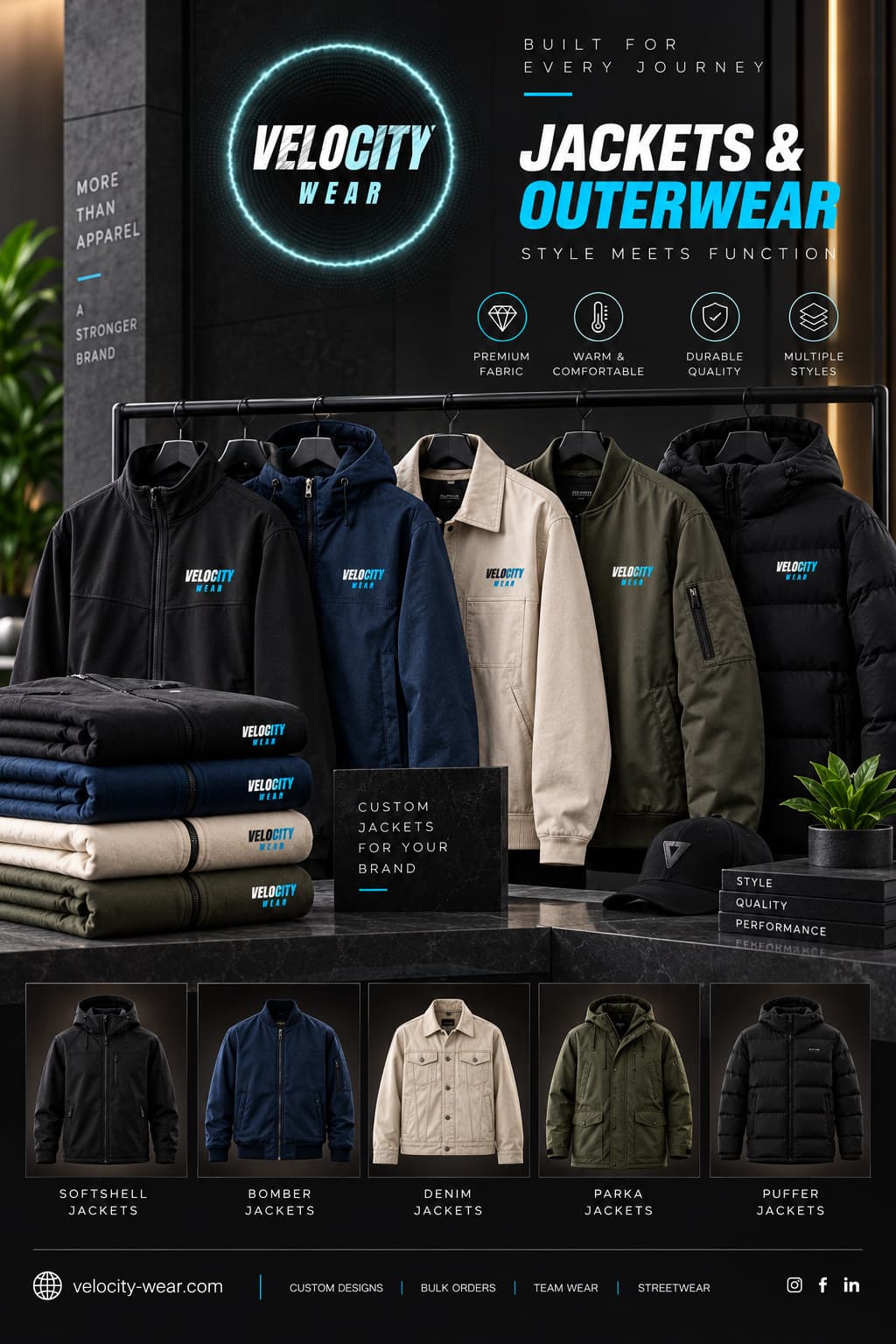
Softshell is the easy one. The face is a tight bonded weave, it holds a stitch flat, and a left-chest badge plus a back yoke block is a standard spec. Detail on that build is covered in our softshell guide. A puffer is the opposite problem: stitching through a quilted panel compresses the fill in a ring around the logo and the garment never recovers its loft there, so a transfer applied to a single baffle is the safer route, which the puffer and padded jacket post goes into properly. Coach and varsity styles sit in between, and both take chenille, twill or embroidery well because the body panel is stable.
Where should a logo sit on outerwear worn over a hoodie?
Higher than you think. A site jacket is worn open, over a hoodie, with a harness or a tool belt across it, and a chest badge placed at the usual height disappears under a strap. Move it up towards the collarbone and inboard, so it clears both the zip and the harness webbing. The back is the position that actually earns its keep: a block across the shoulders reads from twenty metres, which is the whole point of putting a company name on a crew in the first place. A sleeve mark is worth adding when the jacket will be worn with the back to a wall all day.
Colour matters as much as placement. A dark logo on a navy jacket is invisible in low light, and half the working year in the UK is low light. Reverse it to white or a single bright spot colour and check it against the actual garment colour, not against a white mockup.
What does decoration add to a trades jacket quote?
There is no published from-price on jackets, because a softshell and a padded parka are not the same garment in any useful sense. What is fixed is the shape of the quote. Fifty pieces per design is the minimum, sizes can be mixed freely inside that fifty, and the per-piece figure falls as the run grows, by up to 35% at the top tier compared with the fifty-piece price. Production runs 10 to 15 working days from artwork approval, before transit. A sample is £150 and comes off the bulk invoice when you order, so the decision on method can be made on a jacket you have held rather than on a render.