Fits and Cuts for Wholesale Jackets & Outerwear
By The Velocity Wear Team
Bulk jackets come in regular, boxy and oversized cuts, and the right one depends less on fashion than on what goes underneath. Regular follows the body with room for a shirt. Boxy is wide and short and stops at the waist. Oversized drops the shoulder seam down the arm. A jacket worn over a hoodie needs at least one of those three to be generous, or the order comes back too small.
How do the three jacket cuts differ on the body?
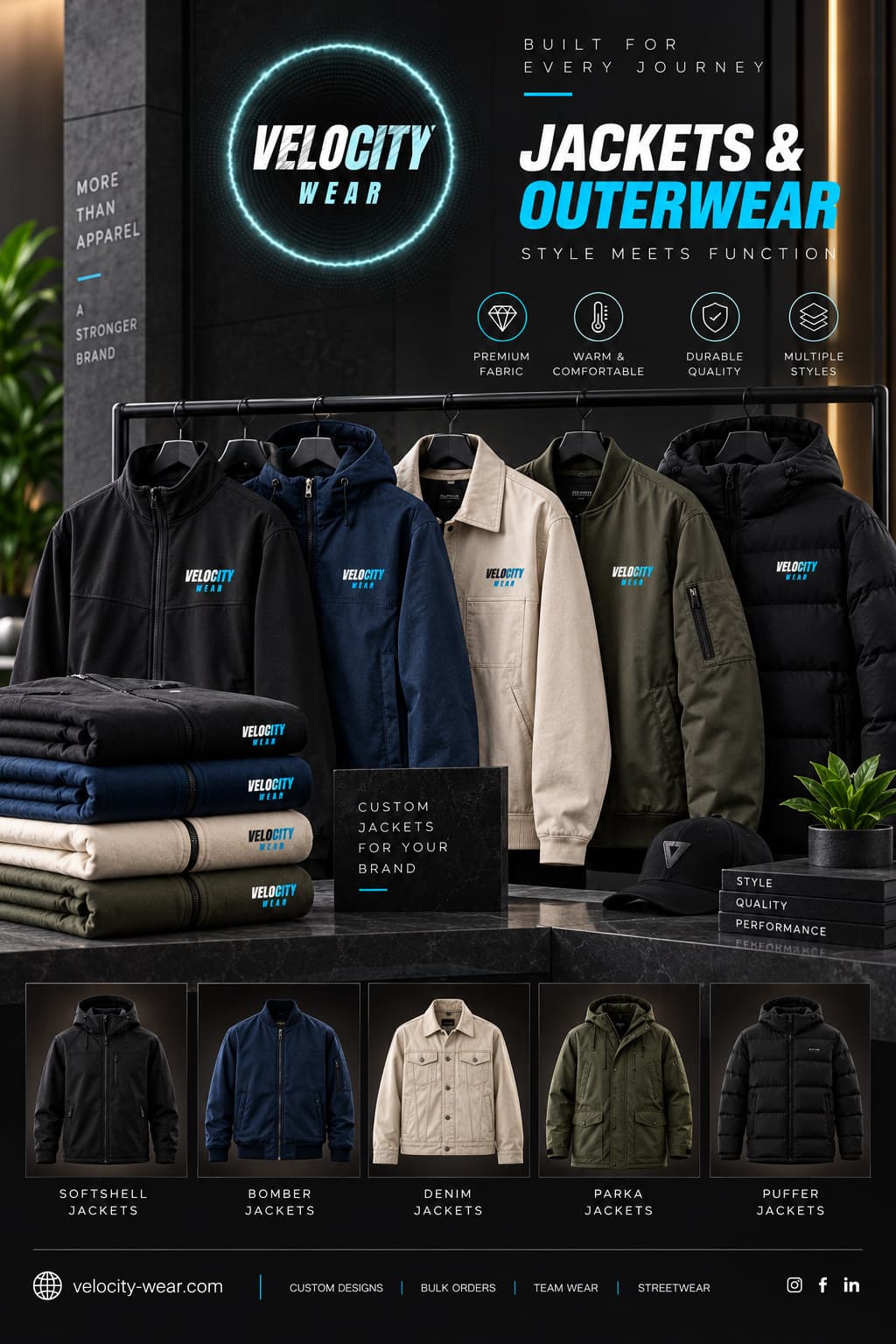
Regular fit keeps the shoulder seam on the shoulder and tapers slightly at the waist, which is why it photographs well and why it is the standard for corporate softshell. Boxy widens the chest and shortens the body, so the hem sits at the waistband rather than below it, and it reads as streetwear. Oversized keeps the boxy width but extends everything: longer sleeves, dropped shoulders, a hem that covers more. Varsity is traditionally cut boxy, coach jackets are loose by default, and softshell is usually the closest to the body of the four styles we build. The whole range is on the bulk jackets page.
What does layering do to the size you order?
It moves the whole run up. If the jacket goes over a mid-layer, sizing it to a bare torso guarantees complaints about the sleeves and the chest. Sites and outdoor teams layer year round, so the honest approach is to specify the garment underneath when you brief the order and let the cut absorb it rather than pushing everyone up a size arbitrarily. A boxy or oversized cut already contains that allowance. A regular softshell does not, which is why regular-fit corporate outerwear is often ordered one step larger than the equivalent polo.
How should the size run be split for a mixed team?
Collect real sizes if you can, because a jacket is expensive enough to justify the admin. Where you cannot, weight the middle of the run heavily and thin the extremes rather than spreading evenly. The 50-piece minimum is per design and sizes mix freely inside it, so there is no penalty for an uneven curve. Two fits, however, count as two designs and two lots of 50. The broader logic for building a size curve is in apparel sizing and fit.
Can you order two cuts in one run?
Only if each one reaches 50. That is worth knowing before you promise a team a choice, because offering regular and oversized to 60 people turns one order into two and doubles the minimum you have to fill. The practical compromise is a single generous cut plus an honest size chart, so people self-select by size rather than by silhouette. Weight and construction affect how a cut hangs too, which is covered in GSM explained for bulk jackets. Terms such as drop shoulder and body length are defined in the glossary.
Sleeve length is the measurement people complain about most on outerwear, and it is the one least captured by a letter on a label. A dropped shoulder pushes the cuff further down the arm at every size, so an oversized medium can have a longer sleeve than a regular large. If the jackets are for work that involves reaching, lifting or wearing gloves, say so in the brief, because a cuff that rides up is a daily irritation rather than a one-off disappointment. Give the crew the chest and sleeve measurements alongside the size letters and the guesswork drops sharply.