
Zip-Seal vs Self-Seal Garment Bags for Clothing
By The Velocity Wear Team
Need this made?Get pricing for this product— free, no obligation, 50 pieces minimum.
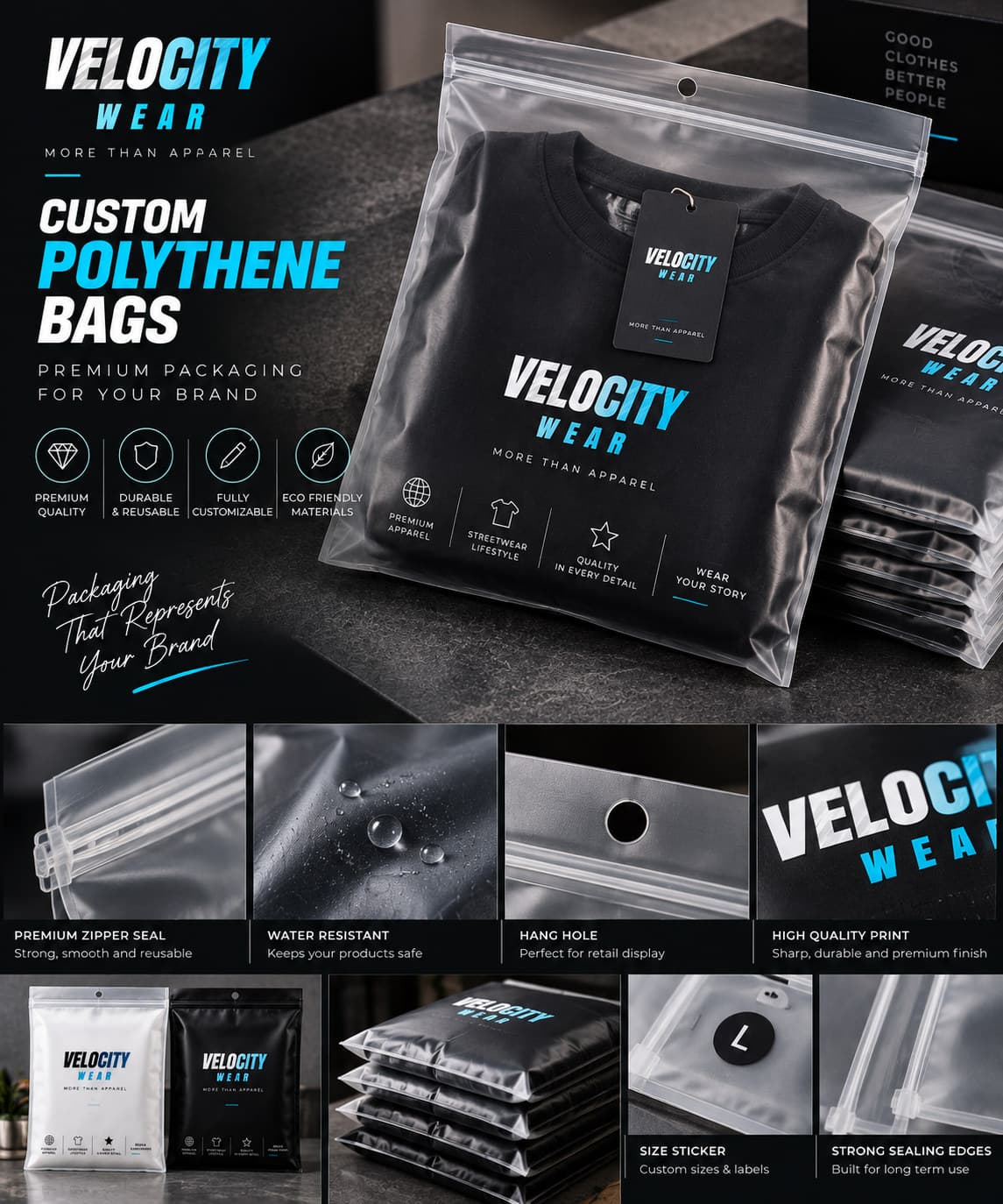
Zip lock bags for clothing close with two interlocking plastic tracks that press shut and pull apart again as often as needed. Self-seal bags close with an adhesive strip under a peel-off liner and are made to be sealed once. Velocity Wear's garment bags use the resealable zip seal, printed with your logo, from 50 bags per design in 10 to 15 working days.
How is a zip seal different from a self seal?
A zip seal, also sold as a zip lock or zipper closure, is a moulded track along the mouth of the bag: a ridge on one side locks into a groove on the other when you press them together. A self seal is a strip of adhesive along a flap, protected by a release liner that the packer peels away before folding the flap over. The first closes and reopens. The second grips once and has to be torn, or peeled with some damage, to get the garment out.
Both are common on clothing. Self-seal bags are what many brands start with because they are familiar and quick, and the same closure is used on most poly mailers, a different product explained in garment bags versus mailing bags. The zip-seal bags we make are the kind that tend to stay with the garment after it has been opened.
How the two closures compare
| What matters | Zip seal | Self seal (adhesive strip) |
|---|---|---|
| Reuse | Opens and closes repeatedly | Sealed once; usually torn to open |
| Customer returns | Garment goes back in the same bag | Customer needs other packaging |
| Storage at home | Keeps a garment clean in a drawer or case | Rarely kept once opened |
| Presentation | Clean top edge, no torn flap | Flap and liner, ragged edge after opening |
| Packing by hand | Press along the track | Peel liner, fold flap, press |
| Shows if opened | No, it is meant to reopen | Usually, as the adhesive tears or lifts |
Why does a reopenable closure matter for returns?
Because a return has to travel back to you, and the easiest packaging for it is the bag the garment arrived in. With a zip seal, a customer can refold the piece, slide it back in and close it, so it comes back clean, protected and still wearing its size sticker. With a torn self-seal bag, the garment usually comes back loose in a mailer, and your returns team has to inspect, refold and rebag it before it can be sold again. For a clothing brand with a steady flow of returns, that difference shows up on every parcel.
Storage is the quieter benefit. A customer who keeps a hoodie or a gym tee in its zip bag between seasons keeps your logo in the drawer with it, and the garment stays free of dust until it is worn again. A torn adhesive bag, by contrast, is usually in the bin on the day it arrives.
Is a zip seal slower to pack?
A little, per bag, if your team packs by hand: pressing a track shut takes a moment longer than pressing down a flap. It is rarely the slowest step in a packing routine, and it disappears entirely when garments are bagged at the factory, because they arrive already sealed. Factory bagging with an apparel run is the route for brands who would rather not pack at all.
Frosted zip bags for clothes and t-shirts
The zip-seal bags in our range are frosted, so the garment shows as a soft outline behind the printed logo rather than in full detail; the look is weighed up in frosted versus clear bags. Each bag is sized to the folded garment, so a zipper bag for t-shirts is smaller than one for a hoodie, and the dimensions for each style are confirmed in your quote.
Ordering zip-seal bags
Send your logo, the garments each bag will hold, the quantity per design, and the delivery country with a target date through the enquiry form here. A reply with pricing usually lands within hours on working days. The full specification is on the resealable polythene bag page, and our guide to printed polythene bags covers everything from sizing to samples.