Minimum Order for Wholesale Tracksuits
By The Velocity Wear Team
The minimum for wholesale tracksuits is 50 per design. Sizes mix freely inside those fifty, so an order can be six smalls, twenty mediums, eighteen larges and six XL without any surcharge. What does not mix is designs: a second artwork, or a colourway needing its own screens, is another fifty.
What counts as one design?
One artwork, printed or stitched in one place, on one body colour. Change the chest mark and you have a second design. Change the body from black to navy in a way that needs new screens and you have a second design. Change the size of the person wearing it and you have changed nothing at all, which is the part buyers most often get wrong in both directions. Minimum order quantities explained covers the same rule across other garments.
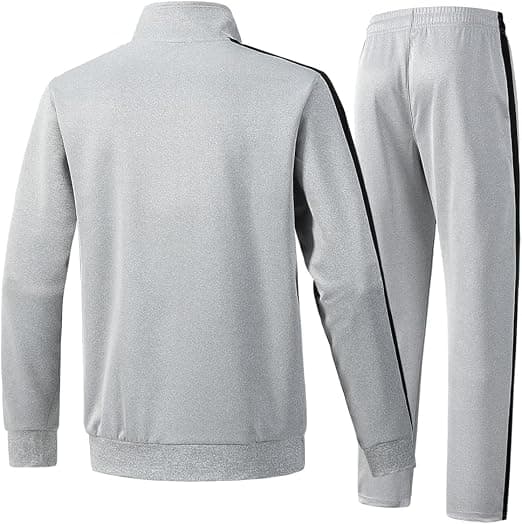
The set itself counts as one piece. Fifty sets is fifty tops and fifty joggers, quoted together at $53 a set, because a co-ord is produced as a matched pair rather than as two lines.
Why fifty and not five?
Because a production run has fixed costs that do not care how many pieces come off it. Screens are made, a machine is set, a colour is matched, and those steps cost the same for five sets as for five hundred. Spread over fifty, they disappear into the unit price; spread over five, they dominate it. What a 50-piece minimum actually changes works through what that means for a new brand.
It is also why the discount ladder exists in the shape it does. The tiers of 50-99, 100-249, 250-499, 500-999 and 1,000 or more, reaching up to 35% off the fifty-set price, are the same fixed costs spreading further.
How do you reach fifty if your team is smaller?
Order for a rotation rather than for a headcount, so each person gets two or three sets. Order for the year ahead, holding stock for starters. Or share a design with another site, branch or organisation and split the delivery. All three are common, and all three are cheaper than trying to run a smaller batch. Prices and options are on the wholesale tracksuits page and the tiers on the pricing page.
What does not work is ordering forty-five sets and hoping. Under fifty, a run cannot be scheduled at all, so the useful conversation is about how to use the fifty rather than how to avoid them.
How does the minimum apply across the rest of the range?
The same way. Fifty per design applies to t-shirts, polo shirts, hoodies, joggers, caps, corporate uniforms and denim jackets alike, so a kit list of four garments is four runs of fifty rather than one order of two hundred.
That is worth knowing before you design a programme around five different items. A buyer with a fixed budget almost always gets a better result from two garments ordered properly than from five ordered at the bare minimum, because the deeper runs reach better tiers and leave fewer orphans behind.
Mixing products in one delivery is straightforward; mixing them in one minimum is not. Plan the list first, then decide which items genuinely need to exist.
One last point worth stating plainly: the figure is not a negotiating position. It reflects what it costs to set a production run up, so there is no version of this conversation where forty sets becomes viable at a higher unit price. Buyers who accept that at the start end up with a better order, because the planning energy goes into using the fifty well rather than into trying to shrink it.