
Wholesale Keychains: cost
By The Velocity Wear Team
Custom keychains are quoted per job rather than from a published from-price, because material, size and finish move the cost across a wide range for an item this small. The surrounding terms do not move: 50 pieces minimum per design, quantity tiers falling to 35% below the 50-piece price, a £150 sample credited against bulk, and 10 to 15 working days from artwork approval.
What does a custom keychain cost per piece?
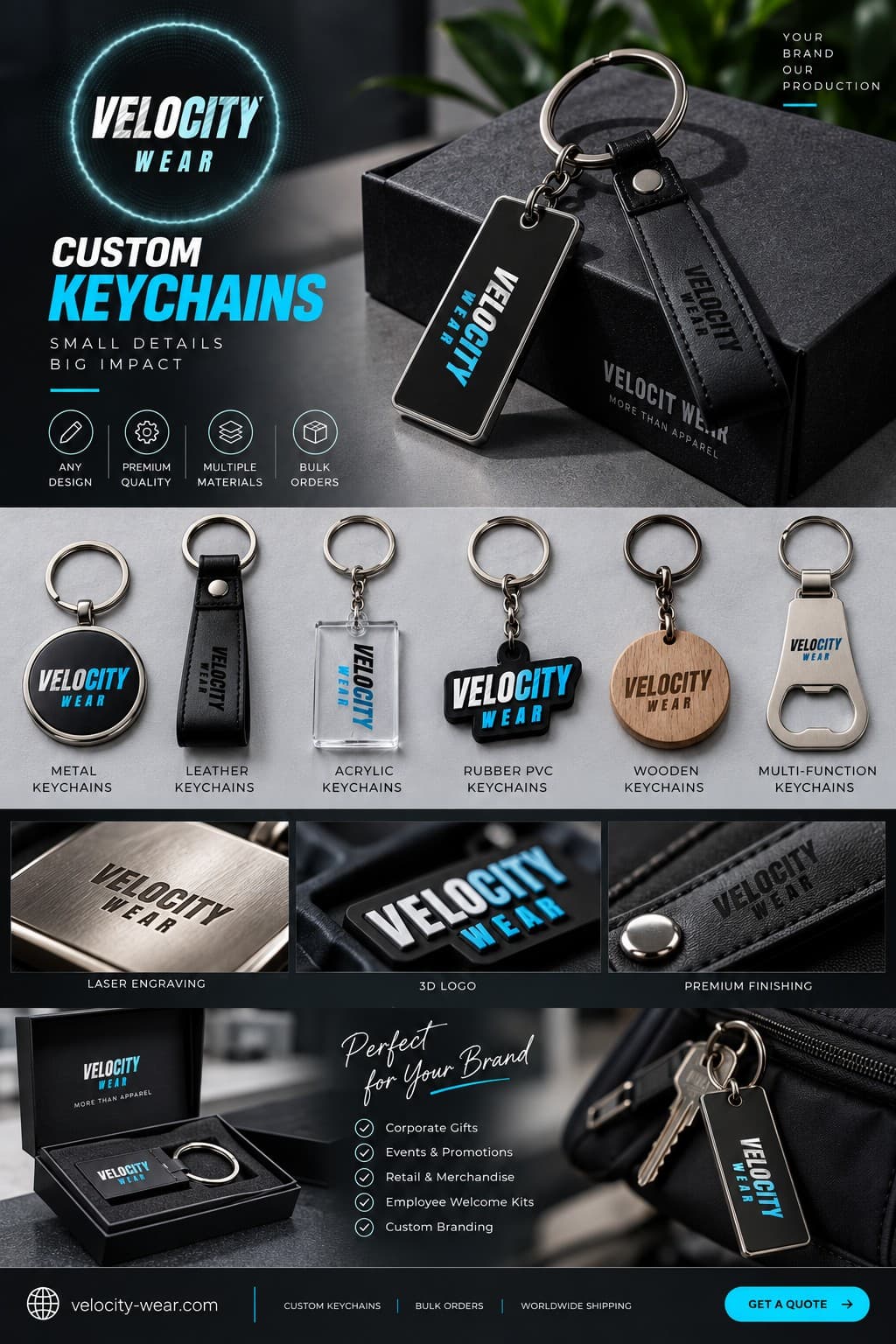
It depends almost entirely on what the keychain is made from and how big it is, which is why no single figure appears on the keychains page. A small flat tag and a substantial three-dimensional piece are different manufacturing jobs, and publishing one number would price one of them wrongly. Send the shape, the rough size and the material you have in mind and the quote comes back against that.
What is predictable is how the price behaves once the specification is fixed. It falls through the bands at 50–99, 100–249, 250–499, 500–999 and 1,000+ pieces, reaching up to 35% below the 50-piece rate at the top. Keychains are one of the items where buying into a deep tier makes obvious sense, since they carry no sizing, no season and no expiry. The rest of the wholesale range shows what they tend to be bundled with.
Why is the quote job-specific?
Because the base item is not a standard commodity in the way a blank t-shirt is. Two keychains of the same footprint can differ in thickness, in the fitting attached to them, and in how the branding is applied, and each of those changes the tooling and the finishing. A supplier who quotes before knowing those details is quoting a guess.
The useful consequence is that you can steer the price by adjusting the specification rather than by negotiating. Simplifying a shape, reducing a size slightly or dropping a second branding position will move a quote further than any conversation about margin. The same relationship between design decisions and unit cost is explained for garments in how much does custom clothing cost.
Do keychains earn their place in a bundle?
They work best as the small item that completes something larger rather than as the reason for an order. A keychain in a member welcome pack or a product box is a low-cost way to make the package feel finished, and it stays in circulation long after a printed card has been thrown away. The same reasoning applies to other low-cost add-ons, which is argued in tote bags and accessories that lift order value.
Where they underperform is as a standalone giveaway with no context. Handed out on their own at an event they tend to end up in a bin by the exit; included in a bag with something else, they get taken home. The distribution plan matters more to the return than the unit price does.
What is outside the unit price?
Delivery, which is charged to your destination across the UK, USA and Europe, and the £150 sample if you take one, though that is credited against the bulk order. Individual bagging is the other line worth naming up front: keychains bulk-packed loose and keychains bagged for retail handout are different finishing jobs and should be priced as such rather than assumed.
Artwork preparation can also sit outside the price if the file you send needs rebuilding. Supplying clean vector artwork from the start costs nothing and removes that line from the conversation entirely.
Judge the spend on cost per person reached rather than cost per piece. Fifty keychains that go into fifty product boxes and stay on fifty sets of keys are doing more work than a thousand handed out at a stand with half abandoned before the car park. Unit price is the easy number to compare; how many are still in use a year later is the number that decides whether the order was sensible.

