Wholesale Keychains: artwork setup
By The Velocity Wear Team
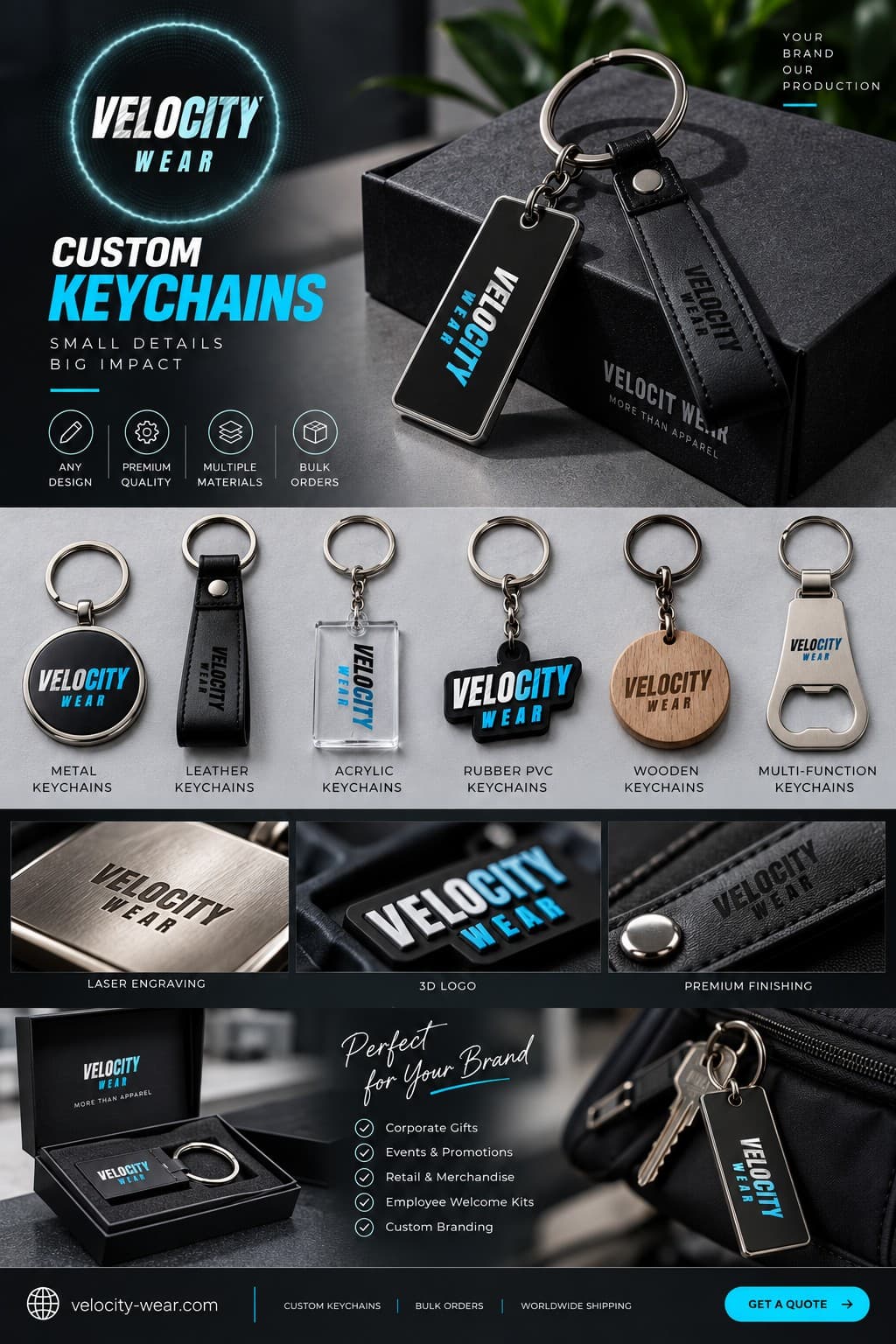
Send keychain artwork as vector, stripped back to the simplest version of your mark that still reads as you. A keychain is the smallest surface in the range, so detail that survives on a hoodie chest disappears here. Expect to drop straplines, thicken thin strokes and reduce colours. We proof the design at actual size before production begins.
What artwork works on something this small?
A bold, closed shape with clear separation between its elements. Logos built from a simple silhouette, a monogram or a wordmark in a sturdy weight all reproduce well. Marks that depend on hairlines, tight counters or a subtle gradient do not, because at keychain scale those features either fill in or vanish entirely.
Supply it as vector — AI, EPS or PDF — so it can be scaled to the exact piece without softening. If all you have is an image file, the resolution question becomes critical, and what that means in practice is spelled out in resolution: what 300 DPI actually means. Check what shapes are possible on the keychains page before finalising anything, and look across the wholesale range if the same mark is going onto clothing in the same order.
How much detail survives at keychain size?
Less than almost anyone expects on first sight of a proof. A reliable test is to print your logo at the finished size on ordinary paper and look at it at arm's length. Anything you cannot make out on paper will not appear on the finished piece, whatever the proof suggests on a screen at 400% zoom.
The right response is to prepare a reduced version of the mark rather than to shrink the full one. Most brands already need a compact lockup for small applications, and building one properly pays off across labels, tags and accessories at the same time. The thinking behind simplifying for reproduction is covered in how many colours should your design have.
What do we send back before production?
A proof showing the mark positioned on the piece at its real dimensions, with the colours identified. Check three things: that it is the current logo, that any text is correct, and that the scale is what you expected rather than what you hoped. Your approval on the proof is what starts the 10 to 15 working day production window.
After approval, changes mean restarting the setup rather than editing a file, which is why the proof deserves proper attention rather than a glance on a phone. The consequences of a late change are set out in can I change my order after approving artwork.
What if your only logo file is low quality?
It needs rebuilding as vector before it can be used, and for a keychain that rebuild is also an opportunity to simplify. A mark traced faithfully from a blurry image will carry the blur's mistakes into a physical object, and enlarging a small file does not add information back, whatever an upscaling tool appears to do — the limits of that are covered in upscaling artwork without losing detail.
The general file rules that apply across the range are collected in preparing artwork files for custom clothing printing, and they hold here with the tolerance for detail cut sharply back.
Build the small version of your mark once and reuse it everywhere. The same reduced lockup that works on a keychain will work on a woven neck label, a swing tag and an embroidered cap, so the effort is not specific to this order. Brands that prepare it early stop having the same conversation with every supplier they work with.
Judge the mark against the material rather than against white. A logo drawn for a white page behaves differently on a dark or metallic surface, and that pairing is better decided at proof stage than discovered when the delivery is opened.