How Retailers Buy Joggers Wholesale
By The Velocity Wear Team
Retailers buy joggers at $22 a piece from the fifty-piece minimum, with up to 35% coming off that figure as quantity rises. The number that matters is not the unit price though: it is landed cost, once decoration, labels, packaging and freight are in. Build that first, then set the retail price, then decide how deep to buy.
What actually goes into the landed cost of a jogger?
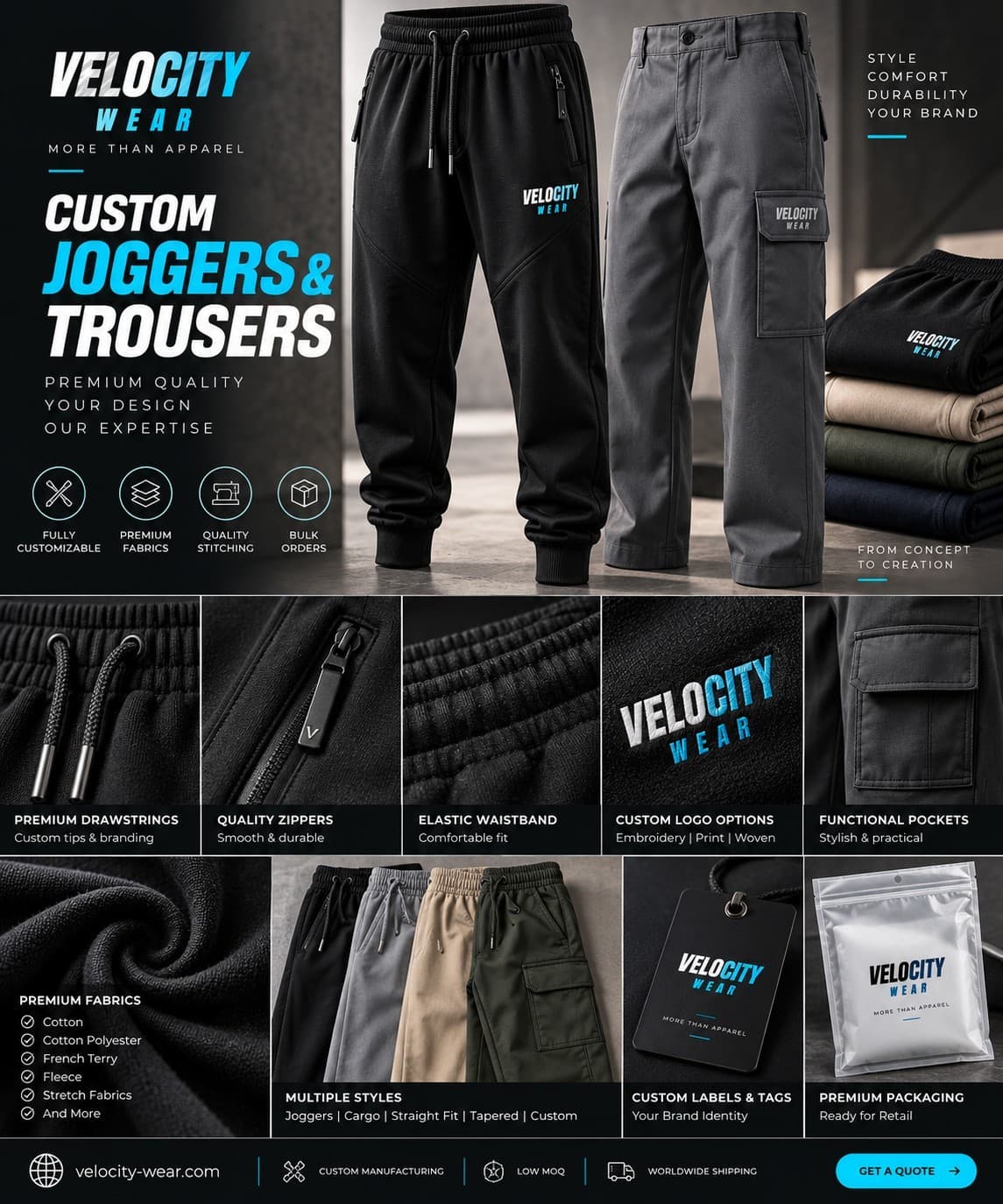
Start with the garment at its tier price. Add decoration, which is priced per position, so a leg print and a waistband mark are two lines rather than one. Add private label work if you are selling under your own name: woven neck labels, tear-out labels and swing tags each carry their own cost. Add polybagging if you are shipping direct to customers. Add freight to your warehouse. Only then divide by the number of pieces.
Retailers who skip that arithmetic tend to discover the problem at the second order, when the first one sold through and the margin turned out thinner than the spreadsheet promised. The tiers and what moves the price are laid out across our wholesale range, and the garment itself sits on the wholesale joggers page.
How deep should a first buy be?
Deep enough to clear a tier, shallow enough that unsold stock does not fund your competitors. For a new style with no sell-through history, fifty to a hundred pieces in one colour tells you whether the style works without committing a season of cash. If it sells, the second order goes deeper and lands in a better tier, which improves the margin exactly when you have evidence to justify it.
Resist buying two colours thin instead of one colour deep. Each colourway that needs its own screens counts separately towards the fifty, so two colours is two minimums and twice the risk spread across half the data. One colour, a proper size run, and a clean read on what sold is worth more than a photogenic range plan. The wider mechanics of selling into stockists are covered in our wholesale primer for clothing brands.
Which size curve sells through on joggers?
Joggers behave differently from tops. Length matters as much as waist, so a buyer who is between sizes tends to size up on a cuffed style and size down on an open hem. That pushes the curve slightly wider through the middle than you might expect and makes the extremes slower.
Write the curve as absolute numbers before you order, weight it to the middle three sizes, and keep the ends thin enough that you are not marking them down in January. Publish the garment measurements on the product page rather than only the letters; returns on bottoms are driven by leg length far more than by chest fit, and a measurement table costs nothing to add.
How do you restock without ending up with dead stock?
Set a reorder trigger rather than reordering when the shelf looks empty. Production runs 10 to 15 working days from artwork approval, and transit sits on top, so the trigger has to be the stock level that covers that window at your current rate of sale, plus a buffer for a busy fortnight. Hitting the trigger late is what turns a good seller into a gap.
Keep the design on file and unchanged between runs so the repeat is a production decision rather than a fresh development. Where colour is part of the identity, ask for the new run to be matched against a retained piece from the last one, because dye lots move. Our note on reordering wholesale joggers in colour sets out what to keep and what to send back.