Jackets & Outerwear for Trades, Ordered Properly
By The Velocity Wear Team
Site outerwear is bought on durability first. A trades jacket has to layer over a hoodie, take a tool belt rubbing at the hip, and still show a company name from the far side of a plot. Jackets are quoted per job rather than at a fixed per-piece price, and the fifty-piece minimum is counted per design.
What does a site jacket have to put up with?
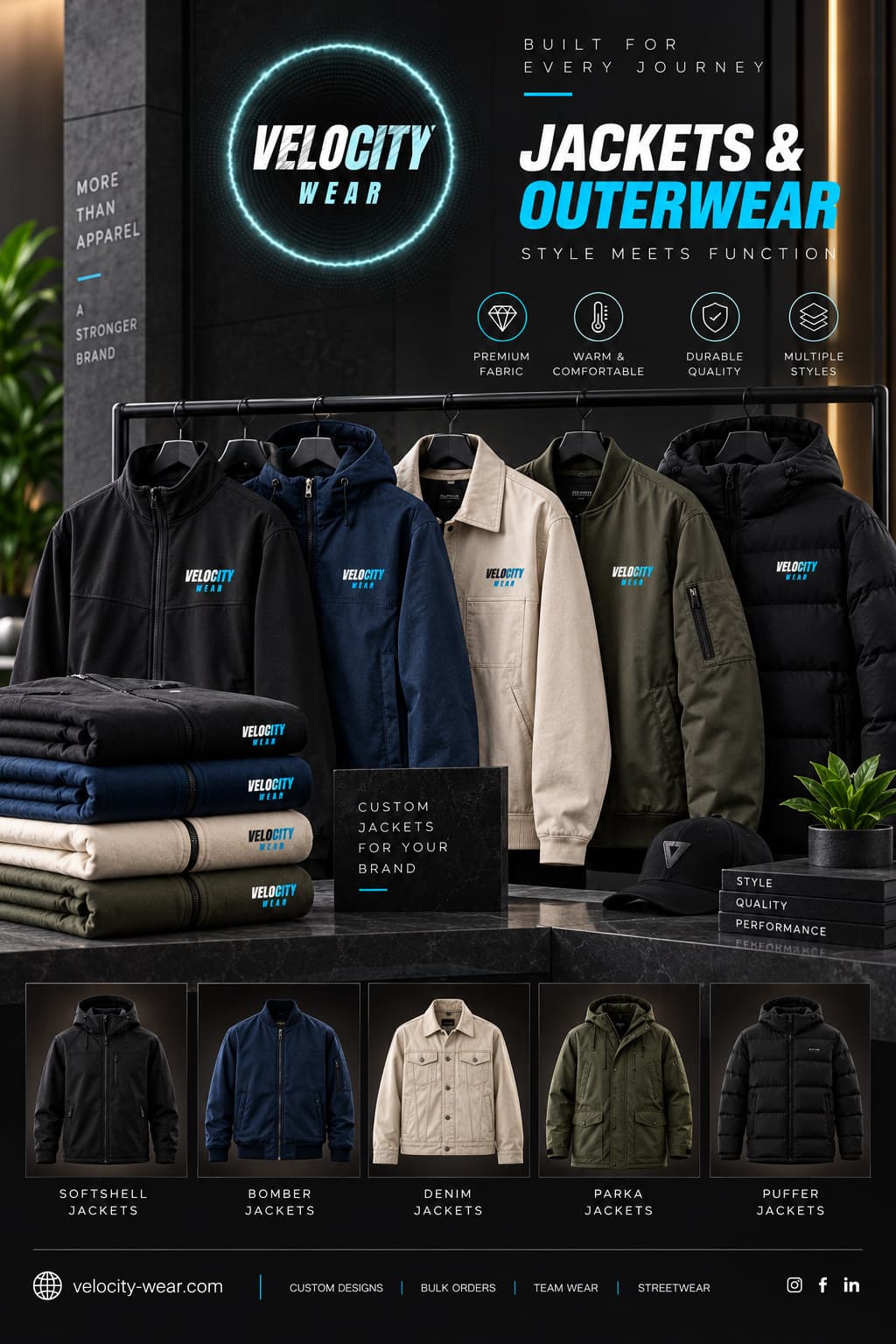
Abrasion at the cuffs and pockets, rain that arrives sideways, and a wash cycle harsher than anything a uniform sees indoors. Softshell handles the everyday case: wind-resistant, warm enough over a fleece, and not so bulky that it snags. Puffers are for standing still in January rather than working. Coach jackets are the throw-on layer for van-to-site. Varsity has no place on a site at all.
Whatever the shell, the seams and the zip pull are what fail first, so ask about both before the price. The wholesale jackets page lists what each style is built from.
Where should the logo go on a work jacket?
Chest left for the company name, back panel for the thing you want read across a plot, and sleeve for a trade or a certification. Embroidery on the chest outlasts the garment. A large back mark is better printed than embroidered, because embroidery at that size stiffens the panel and cracks the backing after a winter. Keep the back mark high, above where a harness or a belt sits, or it will be worn away within months.
Specifying construction workwear goes further into what to write on the spec before you ask for a price, and the construction and trades page covers the rest of the kit list.
How do you layer a crew through the year?
- Base: branded tee or polo, ordered in the highest quantity because it is replaced most often.
- Mid: fleece or hooded sweat, the layer that does most of the work between October and April.
- Shell: softshell for working weather, a waterproof for the rest of it.
- Standing still: a puffer for the two months of the year it earns its cost.
Order the layers on one schedule rather than four. Each is its own design and its own fifty, but placing them together means one artwork approval round and one production window of 10–15 working days. Waterproofs have their own rules about where a logo can go, covered in branding a waterproof.
What does hi-vis change?
Hi-vis is a compliance garment, so branding has to work around the reflective bands rather than across them. In practice that means a chest mark above the top band and a back mark sized to fit the gap between bands. Treat it as a separate design from the softshell it goes over, because it is one, and budget its own fifty accordingly.
How do you stop a crew order going stale?
Buy against the roster you have, not the one you hope for. Crews change, and a firm that orders fifty jackets sized to today's team finds half of them are the wrong size within a year. The fix is a deliberate spread: heavier in the sizes that repeat, with a handful at each end held back for new starters, so a hire in March does not trigger a second run.
Keep a record of what went out to whom. On a site running several gangs, unmarked outerwear moves between vans and disappears, and the firm buys the same jackets twice. A sheet with names against sizes is enough, and it doubles as the size list for the next order.
Agree who replaces a damaged jacket while you are at it. Site kit gets torn, and a policy written before the first tear is worth more than an argument after it.