Choosing Fabric for Wholesale Jackets & Outerwear
By The Velocity Wear Team
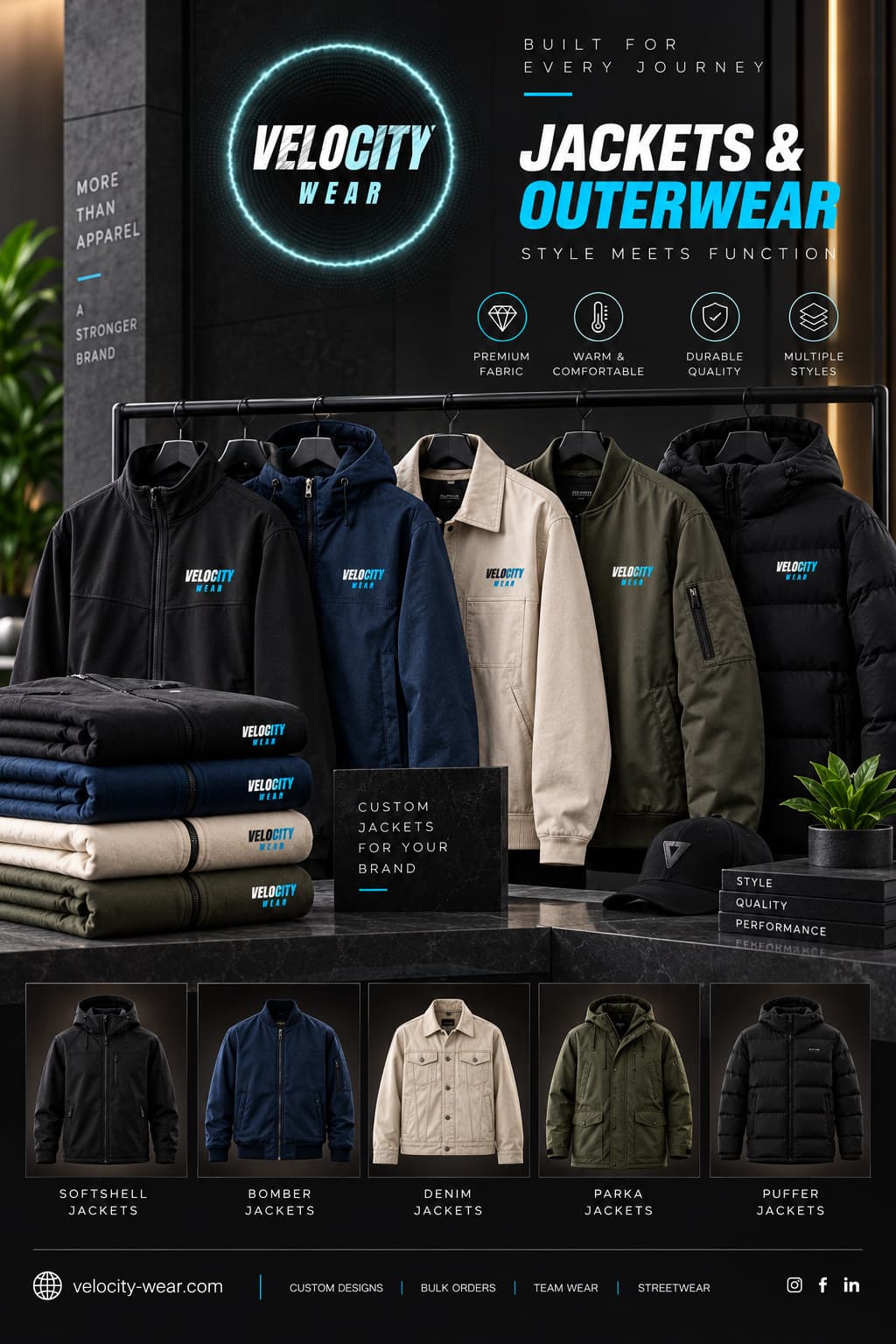
Pick the shell fabric by what the jacket has to survive, not by what looks best on a screen. Bonded softshell handles wind and light rain and takes embroidery cleanly. Puffer shells are light, warm and fussy about needles. Coach jackets use a smooth woven face that prints well. Varsity bodies are wool-feel or fleece-backed with contrast sleeves. All four run at the same 50-piece minimum.
Which shell fabric suits the job?
Start with the wearer. Site staff and outdoor crews want a bonded softshell, because the membrane between the face and the fleece backing blocks wind without the bulk of a coat. Delivery drivers and event teams who move between a van and a venue tend to do better in a light padded jacket they can unzip. A coach jacket is a shoulder-season piece rather than a winter one, and it exists mainly to carry a big graphic. A varsity is a statement garment for a team or a drop, and it is priced and built accordingly. The full comparison is in the custom jackets buyer’s guide.
What does the lining and fill change?
The face fabric decides how the jacket looks and how it takes branding. The lining and fill decide whether anyone keeps it on. A fleece-backed softshell is warm enough for a British autumn without being hot indoors. A quilted or baffled fill moves the garment into proper cold-weather territory, and it also changes how decoration behaves, because the surface underneath the needle is not flat. Unlined coach jackets are the lightest of the group and the easiest to print large. Ask what sits behind the face cloth before you compare two quotes, because that layer is where a cheap jacket and a good one part company.
How does fabric limit your branding?
Every fabric argues with one decoration method. Tightly woven softshell takes embroidery well and takes a heat-applied transfer well too. Puffer shells are thin and slippery, so dense stitching can pucker the panel and pull the quilting out of line, which is why a patch or a small flat logo often reads better than a large embroidered crest. Anything with a water-resistant finish needs a lower press temperature and a gentler hand. Smooth woven coach shells are the friendliest surface of the lot for screen printing. Our writeup on custom softshell jackets goes through the branding trade-offs on that fabric in particular.
Does heavier always mean better?
No, and this is where budgets get wasted. A heavier shell costs more, ships heavier and sits in a wardrobe for nine months of the year if it was bought for a mild climate. Weight is only an advantage if the wearer is outside in it. For a brand selling to customers, a midweight piece has a longer selling season and a lower freight cost per carton, which matters more to the margin than the extra gram weight ever will. For staff kit, match the fabric to the shift, then spend the difference on the decoration instead.
What does the fabric decision do to price?
Jackets and outerwear are quoted per job rather than from a single list price, because a lined puffer and an unlined coach jacket are not the same garment in any meaningful sense. What is fixed is the structure around the quote: 50 pieces per design, mixed sizes inside that 50, and a discount that rises with quantity to a ceiling of 35% measured from the 50-piece price. The tier boundaries are on the pricing page. Send the style, the fabric weight you have in mind and the decoration, and the jackets and outerwear range is quoted against that spec.