
Wholesale Bottles: choosing a supplier
By The Velocity Wear Team
Choose a drinkware supplier on whether they will pin down the bottle itself. Capacity, material, closure, branding method and packing should all be named in writing before any price means anything. Then check the commercial terms: 50 pieces per design, 10 to 15 working days from artwork approval, a £150 sample credited against bulk, and tiers reaching 35% off the 50-piece price.
How do you pick a supplier for branded drinkware?
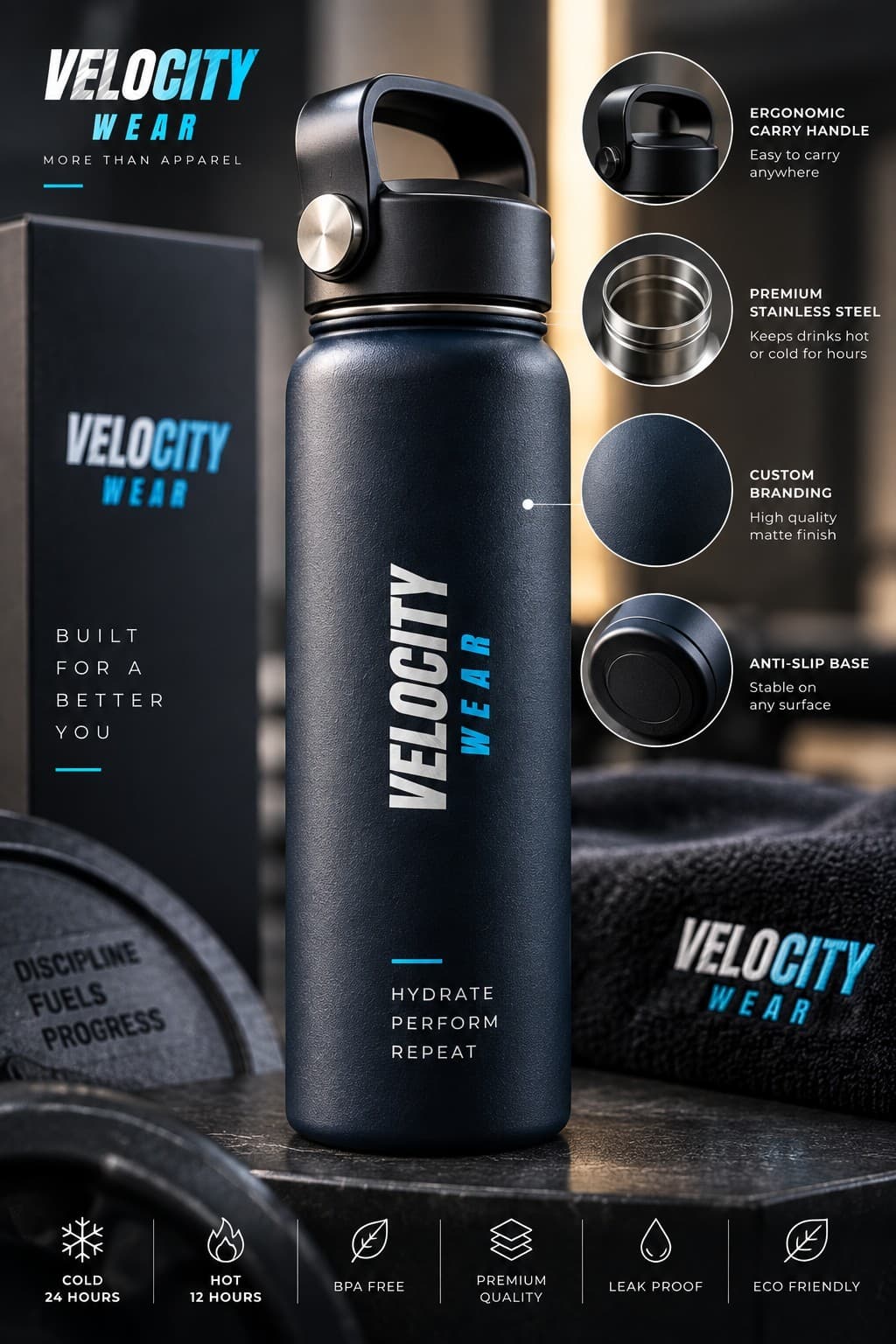
Ask them to describe the bottle rather than the deal. A supplier who names the capacity, the material, the closure type and how the branding is applied is selling you a specific object. One who talks only about price per unit is selling you an unspecified one, and the difference between a good bottle and a poor bottle at the same price is enormous in this category.
The second thing to establish is whether they will produce a physical sample, and on what terms. A supplier unwilling to make one to your specification is a supplier who does not want you inspecting the base item. Our bottles page sets out the product side, and the wholesale catalogue shows what else can be branded to match if drinkware is part of a wider kit.
What should a bottle quote spell out?
Six lines, at minimum: the bottle specification, the branding method and size, the quantity and the tier it sits in, whether packing is bulk or individual, the delivery destination, and the sample terms. A quote missing any of those has room to move later, and it will move in one direction.
Then compare like with like. Put both suppliers on the same bottle specification and the same quantity, and ask each for a second quantity as well so you can see how their tiers behave. Totalling delivery and sample costs into the comparison is the same discipline described in landed cost explained, and with bulky items it changes the ranking more often than you would expect.
How do you test a supplier cheaply?
Order the sample and watch the process rather than only the product. How quickly did the proof come back? Did they flag the problem with your fine-detail logo, or apply it silently and let you find out? Did the sample match what was agreed? That behaviour predicts the bulk run better than any assurance given over email.
Then run a first order at the 50-piece minimum rather than committing to the deepest tier straight away. The discount at 1,000+ pieces is real, but it is a poor trade against discovering the closure leaks. The reasoning behind starting small is covered in what a 50-piece minimum actually changes.
Which claims should make you cautious?
A turnaround figure with no starting point, since 10 to 15 working days means something only when it is anchored to artwork approval. A sample given away at no charge, which is either generic stock or recovered inside the bulk price. And any environmental claim made without a document behind it — that one carries legal risk for you as the seller, not just for the supplier, and is worth reading up on in choosing a lower-impact garment without overclaiming.
Finally, be wary of a supplier who will not tell you what changes the price. If they cannot explain why capacity and closure move the quote, they are reselling from a catalogue without understanding it, and that shows up when something needs fixing mid-order.
Keep the specification sheet from whoever you choose. Capacity, material, closure, branding method and position on one page is what lets you reorder identically in a year, or get a like-for-like quote elsewhere without guesswork. Buyers who skip that step end up describing their own product from memory, which is how a second run quietly arrives different from the first.
Ask, too, what happens if a delivery arrives short or damaged. Every supplier sounds equally reliable until something goes wrong, and knowing in advance who replaces what, and on what timescale, is a question worth putting before the order rather than after it.

