What Makes a Collar Hold Its Shape
By The Velocity Wear Team
Need this made?Get pricing for this product— free, no obligation, 50 pieces minimum.
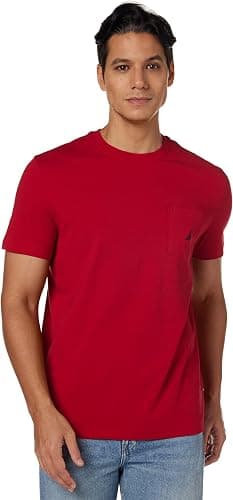
A collar keeps its shape because of three things working together: the rib construction, a small amount of elastane in the rib yarn, and the density that rib is knitted to. The weight of the body fabric has almost nothing to do with it. A stretched, wavy neckline is the most common visible failure on a t-shirt, and it is a rib specification problem far more often than a printing or laundry one.
The Neck Takes More Abuse Than Anything Else
Think about what actually happens to a tee. The body is worn, washed and hung. The neckline is forcibly stretched over a head, twice a day. Nothing else on the garment is loaded like that, which is why nothing else fails like that. Judging a collar comes down to one property: how completely it returns after being pulled past its resting size.
Rib Knit Without the Jargon
Rib is a knit structure where columns of stitches alternate between facing forward and facing back. That makes the fabric fold in on itself like a concertina, so it pulls in tightly at rest and opens up under tension. A 1x1 rib alternates every column and is the fine rib used on most t-shirt necklines. A 2x2 rib alternates in pairs, looks chunkier, and is what you normally find on sweatshirt and hoodie cuffs and waistbands.
Rib gives you elastic behaviour from geometry alone, with no stretch fibre required. What geometry cannot do on its own is guarantee the fabric snaps all the way back rather than most of the way back. That last bit is the difference between a collar that is fine after a year and one that is a wave after two months.
The Elastane Detail Most Spec Sheets Hide
A small percentage of elastane in the rib yarn transforms recovery. The fibre stores the energy of the stretch and pulls the loops back into position instead of leaving them slightly opened out. Crucially, the body of the garment and the rib are often different compositions: a body can be listed as 100% cotton while the neck rib is a cotton and elastane blend.
This is the most useful question to ask about a blank, and the one most buyers never ask. The composition line on a spec sheet usually describes the body only. Ask specifically what the rib is made of. If the answer is that the rib matches the body exactly with no elastane anywhere, the collar is relying entirely on knit density and yarn quality, and it had better be a good one.
Density, Depth and How It Is Attached
A limp, thin rib recovers poorly whatever it is made of. Pinch the collar between finger and thumb. A good one feels dense and springy and has real substance. A poor one feels like a strip of the body fabric folded over. Collar depth counts too, because a very shallow rib has less material to distribute the stretch across, so the same amount of pulling does proportionally more damage.
How the rib is fitted matters as much as what it is made from. Look for these details on any sample.
- The rib should be attached with a clean overlock and covered by a neck tape, not left as a raw exposed edge sitting against the skin.
- The join where the rib meets itself should sit at the back or on a shoulder, lie flat, and not create a lump under a print.
- A rib sewn on under heavy tension is already partly spent before the garment is worn. If a new collar looks stretched open and flat, it will not tighten up later.
- The shoulder seams either side of the neck should be taped, because a stretching shoulder pulls the neckline out of round even when the rib itself is sound.
- On a hoodie the same logic applies to cuffs and waistband, which take load every time the wearer shoves the sleeves up their forearms.
“"Nobody inspects a collar in the shop. Everybody notices one that has gone wavy on somebody else."”
Polo Collars Play by Slightly Different Rules
A polo collar is not a tube of rib. It is normally knitted to shape as a flat piece with a finished edge, then attached along with a placket. The failure mode differs too: instead of going wavy, a poor polo collar curls at the points or goes limp and refuses to stand. Look for a firm, dense knit, a tidy finished edge, and a placket with proper interlining behind the buttons. On staff uniform, where the collar is the part everyone sees across a counter, that is worth real attention.
Test It Before You Order Two Hundred
The test takes a minute. Stretch the neckline wide with both hands, hold for a couple of seconds, and let go. Watch how fast and how completely it returns. Then wash the sample warm, tumble it, and repeat. Most collars pass the first test. The ones worth buying pass the second.
One Decoration Point Worth Knowing
Heat and rib are not friends. If a heat-pressed transfer or a vinyl name sits close to the neckline, the platen can press over part of the rib and flatten the structure you are trying to protect. Keep heat-applied decoration clear of the collar, and if you want a small neck-label style print, raise it early so it can be positioned and pressed properly rather than squeezed in at the last minute.
You can preview placements, including neck-adjacent ones, in Velocity Wear's free Design Studio before committing, and the instant price calculator shows how garment and method choices affect the run as quantity changes.