Print Placement on T-Shirts
By The Velocity Wear Team
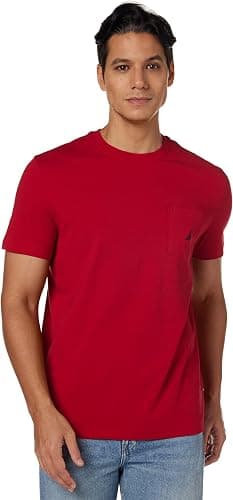
Print placement is measured down from the collar seam, not guessed by eye, and that measurement changes with the size and the cut. A left-chest mark sits roughly a hand's width below the collar and in line with the wearer's eye when looked at. A full front graphic starts lower. Get the placement agreed at artwork stage, because it is fixed once production begins.
Where does a chest print actually sit?
A left-chest logo sits below the collar seam and inboard of the armhole, roughly where a pocket would be. Too high and it creeps onto the collarbone and looks like a mistake. Too low and it disappears under a lanyard or a jacket. The useful check is to look at where a lanyard, badge or zip pull will fall, because a chest mark that is permanently covered is a wasted print.
A full front graphic is a different geometry. It starts further down, because the top of the chest curves and a graphic placed too high bends away from the viewer. The width is limited by the print area rather than by the shirt, so a design that spans the full body on a large will not span it on a small unless it is scaled per size, which we will do if you ask.
How big should a back print be?
Bigger than people expect, and lower. A back graphic has more flat area to work with than the front, which is why band merch, leavers shirts and event crew kit all put the important information there. The top edge usually sits several centimetres below the collar so that it is not lost in the curve of the shoulders.
Two things constrain it. The print area, which is fixed by the size of the platen rather than by the shirt, and legibility. A name list or a sponsor row can technically fit at a small type size, but if it cannot be read from three metres it is not doing its job. We will tell you when type is heading below that threshold rather than printing it and letting you discover it. This matters most on name-list jobs, which is why it comes up in ordering t-shirts for leavers season.
Do sleeve and hem prints cost extra?
Each print location is a separate setup, so yes. A front and back job costs more per piece than a front-only job, and adding a sleeve makes it three. On a screen-printed run the cost sits in the screens, so the effect is largest on a small order and smallest on a large one: 50 pieces carries the setup across 50 shirts, while 500 spreads it thin.
That is worth knowing before you design four locations into a 50-piece order. T-shirts start at $13 a piece at the 50-piece minimum, and the discount rises to a ceiling of 35% as the quantity climbs. Current from-prices are on the wholesale t-shirts page, and the print terms that appear alongside placement on a quote are defined in the glossary.
Does the cut change the placement?
It does, and this is the trap on a mixed order. A boxy body is shorter, so a chest print set for a regular fit lands proportionally higher on it. A dropped shoulder moves a sleeve print further down the arm. An oversized body pushes a front graphic lower relative to the wearer even though it is unchanged relative to the garment.
So specify the cut with the artwork. If you are running one design across two cuts, treat it as two placement setups rather than assuming the file is portable. The differences between the cuts are covered in fits and cuts for wholesale t-shirts. If the placement is critical, the £150 sample, credited against the bulk order, shows you the actual position on the actual garment before 50 pieces are printed.