Ordering T-Shirts for Trade Show Season
By The Velocity Wear Team
Trade show shirts should be in the building a full week before the stand goes up. Work back from that: transit, 10 to 15 working days of production from artwork approval, and the days the artwork itself takes. That makes a show in eight weeks a comfortable order and a show in three weeks a difficult one. The week of slack is what lets you check the print and the sizes.
Why a week before rather than the day before?
Because a trade show is the one context where the shirts are worn by named individuals standing two metres from your prospects. If a size is wrong, someone is on the stand in a shirt that does not fit for three days. A week of slack means you can open every carton, check the print against your brand colour in daylight, allocate by person rather than by pile, and act if something is off.
It also protects you from the ordinary things. A pallet redirected to the wrong depot, a courier delay, a venue that will not accept deliveries. None of those matter with a week in hand and all of them are fatal with a day.
How many shirts does a stand actually need?
For staff, count heads and multiply by the number of show days, then round up. Three days of exhibiting in the same shirt is not a good look and nobody is doing laundry in a hotel sink. Six staff across a three-day show is eighteen shirts before you have given a single one away, and the minimum is 50 pieces per design, so the staff requirement rarely reaches it on its own.
That is the case for making the stand shirt a design you also use elsewhere, so the balance of the 50 goes into normal staff kit rather than a cupboard. If you exhibit at several shows a year, order once for the year rather than once per show: the tiers run 50 to 99, 100 to 249, 250 to 499, 500 to 999 and 1,000 plus, with up to 35% off the 50-piece rate at the top, so one consolidated order beats four small ones. Current from-prices start at $13 a piece on the wholesale t-shirts page.
Should staff and giveaway shirts be the same design?
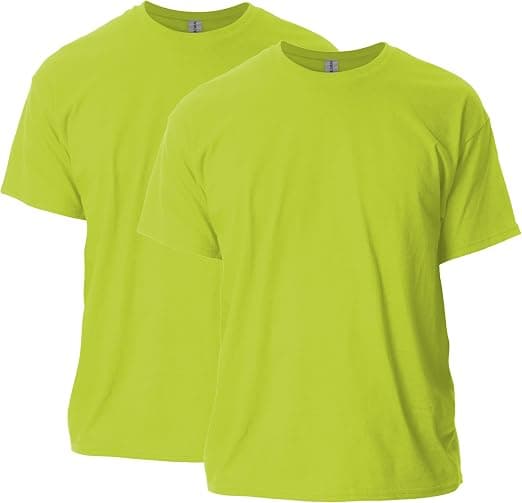
Usually not, and the reason is functional rather than aesthetic. Staff need to be identifiable at a glance in a crowded hall, which means a distinctive colour and a visible mark. A giveaway shirt is doing brand work after the show, so it wants to be something a stranger will actually wear, which usually means quieter branding and a more neutral colour.
If they are two designs, they are two runs of 50, so decide whether the giveaway is worth that commitment before you commit to it. A leaner option is one design in two colourways, but be aware that a colourway needing its own screens also counts as a separate 50. Where a staff shirt genuinely earns its keep is in private label detail: a custom woven neck label makes the shirt feel like a product rather than a freebie, which matters if attendees keep it. That side of it is covered in neck labels on wholesale t-shirts.
What should be locked before you order?
The brand colour, the decoration method and the placement. A trade show shirt is judged against your printed stand graphics standing right behind it, so a print that is nearly your brand colour is more noticeable here than anywhere else. Embroidery holds a corporate mark cleanly at small sizes; screen printing gives you a larger, flatter graphic. Either way, agree the placement before approval, because a chest mark that sits too low reads as sloppy in every photograph from the show. The wider event kit question is covered in conference and corporate event t-shirts.
If your brand colour is specific, take the £150 sample. It is credited against the bulk order, and it is the only way to see the match under real light. The samples page has the detail.