
Poly Bags vs Boxes for Clothing: Which Packaging When?
By The Velocity Wear Team
Need this made?Get pricing for this product— free, no obligation, 50 pieces minimum.
For most clothing, a printed poly bag is the better everyday packaging: it keeps the garment clean and dry, adds almost no bulk to the fold, and carries your logo. A box earns its place when the pack has to be rigid, gifted or stood on a shelf. Velocity Wear makes the bag side of that choice: frosted zip-seal garment bags with a hang hole and size stickers, from 50 bags per design.
Should clothing go in a poly bag or a box?
Decide by the job the packaging has to do. A garment bag is the layer that touches the clothing: it seals the folded piece against dust and damp and puts your brand on the first thing the customer handles. A box is a shell around the order: it resists crushing and turns opening into an occasion. Poly bag here means the inner garment bag, not the outer sack a courier carries, a difference set out in garment poly bags compared with mailing bags.
Plenty of brands use both, the bagged garment inside the box. The question is then whether the box adds enough to justify its size, cost and storage, or whether a printed garment bag inside a plain mailer already does the job.
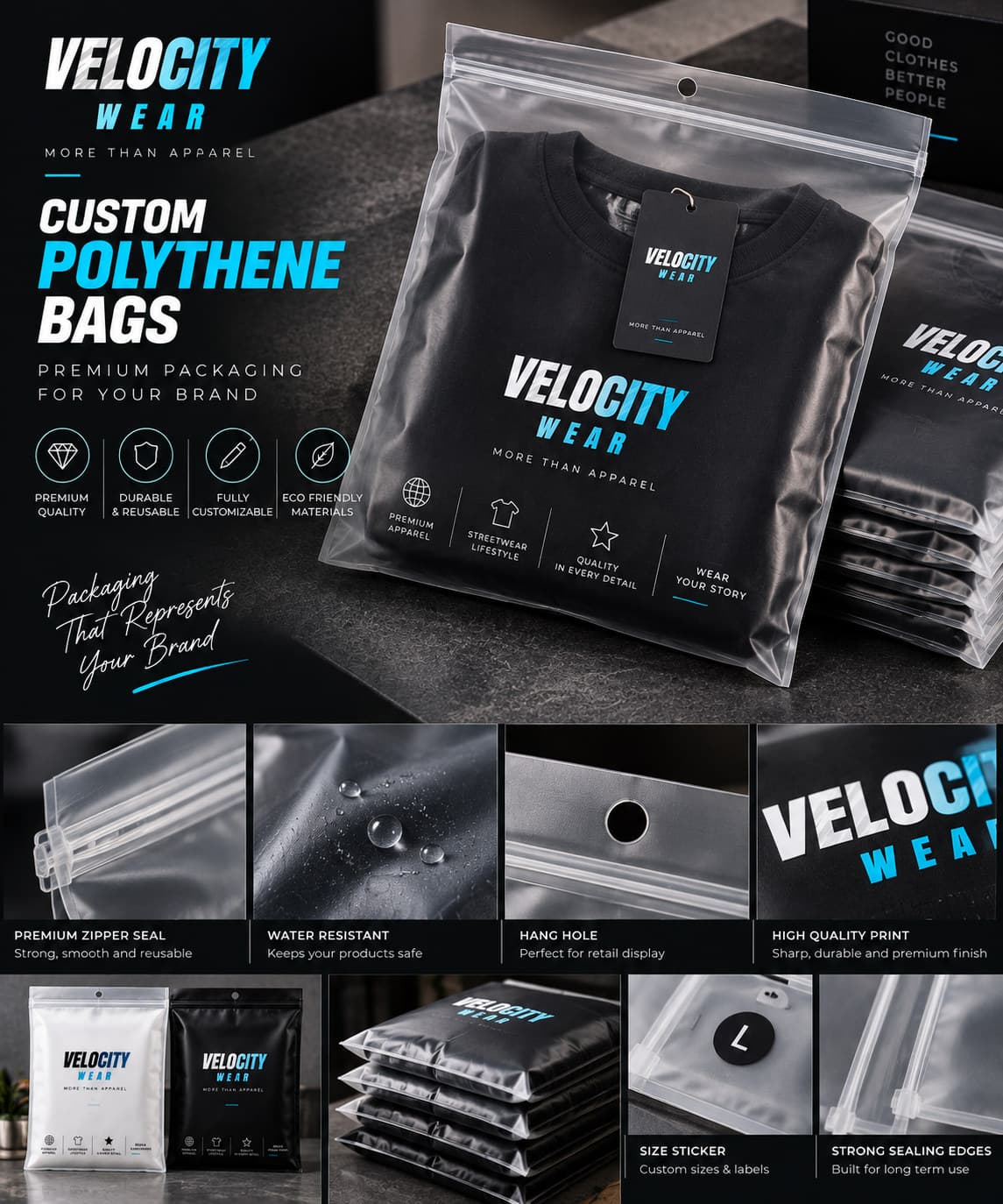
How do a garment bag and a box compare?
| Factor | Garment poly bag | Box |
|---|---|---|
| Dirt and damp | Water-resistant film sealed around the garment | Card shell; the garment inside is exposed unless it is bagged too |
| Crushing | Little resistance: the bag follows the fold | Good: rigid sides hold their shape |
| Presentation on opening | Logo on the frosted face, garment visible behind it | A lid to lift, with room for tissue and a card |
| Space in freight | Adds almost nothing to the folded garment | Fixed outer size, often with empty space inside |
| Returns | Zip seal reopens, so the item goes back in the same bag | Depends on the box surviving the first opening |
| Gifting | Tidy, but reads as retail packaging | Reads as a present |
| Shop display | Hangs from a peg by its hang hole | Stacks on a shelf |
Read the table by use rather than totting up rows. An everyday t-shirt order turns mostly on dirt, space and returns, where the bag is stronger. A gift set turns on crushing and gifting, where the box is.
Do boxes protect clothes better than bags?
Against crushing, yes; against damp and dirt, not on their own. A folded t-shirt or hoodie is soft and hard to damage by pressure, so crush resistance matters less than it sounds. What actually marks clothing in transit is dust on the packing bench, a wet van floor or a parcel left on a doorstep in the rain. Card keeps its shape but can soak through, while a bag sealed around the garment keeps it clean. The pieces that genuinely need rigidity are structured ones, such as a cap's crown, which is why bags for caps and accessories are planned differently.
What does a box add to freight and storage?
Mostly space. Bagged stock packs tightly into cartons, and a single bagged order fits a slim parcel. A box has fixed outer dimensions whatever is inside, so some of what you ship is air, and many carriers charge by volumetric weight, meaning the space a parcel occupies, as well as by what it weighs. Boxes also need storage before they are used and someone to assemble them at the packing bench. None of that rules a box out; it is the cost to set against what the box adds.
When is a box worth it?
- Gift sets, where the box holds several items together and reads as a present.
- Premium or limited pieces, where the opening moment is part of what the customer is paying for.
- Structured items that must not be squashed, such as caps packed alongside clothing.
- Subscription orders, where the box is the recurring moment; the garment inside still wants its own bag, as covered in inner bags for subscription boxes.
Even then, bag the garment inside the box. The box is opened once and usually thrown away, while the bag stays around the garment, protects it if the box is crushed or gets wet, and gives the customer something clean to send an exchange back in.
Quoting bags for your packaging plan
Tell us, through the enquiry form here, which garments need bags and whether they will ship in a box, a mailer or hang on a shop peg, then add your logo file, the number of bags per design and the delivery country and date. Bags are quoted per size and print, and the reply usually arrives within hours on working days. The frosted garment bag range has the full specification, and the printed polythene bag guide covers the minimum, samples and the 10 to 15 working days of production.