Ordering Polo Shirts for Trade Show Season
By The Velocity Wear Team
Have trade show polos in the office a week before the stand goes up. Counting back from there through delivery transit and 10 to 15 working days of production from artwork approval, an autumn show is a summer order. The extra week is not padding: it is when you check the garments, hand them out and find out that two people need a different size.
Why build a week in before the stand goes up?
Because the alternative is opening cartons in a hotel room. That week is used for four things: counting the delivery against the packing list, checking the decoration on a handful of pieces, distributing to people who may be travelling from different offices, and swapping the sizes that are wrong. None of those are optional and all of them are impossible on the morning of set-up.
For a multi-day show with a team flying in, make it two weeks and ship to whoever is packing rather than to the venue. Venues do accept deliveries, but a box that arrives at a loading bay on a Friday for a Monday show is not a box you can rely on. What to look at when it lands is covered in quality checks on bulk polo shirts.
What makes a stand team readable across a hall?
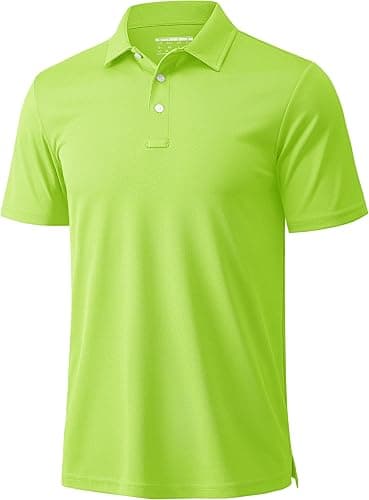
Contrast, not detail. From ten metres a visitor sees a colour and a silhouette, and nothing else. A single strong body colour that matches your stand graphics does more than any logo, and a chest mark large enough to read at conversational distance does the rest. Fine straplines and web addresses are invisible at every distance that matters and clutter the garment close up.
Embroidery is the default for exhibition kit because it photographs well, does not crack in a suitcase and looks deliberate on camera. Where the logo has fine type or a gradient, a print will hold detail that thread cannot, and the trade-offs are worked through in embroidery vs puff embroidery on polo shirts. Whichever you pick, settle the size of the mark by measuring it on a garment rather than on a screen.
How many should you order for a show season?
The minimum is fifty pieces per design, which for a six-person stand looks like far too many until you count the season. A company doing four shows a year with rotating staff, a spare for spills and a few for the wider sales team gets through fifty without trying. Ordering once for the year is also what gets you a consistent garment across every show, where four small orders would not.
If the number genuinely is larger, the tiers do real work: 50–99, 100–249, 250–499, 500–999 and 1,000-plus, with up to 35% off the fifty-piece price at the top. A company kitting out a whole sales organisation is in a different price bracket from one kitting out a stand, for the same garment and the same decoration.
What should the garment specification be?
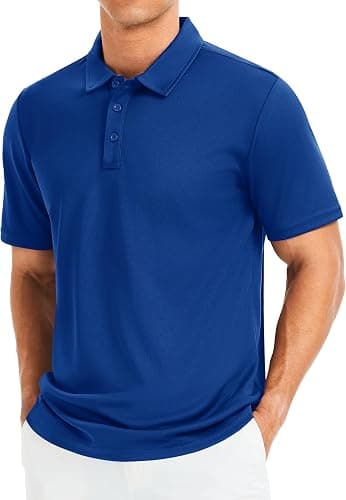
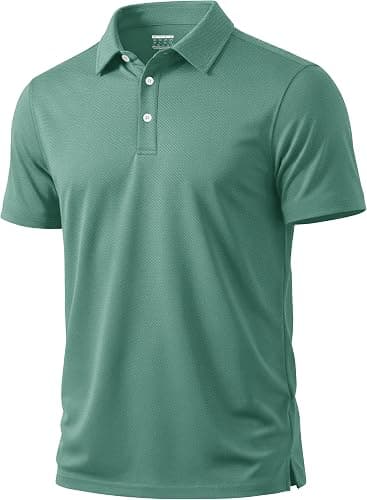
Something that survives a long day standing up. A midweight piqué in a mid-tone colour is the safe default: heavy enough to be opaque under stand lighting, light enough to be bearable in a hall with poor ventilation. A three-button placket photographs more formally than a two-button one, and a standing rib collar holds its shape after the third day, where a soft self-fabric collar will have given up.
Fit is the detail worth over-thinking, because a stand team is seen as a group and one badly fitting shirt reads as sloppiness across the whole line-up. Order to measurements rather than letters, and offer both a straight and a tailored block if the team is mixed. Fits and cuts for wholesale polo shirts sets out how they size in practice, and the current fabric options are on the wholesale polo shirts page. If you want a physical garment before committing, a sample is £150, credited against the bulk order, and the samples page explains the build.