Reading a Wholesale Quote for Joggers
By The Velocity Wear Team
A jogger quote should show the price per piece at your quantity, the garment specification it is based on, the decoration included, the lead time from artwork approval and anything charged separately. The per-piece figure on its own tells you very little: two quotes at the same number can differ by a whole fabric weight, a second placement or a set of labels nobody mentioned.
What is inside the per-piece price?
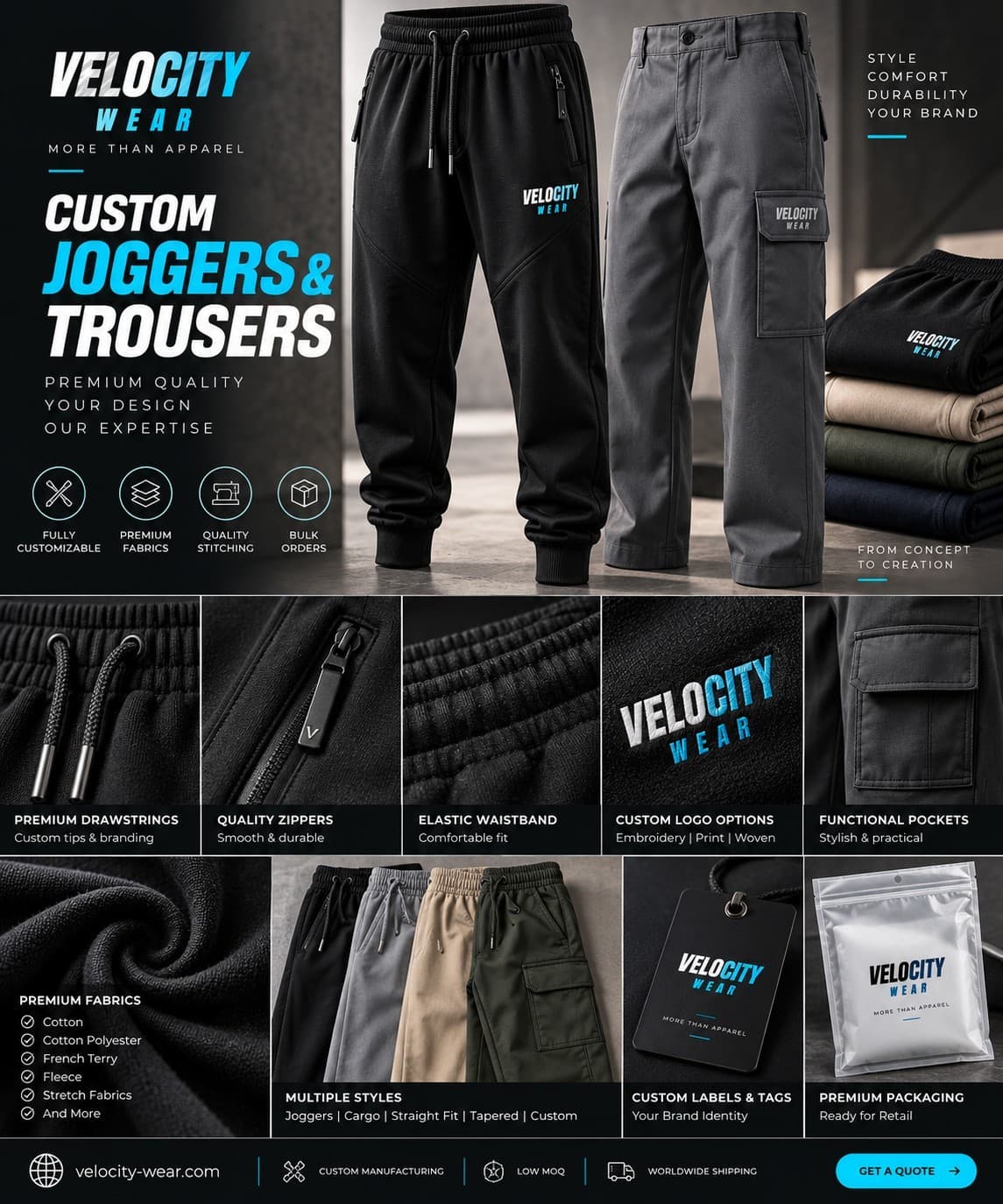
The garment in the stated fabric, cut and colour, with the decoration described, produced to the quantity quoted. Our published from-price is $22 a piece at fifty, which you will find on the wholesale joggers page. What that figure assumes is a specific construction and a specific decoration, so if your brief asked for something heavier, or for embroidery instead of print, the number you are looking at should reflect that and the quote should say so explicitly.
What sits outside it?
- The sample, at £150, which is credited back against the bulk order.
- Additional decoration placements, each of which is a separate setup.
- Private label components: woven or tear-out labels, swing tags, custom packaging.
- Delivery and any duties or taxes applicable to your destination.
- Anything added after the quote was issued, including a second colourway.
Why does the figure change with quantity?
Because setup costs spread. Screens, digitising and machine time are largely fixed per design, so they cost the same across fifty pieces as across five hundred and the per-piece share falls. That is what the tiers describe: 50-99, 100-249, 250-499, 500-999 and 1,000-plus, with up to 35% off the fifty-piece price at the top. The structure is published on our pricing page, and it is worth asking for your quantity and the next tier up priced together so you can see the step.
Does the quote say how many designs it covers?
It should, and this is where quantities are most often misread. The fifty-piece floor applies per design, and each colourway needing its own screens counts on its own, so a quote for a hundred pieces may describe two runs of fifty rather than one run of a hundred. Those are different unit prices, because the setup is duplicated and neither run reaches the next tier. Ask for the breakdown by design rather than accepting a single total.
What should you ask before signing?
Confirm the fabric weight and construction in writing. Confirm the lead time runs from artwork approval rather than from the order date. Confirm the packing format, the labelling and the delivery address. Ask how long the quoted price holds, and get the answer in writing rather than assuming. If the quote arrived after a thin brief, the answer is usually to go back and complete it, using briefing a supplier for joggers.
How do you compare two quotes fairly?
Line the specifications up before the prices. A cheaper quote on a lighter fabric with one placement and no labels is not a cheaper quote, it is a different product. Put fabric, construction, hem, cut, decoration, placement count, labelling, packing and lead time into a table and fill both columns in. Whatever is blank is the thing that will cost you later. If either quote is your first, walk through the sequence in your first bulk jogger order.
Check which currency the quote is in and which one you will be invoiced in, because they are not always the same thing. Invoicing is available in seven currencies, so a UK buyer looking at a dollar from-price can usually settle in sterling, but the conversion has to be agreed rather than assumed. Raise it at the quote stage. A rate applied at invoice time on a figure you budgeted months earlier is an unpleasant surprise on a large run, and it is entirely avoidable by asking one question early.