
Briefing a Supplier for Joggers
By The Velocity Wear Team
A good jogger brief fits in one message and answers eight things: garment, fabric, hem, cut, colour, decoration, placement and quantity, plus the date you need the goods. Send all of it at once and the first quote is the price you will actually pay. Send half of it and you get a figure that moves every time another detail arrives.
What does a supplier need before quoting?
- The garment and the fabric: brushed fleece or loopback, and the weight if you know it.
- Hem and cut: cuffed or open, regular, boxy or oversized.
- Colour, given as a Pantone textile reference or a physical object, not a hex code.
- Decoration: screen printing, DTF, embroidery, 3D puff or sublimation, with placement and approximate size.
- Quantity per design, and how many designs and colourways there are in total.
- Any private label requirement: woven or tear-out labels, swing tags, packaging.
- The date the goods have to be in your hands, and where they are shipping to.
How should you describe the garment?
In specifics rather than adjectives. Premium, chunky and high quality mean nothing on a spec sheet; brushed fleece, cuffed hem, regular fit means something a factory can cost. If you own a jogger you want to match, say so and offer to send it, because a physical reference removes more ambiguity than any amount of description. Use the terms defined in our glossary so both sides are describing the same construction.
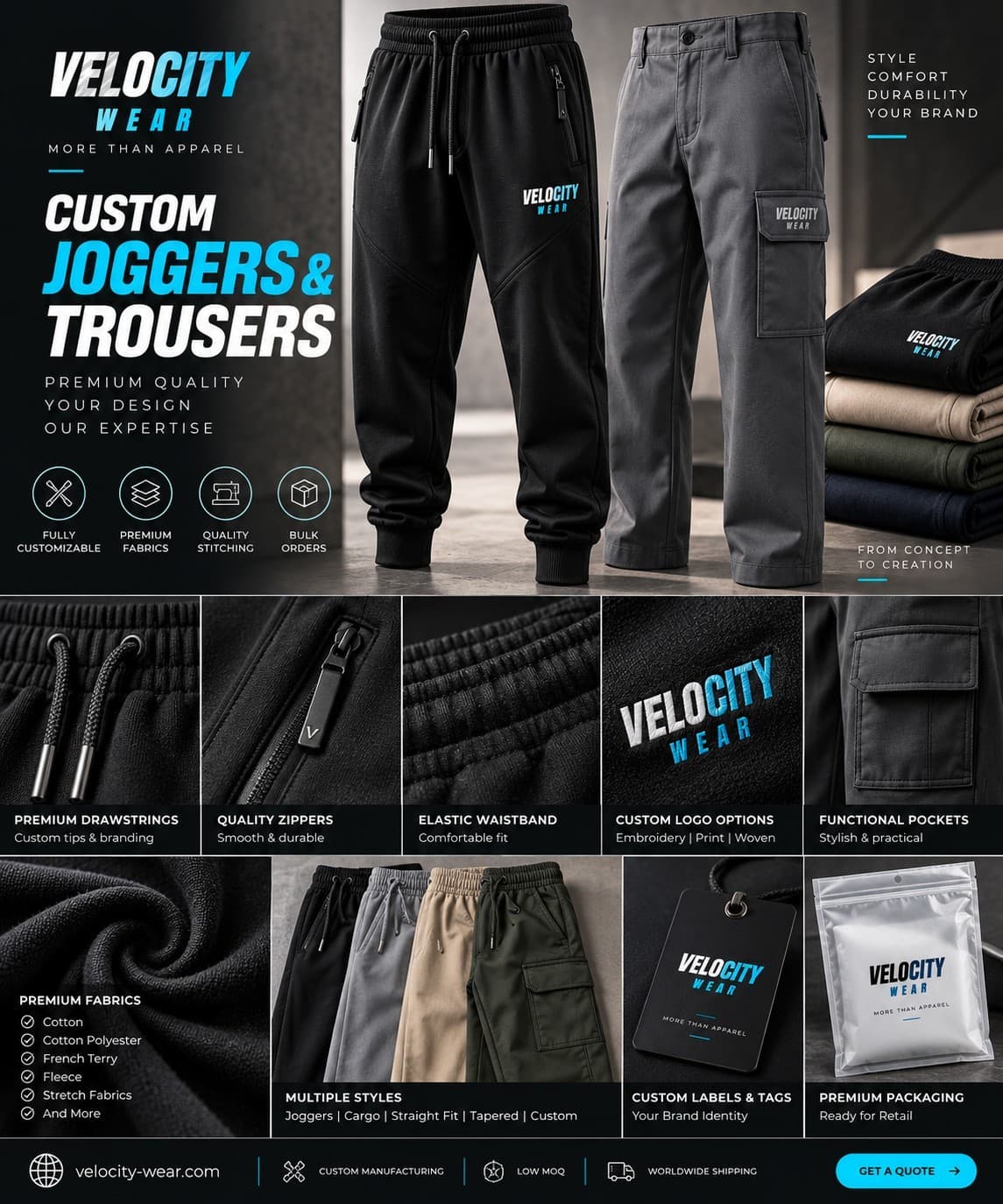
What artwork format should you send?
Vector, as AI, EPS, PDF or SVG, with fonts outlined and colours named. A logo pulled from a website is the most common reason a proof comes back looking soft, because it was built for a screen at a fraction of the size it needs to be printed at. If you only have a raster file, send the largest original you have rather than a resized copy. Embroidery has its own requirements on top of that, because the artwork has to be converted into stitch instructions before anything can be sewn, and a file that prints beautifully can digitise badly if the detail is too fine.
What should you ask in return?
Ask for the price per piece at your quantity and at the next tier up, what is included and what is extra, the fabric weight and construction in writing, the lead time from artwork approval, and the packing format. Our pricing page shows the tier structure so you can sanity-check the numbers against the published position, and the garment detail sits on our wholesale joggers page. Reading the answer properly is covered in reading a wholesale quote for joggers.
How do you stop the brief changing after the quote?
Get the people who can change their minds into the conversation before it is sent. Most brief creep comes from someone senior seeing the proof for the first time at approval stage and raising a point that should have been settled at the start. Name one approver, circulate the brief internally before it goes out, and put a date on when the specification is frozen. A wider version of this discipline is in how do I brief a clothing supplier properly.
Send the identical brief if you are approaching more than one supplier. Comparing quotes only works when both were answering the same question, and a brief tailored slightly differently for each produces two prices that cannot be set against each other. Paste the same text, attach the same artwork, name the same quantity, and ask for the reply in the same structure. It also tells you something useful about each supplier: the one who spots a gap in your brief and asks about it is usually the one who will spot a problem in production.

