Jackets & Outerwear for Trades: cost
By The Velocity Wear Team
Jackets for a trades crew are quoted per job rather than from a fixed list, because a coach jacket and an insulated softshell are different products with different costs. The levers you control are quantity, fabric, and the number of decoration placements. Quantity is the largest: discounts reach up to 35% off the 50-piece price as the order rises through the tiers.
What drives the price of a site jacket?
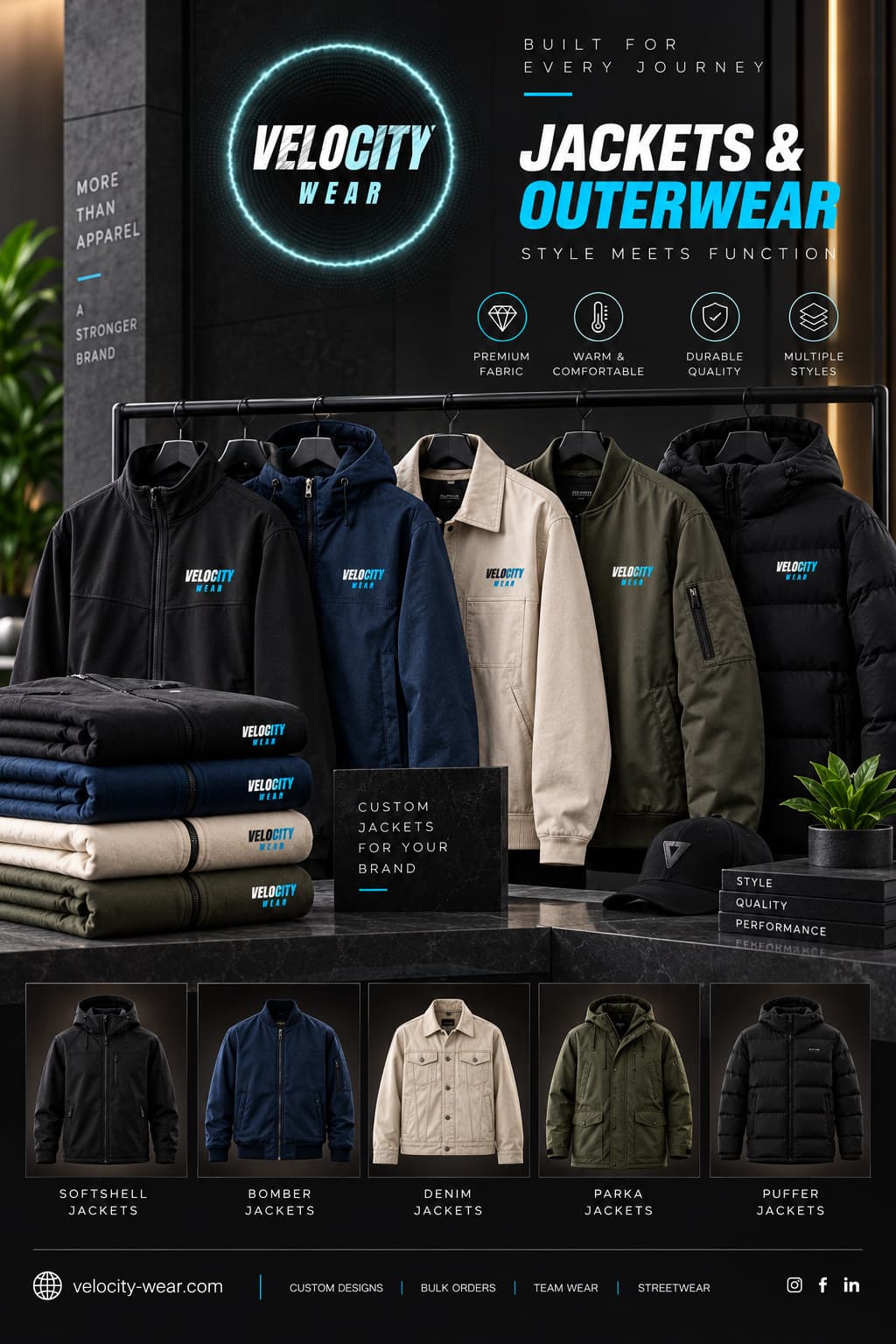
Construction first. A lined, insulated or bonded garment takes more materials and more operations than an unlined shell, and that difference is permanent rather than negotiable. Then fabric weight and quality, which on site is not a place to economise, because a shell that fails in the first winter costs more than the saving. Then decoration: each placement is a separate setup and a separate pass. Then quantity, which is where the real movement is. The styles we build, from softshell through puffer, coach and varsity, are on the wholesale jackets page, and the trades-specific range is on the construction and trades page.
How far does the volume discount reach?
Up to 35% off the 50-piece price, through tiers at 50 to 99, 100 to 249, 250 to 499, 500 to 999 and 1,000 plus. For a contractor with several sites, that changes how the order should be structured: consolidating a year of kit into one annual run reaches a higher tier than four quarterly orders of the same total. The trade-off is storage and the risk of a design change mid-year. For a crew of thirty, the fifty-piece minimum already delivers spares, which is useful given how fast site kit gets damaged.
Which decoration is most economical on workwear?
For a small chest logo, embroidery is durable and priced by stitch count, so a simple mark is inexpensive and survives site conditions and repeated washing better than anything applied to the surface. For a large company name across the back, screen printing is more economical than covering that area in stitches. Combining a stitched chest logo with a printed back name is the usual answer and keeps the setup count to two. Adding a sleeve mark is a third setup, so it should earn its place.
How should replacement kit be costed?
Site outerwear wears out, gets torn, and gets covered in things that do not wash out. Treat jackets as consumable over a known period rather than as a one-off purchase, and order the replacements in the same run as the originals, since a top-up later carries its own fifty-piece minimum. Layering also affects the count: crews wearing a jacket over a mid-layer for months need fewer washes and fewer replacements than crews wearing it against a work shirt. The full cost breakdown method is in budgeting a bulk jacket order, and specifying for site conditions rather than from a catalogue is covered in construction workwear specification.
Where roles differ genuinely, price the roles separately rather than buying one compromise garment for everybody. A site team outdoors all day and an office-based team visiting twice a week do not need the same jacket, and buying to the harder requirement across the whole headcount is an expensive way to be fair. The constraint is the fifty-piece minimum per design, so this only works once each role group reaches fifty on its own. Below that, one generous specification for everyone remains the sensible answer.