Colour Matching Bulk Jackets & Outerwear
By The Velocity Wear Team
A jacket can be matched to a Pantone reference closely, but not exactly. Dye behaves differently on a bonded softshell, a melton varsity body and a coated puffer shell, and ink sits differently on each of them again. Give the reference at enquiry rather than at proof, accept a small tolerance in writing, and sign off against a physical piece rather than a monitor.
Can a jacket be matched to a Pantone reference?
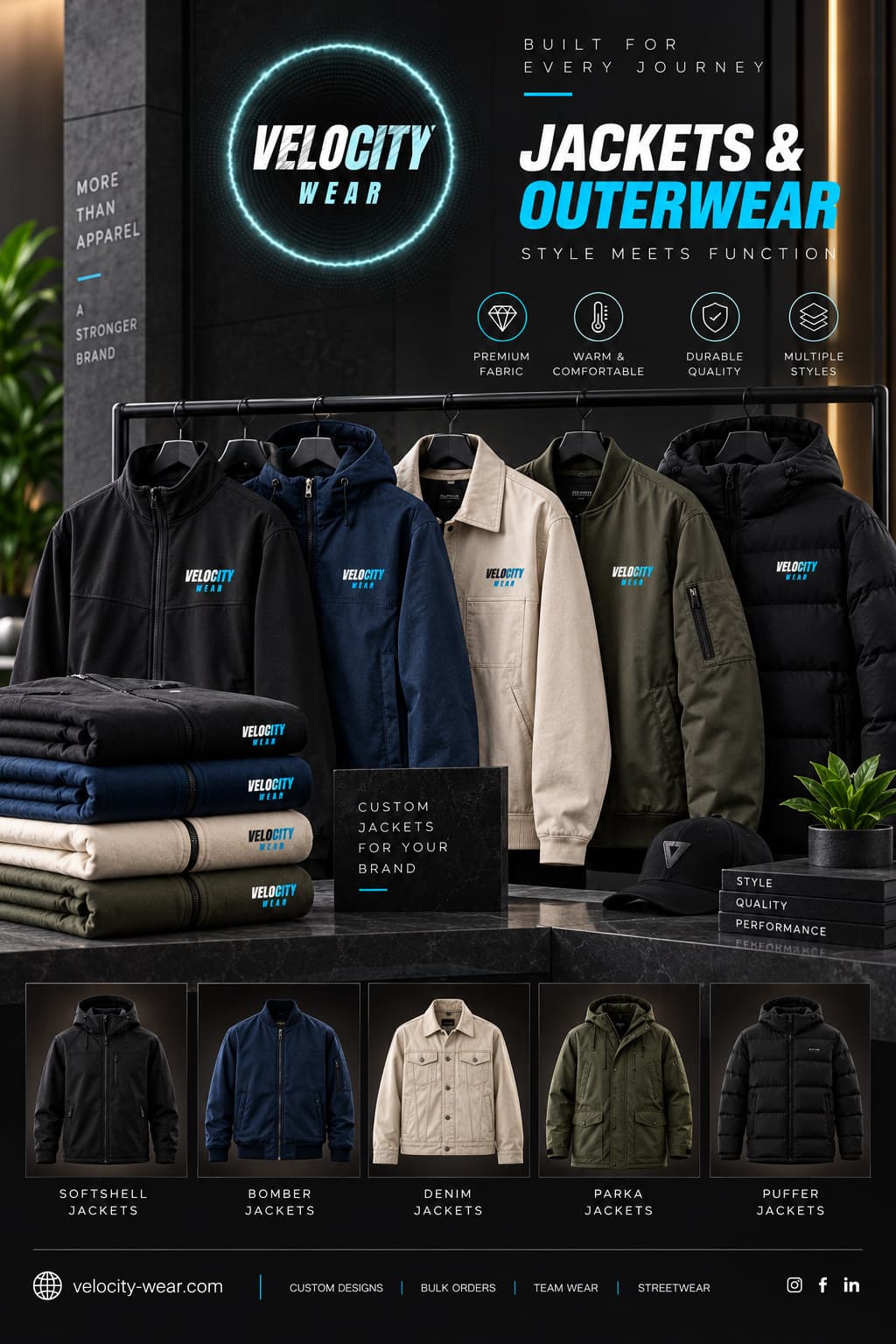
Pantone is a common language, not a guarantee. The system was built for ink on paper, and a jacket is neither. Printed decoration can be mixed to a solid coated reference and gets close, particularly on flat woven shells. Dyed body fabric is harder, because the colour is in the fibre and the fibre reflects light differently depending on whether it is brushed, coated or bonded. State the reference early so the fabric can be chosen with it in mind. Styles and decoration options are on the wholesale jackets page, and the vocabulary of proofs and tolerances is in the glossary.
Why does one ink look different on softshell and fleece?
Surface, absorbency and sheen. A smooth woven shell reflects light evenly and returns a colour close to the mixed ink. A brushed or fleece-backed face scatters light, so the same ink reads lighter and softer. Coated puffer shells are glossy and can push a colour cooler. Embroidery changes the question completely, because thread colour is chosen from a thread card, not mixed, so you pick the nearest available shade rather than specifying a value. The trade-off between dyed fabric and printed colour is covered in colour matching in custom apparel.
What is batch variation and how is it handled?
Fabric is dyed in lots, and two lots of the same colour can differ slightly. Within a single production run this is controlled, because the fabric is cut from one lot. Across repeat orders months apart it is a real risk, and the standard way to manage it is to agree the tolerance against an approved reference piece rather than against the last delivery you received. If an order will grow later, say so at the quote stage so the fabric can be booked in one go. Matching two different garments in the same colour is its own problem, set out in can two different garments match in colour.
What should be signed off before production starts?
The fabric colour, the decoration colours, the placement and the method, all against something physical. A sample at £150, credited against the bulk order, is the only way to see the combination on the actual shell before 50 pieces are committed. Sign off in daylight or under a consistent light source, because office lighting will tell you a different story than the shop floor will. Once you approve, the 10 to 15 working day build starts and the colour is fixed with it.
Two shades cause more trouble than the rest of the palette put together: very bright fluorescents and very deep blacks. Bright shades depend on the fabric being able to hold the dye at that saturation, and not every shell will. Deep black looks consistent on screen but reads with a brown or blue cast on some fibres, and the difference shows most when two garments in the range sit next to each other. If either sits at the centre of your identity, raise it at enquiry so the fabric can be selected around it rather than discovered at proof stage.