
Trades: Ordering Joggers in Bulk
By The Velocity Wear Team
Joggers suit trades as workshop, van and travel kit rather than as site trousers. At $22 a pair at the fifty-piece minimum they are cheap enough to issue two per person, and branded legwear keeps a crew looking like a firm rather than a group of individuals. Where a site demands protective or high-visibility trousers, joggers are not the garment.
Where do joggers actually work on a trades job?
In the workshop, in the van, on fit-out and second fix, and on the travel either side of a shift. They move better than a heavy work trouser and they are warmer than most alternatives once a brushed fleece is on. Where they do not work is anywhere the risk assessment calls for knee pads, cut resistance or hi-vis legwear, and that line is the client's to draw, not ours. The wholesale joggers page sets out the fabrics, and the construction and trades pages cover the workwear that sits around them.
Most firms end up with joggers as the layer under or after the day's real kit. Treated that way they last, and they carry the logo into places a branded polo never reaches.
What fails first, and how do you spec around it?
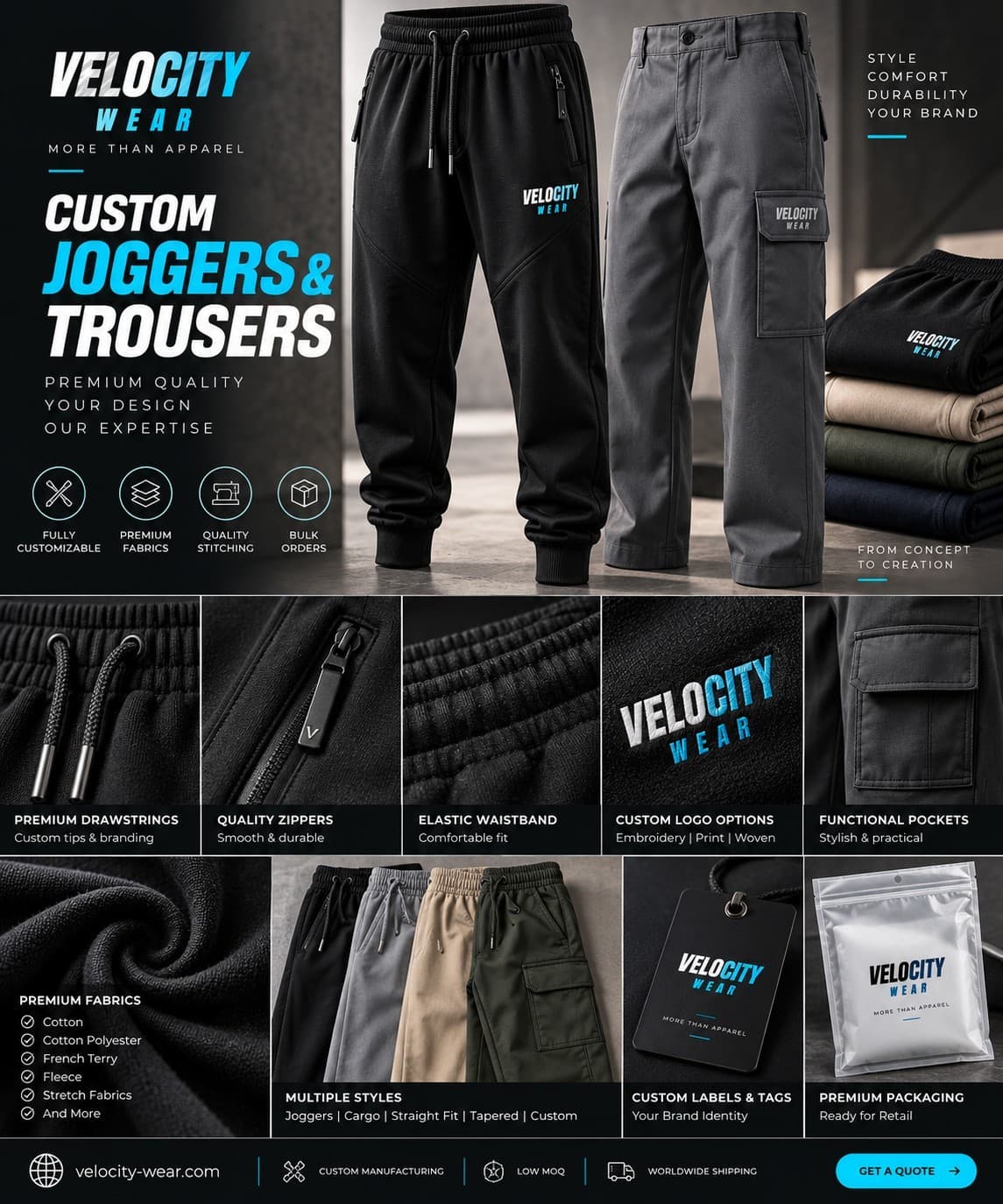
The hem and the pockets. An open hem frays and picks up everything on a site floor, so cuffed is the sensible default for trades. Pockets go from carrying a phone to carrying a tape measure and a handful of screws, which is a different load entirely, so the seam quality around the pocket opening matters more than the fabric weight does.
Fabric choice splits by season. Brushed fleece is the warmer option and earns its place from October. Loopback is lighter, dries faster and suits a summer run or an indoor fit-out crew. Firms ordering once a year usually take fleece and accept that it is warm in July. Understanding seams and garment construction explains what to look for where the stitching does the work.
How should a crew be kitted out?
- 1Two pairs per person as the baseline, so one is in the wash while the other is on.
- 2One design across the whole firm, because fifty pieces is per design and splitting by trade doubles the minimum.
- 3Dark colours, since site dust and sealant do not come out of pale fabric.
- 4A small, high-placed logo — hip or upper thigh — away from the knee and the seat where abrasion is worst.
Sizes mix freely inside the fifty, so a crew of twenty-five covers the minimum at two pairs each with nothing wasted. Order a few extra in the middle sizes for new starters rather than raising a second run later.
What does a fifty-pair order cost a small firm?
It starts at $22 a pair and falls through the quantity tiers, up to 35% off the fifty-piece price at the top of the scale. For a firm of twenty-five, the whole run is a modest line against a single job, and it replaces the annual argument about who is wearing what. Production is 10 to 15 working days from artwork approval, plus transit, so order before the season rather than during it.
If the joggers are part of a wider kit refresh, plan them alongside the hi-vis and the fleeces so everything carries the same mark — construction and trade workwear branding covers how those pieces are decorated, and construction workwear specification goes into speccing for the site rather than the catalogue.

