Joggers for Agencies, Ordered Properly
By The Velocity Wear Team
Agencies order joggers at $22 a piece from a fifty-piece minimum, with production running 10 to 15 working days from artwork approval. The risk on an agency job is almost never the factory. It is the fortnight that disappears between sending a proof to a client and getting a written yes, because that fortnight sits outside the production clock entirely.
Why do agency merchandise jobs run late?
Because the approval chain is longer than the production chain. A jogger goes from brief to proof in days. Then it waits for a brand manager, who waits for a global guideline check, who waits for legal to look at a strapline nobody intended to print. None of that is visible on a production schedule, and all of it happens before the clock starts.
The fix is to treat artwork approval as a milestone with a named owner and a date, the same way you would treat a campaign live date. Put it in the plan at the top, not as a dependency buried underneath. Our corporate apparel page sets out what we need at that point, and getting the file right first time removes a whole approval loop on its own.
How do you keep a jogger inside a brand guideline?
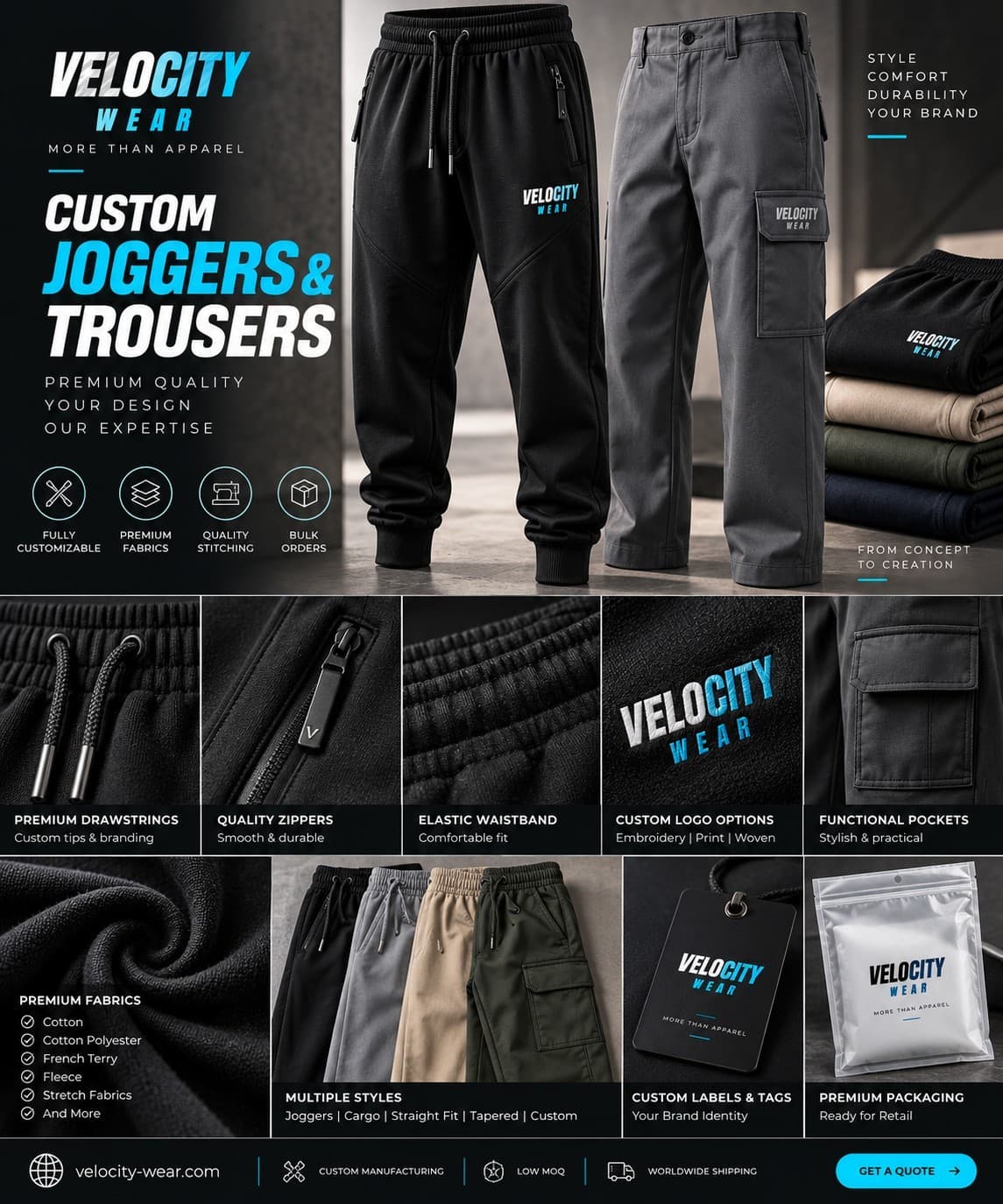
Most guidelines were written for screens and print, not knitwear. Three things reliably need a decision. Minimum clear space, because a waistband mark has less room than a page. Minimum size, because a logo that survives on a business card can fill in on brushed fleece. And colour, because a screen ink or a thread shade matches a reference rather than reproducing it exactly, especially on a marl body.
Raise all three with the client before the proof rather than after, and get the concession in writing. A brand manager who has already agreed that the thread is the nearest available match will not reopen it when the sample lands on the desk. The garment options themselves are on the wholesale joggers page, including brushed fleece and loopback bodies with cuffed or open hems.
What do fifty pieces actually cover on a campaign?
Fifty is per design, with sizes mixed freely inside it. On a campaign that is usually the client team, the agency team who will be photographed in them, a press allocation, a giveaway pool and a reserve for the sizes nobody predicted. Counted honestly, fifty disappears quickly.
What breaks the budget is fragmentation. Three regional variants of one logo is three designs and three minimums. If the campaign genuinely needs variants, put the common element in the main decoration and the variable element somewhere small and separate, so one production design covers all three. The same discipline applies to colourways, since each one that needs its own screens counts on its own.
How should the calendar be built backwards?
Start at the shoot or the event date. Take off delivery transit. Take off the 10 to 15 working days of production. Take off a week for a physical sample if the client wants to see one before committing, which at £150 credited against the bulk order is usually worth it on a job with a visible client. Then take off your approval window, which is the part people underestimate.
Whatever date that arithmetic produces is when artwork has to be final, and it is normally earlier than anyone expects. Build in a buffer at that point rather than at the end, because a buffer at the end is the one that gets eaten. Our guides to artwork setup for custom joggers and planning lead times so you never air freight cover both halves of that plan.