
How Much Do Wholesale Joggers Cost?
By The Velocity Wear Team
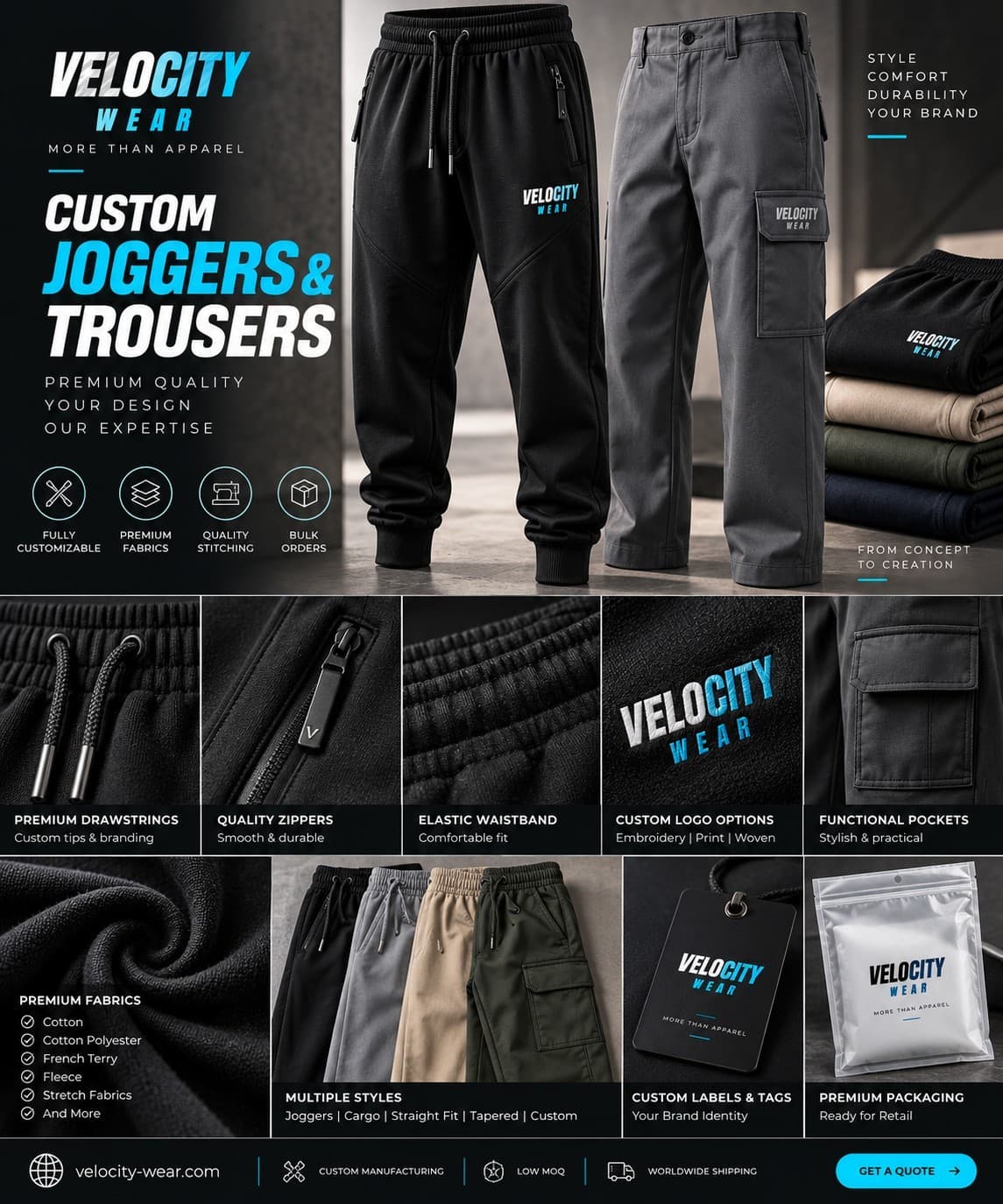
Wholesale joggers start at $22 a piece at our fifty-piece minimum. That figure falls as quantity rises, by up to 35% at the largest tier, and it moves upward with decoration positions, private label work and packaging. A matching tracksuit, meaning a hooded top and jogger together, starts at $53 a set at the same minimum.
What is included in the from-price?
The from-price is the garment, made to your spec, in your chosen body colour and size split. Sizes mix freely inside the fifty. What it does not include is decoration, which is quoted per position, and it does not include private label elements or bespoke packaging. Those are separate lines on a quote for a good reason: two buyers ordering the same jogger can want wildly different finishing, and averaging them into one number helps nobody.
So a quote reads as garment, plus decoration per position, plus any labelling and packaging, plus delivery. The current from-price sits on the wholesale joggers page, and the tier structure is set out on the pricing page.
How much does the price fall with quantity?
The tiers run 50 to 99, 100 to 249, 250 to 499, 500 to 999 and 1,000 upwards, and the discount is measured from the fifty-piece price with a ceiling of 35%. The reduction is not linear. The early steps move the number less than the late ones, because a chunk of the saving at high volume comes from setup costs being divided across far more garments rather than from the garment itself getting cheaper.
That has a practical consequence for anyone sitting just under a tier boundary. Ordering 96 pieces when 100 is the next tier means paying the higher rate on all 96. Check the boundary before you finalise quantity, because the extra four pieces frequently cost less than nothing.
What pushes the price up?
Decoration positions, first and foremost. A single thigh print is one position. Add a waistband mark and an embroidered ankle and you have three, each priced on its own. Screen printing adds a setup per colour, which is significant at fifty and negligible at a thousand. Embroidery adds a one-off digitising charge and then a stitch-count cost that repeats on every piece, so it flattens with volume rather than falling away.
Finishing is the second lever. Custom woven neck labels, tear-out labels, swing tags and branded packaging each add cost per piece. They are worth it on a retail garment and usually pointless on staff kit. The broader arithmetic across garment types is covered in how much custom clothing costs.
How do you compare two jogger quotes honestly?
Put both on the same basis before comparing anything. Same quantity, same number of decoration positions, same labelling, same delivery terms, same currency. A quote that looks cheaper per piece often excludes setup, or assumes one print position where you specified two, or quotes ex-works while the other quotes delivered.
Then look at what the low number implies about the garment. A body weight that is not stated, a fabric described only as cotton-rich and no sample offered are the places where a cheap quote gets its margin back. Ours is a £150 sample, credited against the bulk order, precisely so the comparison happens on a real garment. The minimum that sets the top of the price ladder is explained in the minimum order for wholesale joggers.

