
Tracksuits for Societies: print or embroidery
By The Velocity Wear Team
Embroider a small society crest on the chest, screen print or DTF the large design on the back, and use DTF again for individual nicknames. Thread suits compact marks that need to last; ink suits big, colourful artwork that thread could never hold. A society set commonly carries both, and they are quoted position by position rather than as one decoration charge.
Which decoration suits a society crest?
Stitch, if the crest is simple enough to survive being reduced to thread. Embroidery on a left chest gives a society mark a weight that print does not, and it is the detail that makes kit look commissioned rather than knocked out. Anything with a gradient, a photograph or text under a few millimetres has to be printed instead.
The judgement is made at the digitising stage, where the artwork is converted into stitch paths. If your society crest was drawn by a member in an image editor rather than as vector artwork, it will need rebuilding first, and how do I brief a designer for apparel artwork covers what to ask for.
How does a large back design sit on a hooded top?
It needs planning around the hood, the shoulder seams and the drawcord. A full-width back print on a hooded top has less usable flat area than the same print on a crew neck, because the hood gathers the fabric at the top and the print cannot run up into it. Place the design lower than instinct suggests.
Colour count drives the cost on a screen print, since each colour is its own screen. A four-colour back design costs more to set up than a single-colour one, and at 50 sets that setup is spread across fewer garments. DTF handles full-colour artwork without per-colour screens, which often makes it the better choice for a complex society design. Positions and methods are listed on our wholesale tracksuits page.
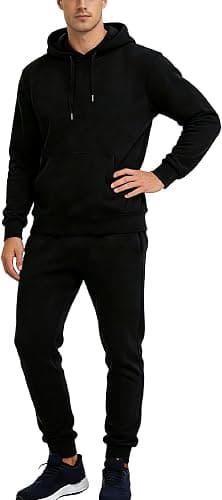
Can members have their own nickname printed?
Yes, and it is the thing societies ask for most. Each nickname is applied individually, usually by DTF, so it is priced per piece rather than as a one-off setup. That is worth saying to members before the order, because it changes the per-head figure and people assume it is included.
Collect the names on the same form as the sizes and close them at the same time. A late name list holds up the whole run, since the personalisation happens during production rather than afterwards. Student group projects are described on our schools and leavers page.
Which artwork will not reproduce well?
Anything with a soft edge, a drop shadow or a gradient going into embroidery. Anything pulled from a web page at screen resolution. Anything with a white box behind it that was meant to be transparent. And anything generated quickly without being checked at full size, where the detail falls apart the moment it is enlarged to a back print.
Look at the artwork at the size it will be printed, on a screen, before sending it. Problems that are invisible in a thumbnail are obvious at 30 centimetres wide. Spotting low-effort AI artwork before it reaches your garments goes through what to look for.
Check the wording as carefully as the graphics. A society design carrying a year, a tour name or an in-joke is being committed to fabric for its whole life, and a typo that survives the proof survives the entire run. Read every word aloud before approving, and have somebody who did not write it read it too.

