Cotton vs Poly Blend on Tracksuits
By The Velocity Wear Team
Cotton-rich fleece feels better and shrinks more. A poly blend holds its dimensions and its colour through repeated washing but has a flatter handle. For a retail tracksuit sold on feel, go cotton-rich. For club kit laundered twice a week, or training sets that have to stay the same size all season, a blend is the sensible answer.
Which one shrinks, and where does it show?
Cotton moves along the length first, so a jogger loses more than the top does, which is precisely the wrong way round on a co-ord. Polyester in the blend restrains that. Neither behaviour is a defect and both are predictable. The point is knowing which you have bought before you publish a size chart, not after a customer tells you the leg finished short.
Ask for the fibre split and the recommended wash temperature together. That pairing is what goes on the care label, and the care label decides whether a shorter leg in month three is the wearer problem or yours. Our fabric glossary defines the terms a mill will put on a spec sheet.
How does the fabric change the print?
Cotton takes screen ink readily and holds a crisp edge. Polyester brings dye migration into it: under curing heat, dye can move out of the fabric and tint a light print, which is why a white logo on a red poly garment sometimes turns pink weeks later. A blocker base or a low-cure ink handles it, but it has to be specified rather than assumed.
Sublimation is the mirror image and only works on polyester, so an all-over pattern on a training set needs a poly face. Embroidery is largely indifferent to fibre and cares far more about weight and stability. Choosing blank garments for printing works through those interactions.
What does each one cost to run?
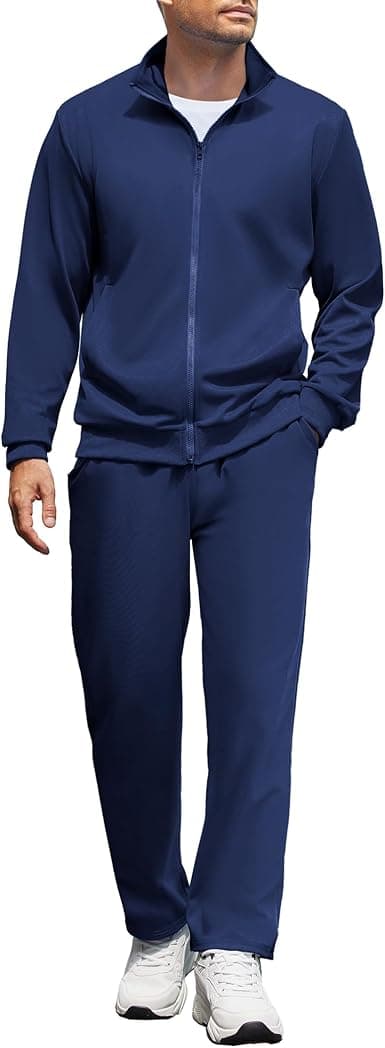
Fibre rarely swings the set price as far as weight does. A heavier fleece costs more than a lighter one whatever it is made of, and a set opens at $53 at fifty on the bulk tracksuit page with up to 35% coming off through the bands. Where fibre does surface is in decoration, since a poly-heavy garment needing a blocker base adds a print operation.
There is a second cost that never appears on any quote. Returns caused by a size that moved in the wash are expensive and they arrive weeks after the invoice is paid. A blend that holds its shape is frequently the better buy once that is counted in.
Pilling is the other difference nobody quotes on. A cotton-rich face can pill where it rubs, at the cuff and under a bag strap, while a blended face resists it and stays smoother for longer. On a retail set that appears in the second month rather than the first week, which is exactly when a customer decides whether to buy from you again. Ask what finishing the fabric has had, because brushing and singeing both change how it behaves.
Which fabric fits your buyer?
Retail buyers judge handle in the first three seconds, so a cotton-rich brushed back earns its keep even with a fussier laundry instruction. Clubs and academies judge whether the kit still fits in March, so a blend wins there. Gyms and staff kit fall between the two and usually end up blended, because the washing never stops.
Weight interacts with all of this. A lightweight poly set and a heavy cotton-rich set are different products aimed at different buyers, and GSM explained for bulk tracksuits covers where the numbers land.