Screen Printing vs Embroidery on Polo Shirts
By The Velocity Wear Team
Embroidery stitches your mark into the cloth and costs roughly the same per piece at fifty as at five hundred, because it is priced on stitch count. Screen printing lays ink on the surface and gets steadily cheaper as the run grows, because its setup is fixed per colour. On polos, embroidery usually wins small, print usually wins large and loud.
How does the cost behave at 50 and at 500?
At the 50-piece minimum, a screen print carries its full setup — one screen per colour — spread across very few shirts, so a three-colour print at fifty is expensive per piece. Embroidery at fifty carries a one-off digitising cost and then a stitch-count price that barely moves. At five hundred the picture inverts: the screen setup has been diluted almost to nothing while the embroidery is still being stitched piece by piece at the same rate. The garment price falls through the volume bands underneath both, reaching up to 35% below the fifty-piece price of $18 — the bands are on the pricing page.
Which one survives the wash better?
Embroidery, and not marginally. Thread is part of the garment, so there is nothing to crack, lift or fade, and it tolerates high wash temperatures without complaint. A well-made screen print is durable too, but it is a film sitting on the cloth and it will eventually show its age at the edges and across fold lines. For a shirt washed commercially several times a week, that difference is the whole argument.
What does the polo itself allow?
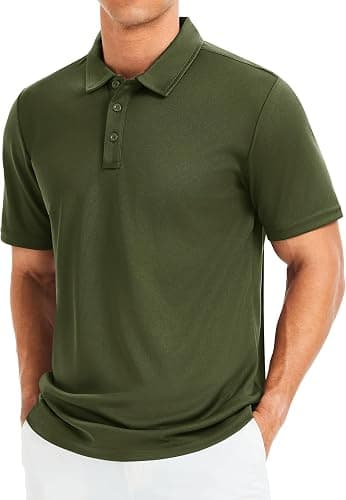
The placket restricts both. A chest mark has to sit clear of the buttons, which pushes it left and caps its width, and that limit hits a print harder than a stitch because prints tend to want more room. Piqué's textured surface takes thread beautifully and gives a print a slightly broken edge at very fine detail, which is another reason most polo logos are stitched. On a smooth performance knit a print sits cleaner, but the thin cloth needs a backing under dense embroidery. The fabric side of that decision is in choosing fabric for wholesale polo shirts.
Which artwork suits which method?
Embroidery wants simple shapes, solid areas and lettering above roughly four millimetres tall. It flatters a crest, a monogram or a compact wordmark and it destroys hairlines and tiny counters. Screen printing wants flat spot colours and holds fine type and sharp edges without trouble, which makes it the right answer for a strapline, a back-yoke line or a design with detail that thread would close up. Neither handles photographic gradients well — that is a DTF job, and it is compared in DTF vs screen printing on polo shirts.
So which do you pick?
Pick embroidery when the mark is small and on the chest or sleeve, when the shirt is guest-facing or uniformed, when it will be washed hard, and when your quantity is near the 50-piece minimum. Pick screen printing when the artwork is large or carries fine type, when you need flat colour across a back yoke, and when the run is several hundred pieces or more so the setup disappears into the quantity. Both are quoted on the wholesale polo shirts page, and a £150 sample credited against the bulk order will settle it physically if the decision is close. You can also see the methods side by side on our comparison pages.