Midweight vs Heavyweight on Joggers
By The Velocity Wear Team
A midweight jogger drapes, packs small and reads as a tracksuit bottom. A heavyweight jogger holds its shape, sits away from the leg and reads as a garment somebody paid for. Both start from $22 a piece at our minimum of 50 per design. Midweight wins on warm-weather wear and resale margin; heavyweight wins on staff kit and anything meant to last a season of washing.
What does the weight actually change in the hand?
Two constructions cover most of the range. Loopback leaves the inside of the knit as bare loops, so the cloth stays flat, dries fast and keeps its line after a wash. Brushed fleece runs those loops through a napping machine until the inside is soft, which traps warmth and feels better on bare skin but adds bulk. A midweight brushed fleece feels warmer than a heavier loopback, which is why the number on its own never settles the argument. We go through the measurement itself in GSM explained for bulk joggers.
Is a heavyweight jogger more expensive?
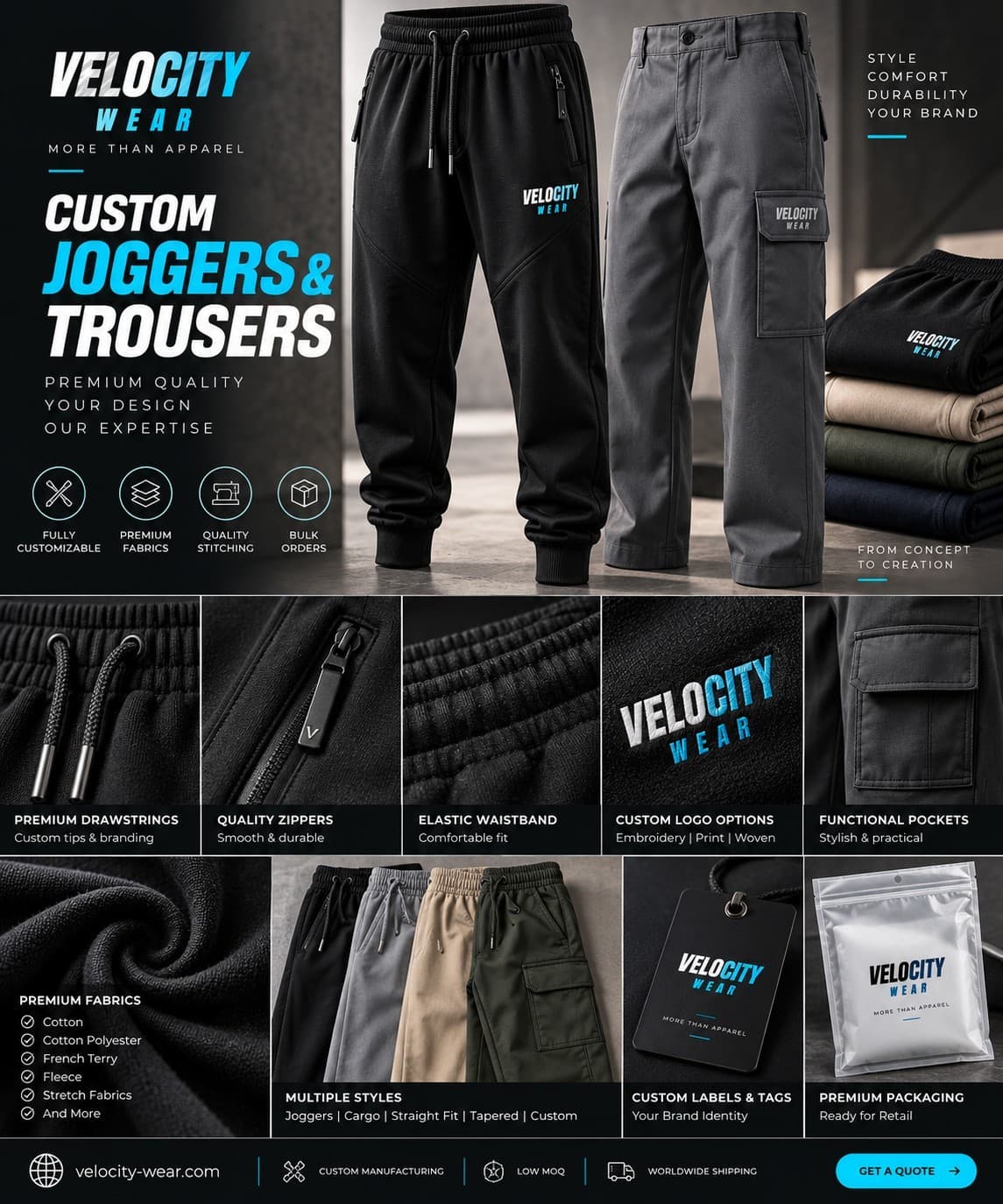
Not by a fixed amount. The $22 from-price on our wholesale joggers page is set at fifty pieces, and quantity moves it far more than cloth weight does: the tiers run 50-99, 100-249, 250-499, 500-999 and 1,000 and up, with up to 35% off the fifty-piece price at the top. Heavier cloth and a more built cuff do add to a quote, so ask for both weights priced on the same sheet rather than guessing. You can line the options up side by side on our comparison page.
Does decoration behave differently on the two?
Yes, and this catches people out. A brushed nap has fibres standing up off the surface, so a fine screen print can sink into it and a thin line loses its edge. Flat loopback gives a cleaner base for screen printing and for sharp DTF work. Embroidery and 3D puff prefer the denser, more stable cloth because the stitch has something to sit against; on a soft midweight the backing does more of the work. If your logo has small type, say so before the fabric is chosen, not after.
Which cuff and hem suits each weight?
A cuffed hem gathers the fabric at the ankle and shows off a taper, which is what most people picture when they say jogger. An open hem falls straight and is more forgiving across a mixed team, because it does not need to fit a specific ankle. Heavyweight cloth in a cuff gives the strongest shape and the most obvious taper. Midweight in an open hem is the easier garment to wear in summer. The cut interacts with all of this, and we deal with it in fits and cuts for wholesale joggers.
So which one should you order?
- Pick midweight when the joggers will be worn indoors, sold through in spring or summer, shipped in volume where weight affects freight, or worn by people who will complain about heat.
- Pick heavyweight when they are staff kit worn on shift, a winter drop, or a retail piece where the customer judges quality by picking it up.
If the order splits cleanly between the two, remember that each design carries its own fifty. A midweight run and a heavyweight run are two orders of fifty unless the artwork and the garment are identical.
One more thing worth pricing before you choose: weight travels. Several hundred heavyweight joggers cost more to ship than the same count in a lighter cloth, and on a long route that gap is real money rather than a rounding error. If the two constructions are genuinely close on suitability for the job, compare the delivered cost rather than the unit cost, and ask for both to appear on the quote so you are not doing the arithmetic yourself afterwards. Where the garment is clearly better in one weight, buy that one and treat the freight as part of the specification.