Budgeting a Bulk jogger Order
By The Velocity Wear Team
Joggers start at $22 a piece at our 50-piece minimum, so a first run of 50 is $1,100 before anything is printed on it. Four lines make up the budget: the garment, the decoration, a £150 sample that is credited back against the bulk invoice, and delivery. Write those four down before you ask anyone for a quote.
Buyers usually get the garment figure right and then get caught out by the parts around it. The fix is not a spreadsheet full of guesses. It is knowing which of the four lines is fixed, which one moves with quantity, and which one you only pay once. Our wholesale joggers page carries the current from-price, and the tiers behind it sit on the pricing page.
What goes into the line on the invoice?
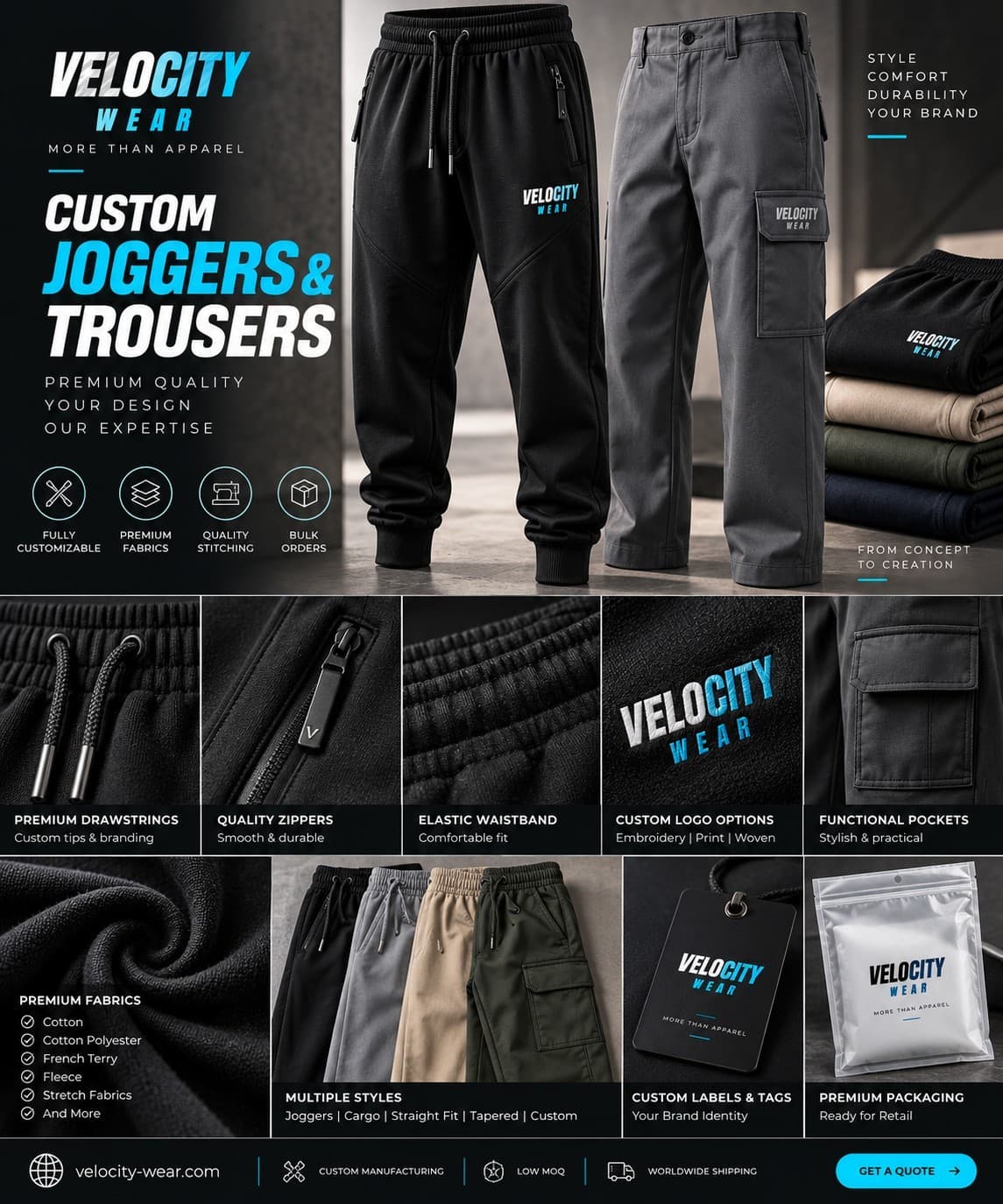
The blank garment is the largest single figure. Two fabrics dominate: brushed fleece, which is napped on the inside and holds warmth, and loopback, which leaves the knit loops exposed and moves air better. Cuffed or open hem is a shape decision rather than a cost one, so pick the leg your wearers will actually put on. Sizes can be mixed freely inside the 50, which means the garment line does not change if you order twelve smalls and four extra-larges.
Decoration is the second figure and it is the one that varies most. Screen printing rewards flat colour and volume. DTF handles detail and gradients without screens. Embroidery is priced by how much thread goes into the design, which is why a dense badge costs more than a clean wordmark, as stitch count pricing sets out. 3D puff and sublimation exist for specific looks rather than general use.
How far does the quantity discount actually move the price?
The discount is banded, not continuous. The bands are 50 to 99, 100 to 249, 250 to 499, 500 to 999, and 1,000 and over, and the saving reaches up to 35% off the 50-piece price at the top band. What matters for a budget is where your number sits relative to a band edge. Ordering 96 pairs and ordering 104 pairs are very different invoices per piece, so if you are near a boundary it is worth counting again before you commit.
Should the sample cost sit in the budget or outside it?
Put it in, then take it out again. The sample is £150 and it is credited against a bulk order, so on a job you intend to place it is a timing cost rather than a real one. On a job you might walk away from, it is the whole cost of finding out. Treat it as the smallest line in the budget and the one most likely to save you from a mistake you cannot unpick once 50 pairs are cut.
What do people forget to budget for?
- A second colourway. Each design, and each colourway that needs its own screens, counts as its own 50.
- Delivery transit, which sits after the 10 to 15 working day production window rather than inside it.
- The currency you are invoiced in, since we bill in seven and the one you pick affects what lands on your card statement.
- Spare pairs for replacements, which are far cheaper bought now than as a separate run later.
Once those four are on the page, the quote becomes a confirmation rather than a surprise. If you are planning a year of orders rather than one, the approach in budgeting annual workwear spend folds the same lines into a rolling figure. And if the joggers are going to be sold on rather than handed out, work the numbers backwards from the shelf price instead.
Two habits make a budget hold. Ask for the quote at more than one quantity, because seeing 50 and 150 side by side shows what the next band is worth in actual money rather than in percentages. And fix the specification before you ask, since a quote built on brushed fleece with an open hem is not comparable to one built on loopback with a cuffed leg. Buyers who change the garment halfway through a quoting process end up comparing numbers that were never measuring the same thing. Write the spec down, ask once, and the figure that comes back is one you can put in front of whoever signs it off.