How Do I Choose Between Print and Embroidery?
By The Velocity Wear Team
Need this made?Get pricing for this product— free, no obligation, 50 pieces minimum.
Choose embroidery for anything worn as uniform, especially polos, fleeces, jackets and caps, where it has to survive constant washing and read as professional. Choose print for anything with fine detail, gradients, photographic content or a large coverage area, and for t-shirts and hoodies aimed at people who want to wear them rather than have to. The garment's job decides this more reliably than the logo does.
Ask What the Garment Is For, Not Which Method Is Better
There is no better method, only a better fit. A staff polo worn four days a week and washed after each one has different demands from a hoodie sold at a merch stand. The polo needs decoration that still looks deliberate after a year of abuse and that signals professionalism at close range across a desk. The hoodie needs a design people actually like enough to choose it over the other things in their wardrobe. Those two requirements point in different directions, and starting from the garment's purpose sorts most of these decisions in one move.
What Embroidery Does Well, and What It Refuses to Do
Embroidery is thread in fabric, so it lasts as long as the garment and often longer. It has physical texture and a slight sheen that reads as considered and expensive, particularly on heavier fabrics like fleece and canvas. What it refuses to do is fine detail. Gradients are impossible, hairlines vanish, and small text fills in below about 4 to 5mm. It also refuses large solid areas gracefully: a big embroidered block is heavy, stiff, expensive, and can pull the fabric out of shape. If your logo needs a gradient to work, embroidery will not give you that logo. It will give you a simplified relative of it.
Where Print Wins Outright
Print handles everything embroidery cannot. Full colour, photographic images, subtle gradients, thin lines, tiny type, and large areas without adding weight or stiffness. DTG gives a genuinely soft finish on cotton. DTF handles detail and full colour on short runs across cotton, blends and polyester with no per-colour setup. Screen printing gets very cheap per unit at volume, with the caveat that setup is charged per colour, so a six-colour design on 25 shirts is poor value and the same design on 500 is excellent value.
The Fabric Often Decides Before You Do
This is the constraint people forget. Embroidery puts thousands of needle holes through the fabric, which is a genuine problem on a waterproof jacket, since you are perforating a membrane. Heat-sensitive softshells limit your pressing options. Deep fleece pile swallows fine printed detail. Polyester rules out DTG entirely and opens up sublimation. Before you weigh up aesthetics, check the fabric will accept the method, because otherwise you will design something beautiful that cannot be applied to the garment you chose.
The Two Cost Curves Behave Completely Differently
Embroidery is priced largely by stitch count, so a dense, complex logo costs more per garment no matter how many you order, and that premium does not disappear at volume the way a screen setup does. Screen printing loads its cost into setup, per colour, then becomes very cheap per piece as quantity climbs. DTF sits flat, with no setup but a per-print cost that does not fall away sharply. This means the right answer changes with quantity. A simplified logo embroidered on 40 polos is sensible. The same logo screen printed on 500 t-shirts is sensible. Run both through the free instant price calculator and the shape of the difference becomes obvious.
Size and Placement Push You One Way
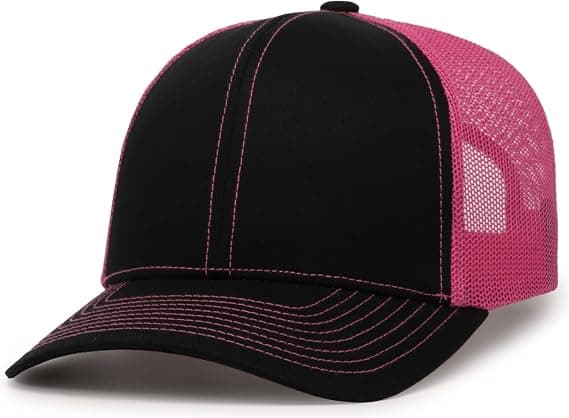
Small placements suit embroidery. A left chest at 80 to 100mm, a cap front, a sleeve, a beanie cuff: all natural embroidery territory, and all sizes where print can look slightly flimsy on a structured garment. Large placements suit print. A full back, a large front graphic, an all-over design: embroidering those is technically possible and almost always the wrong call on weight, cost and comfort. If you find yourself asking for a 250mm embroidered back logo, that is the moment to reconsider the method rather than the size.
The Answer Is Often Both, and Your Logo Needs Two Versions
Plenty of the best-looking branded clothing uses both: an embroidered chest logo for the professional close-up read, and a printed back or sleeve design carrying the detail, the strapline or the artwork. Worth knowing before you start is that this normally means maintaining two versions of your logo, a simplified stitch-friendly version and the full print version. Agreeing that simplified version once, and saving it properly, ends the recurring argument about why the embroidered logo does not look identical to the printed one. They will never be identical. They should look like siblings.
- Polos, fleeces, softshells, caps and workwear worn daily: embroidery.
- T-shirts, hoodies and merch people choose to wear: print.
- Gradients, photographs, fine lines or text under 5mm: print, always.
- Waterproof or membrane fabrics: avoid embroidery, or ask before committing.
- Large back and front graphics: print, regardless of what the chest logo uses.
“"Embroidery flatters a logo that has already been simplified. It punishes one that has not."”