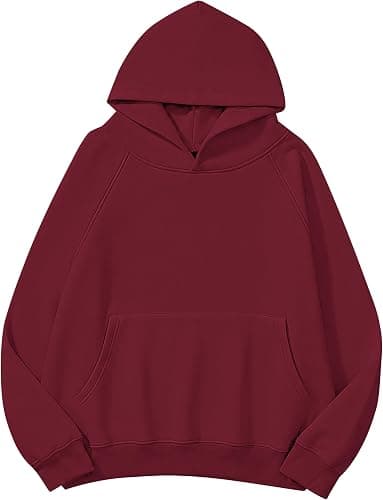
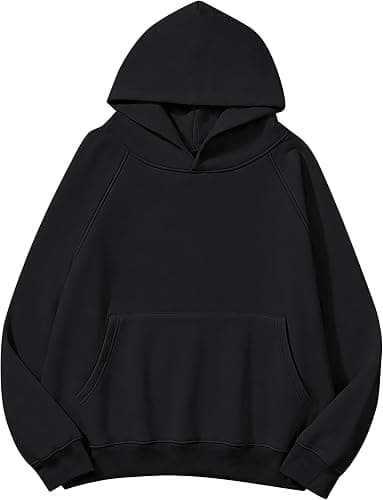
Custom Oversized Hoodies: Pattern Cut, Not Just a Bigger Size
By The Velocity Wear Team
Need this made?Get pricing for this product— free, no obligation, 50 pieces minimum.
An oversized hoodie is a different pattern, not a larger size. The body is cut wider and usually shorter, the shoulder seam is dropped several centimetres down the arm, and the sleeve is cut fuller through the bicep. Sizing up a standard block gives you sleeves past your knuckles and a body to mid-thigh, which is a badly fitting hoodie rather than an oversized one. Velocity Wear supplies oversized styles from a 50-piece minimum with free Design Studio previews so you can see how the drop shoulder moves your artwork.
What Makes a Hoodie Genuinely Oversized
Look at the ratio of chest width to body length. A standard hoodie is roughly balanced, sometimes slightly longer than it is wide. An oversized block widens the chest substantially while holding the body length close to standard, or even shortening it. That is what creates the boxy silhouette people are actually buying.
The second marker is the shoulder. On a standard hoodie the shoulder seam sits on the bone. On an oversized cut it sits somewhere down the upper arm, which is what softens the whole line of the garment. The sleeve then has to be cut shorter to compensate, because the arm starts lower down. A supplier who has simply graded up will have a long sleeve and a seam that lands nowhere in particular.
Drop Shoulders Move Your Print Down the Chest
This is the part that catches people out. Print placement is normally measured down from the collar or the shoulder seam. On a drop shoulder garment the visual centre of the chest sits lower than on a standard block, and a print positioned by the usual measurement can end up sitting high and looking stranded near the neck.
Because the body is wider, the same print also occupies proportionally less of the chest. A 250mm wide graphic that fills a standard hoodie can look modest on an oversized one. Either scale the artwork up or accept a deliberately small chest mark, which is a legitimate look on this silhouette. What you should not do is keep the standard placement spec and hope.
Weight Is Doing More Work Than You Think
Oversized garments hang away from the body, so there is nothing supporting the fabric. A 280 GSM oversized hoodie collapses and looks like it was borrowed. Somewhere from 350 GSM upwards the extra width reads as intentional, and heavyweight fleece around 400 to 450 GSM is where the style really works. That weight costs more per piece and adds to shipping, which is a genuine trade-off rather than an upsell.
Ribbing matters here too. Wide, dense cuff and hem ribbing holds the boxy shape in place. Thin, soft ribbing lets the whole garment sag outward and the oversized cut turns into a shapeless one.
Sizing an Oversized Run Without Guessing
Forget letter sizes. Ask for the flat measurements, chest width pit to pit and body length from the high point of the shoulder, and publish those to whoever is choosing sizes. Oversized blocks vary enormously between suppliers, and one brand's medium is another's large. If you are collecting sizes from a team, give them the numbers and a garment they already own to compare against.
Expect the size curve to skew. People buying oversized deliberately often size down rather than up, because the cut already delivers the volume they want. That is the opposite of what happens with standard fits, and it will wreck your ordering if you apply a normal size split.
- Request pit-to-pit and body length figures for every size before you commit to a split.
- Reposition chest prints lower than your standard spec to suit the dropped shoulder line.
- Choose 350 GSM or heavier, because lighter fabric makes the volume look like a mistake.
- Check the ribbing depth at cuff and hem, since it is what holds the boxy shape.
- Expect people to size down, not up, and adjust your quantities accordingly.
“"Oversized is a shape. A bigger size is just more fabric in the wrong places."”
Where Oversized Is the Wrong Call
Oversized is a poor choice for uniform. Staff kit needs to look consistent across body types, and a boxy cut on a mixed team produces wildly different silhouettes. It also tends to come in unisex sizing only, which narrows the range for anyone at either end of the scale. For workwear, hospitality or anything customer-facing, a regular fit does the job better.
It also fights embroidery. Large embroidered chest logos on a loose panel pucker and pull, because there is no body underneath holding the fabric taut. Keep embroidery small on oversized styles, or print instead.
Sample First, Then Run
If the oversized fit is central to the product, get a sample on a real person before the run. Fit is the entire proposition here, and a photograph on a flat surface will not tell you whether the shoulder lands where it should. Once the block is confirmed, production runs around 10 to 15 working days from artwork approval for screen printing, and tracked delivery reaches the UK, USA, Europe and worldwide.