Custom Apparel for Catering Companies
By The Velocity Wear Team
Need this made?Get pricing for this product— free, no obligation, 50 pieces minimum.
Event catering is not a kitchen with wheels. Kit travels, gets issued to staff you may have met an hour earlier, and often has to work at a venue where the client would rather your logo were not visible. Build the wardrobe around aprons, neutral bases and generous sizing, and it will cover far more jobs than a tightly branded set ever does.
You Are Kitting People You Have Never Met
A fixed restaurant knows its team and buys to fit. A caterer confirms twelve agency staff on Thursday for a Saturday, gets names but no measurements, and needs everyone looking like one outfit by six in the evening. That single fact should drive most of your purchasing decisions.
It means favouring garments with forgiving fits and adjustable elements, buying the middle sizes deep rather than spreading evenly across the range, and leaning on items that fit almost anyone. It also means labelling and tracking, because kit that goes out with casual staff has a habit of not coming back. A simple issue and return list at the van beats a stock cupboard nobody audits.
Why the Apron Does the Heavy Lifting
An apron has no size problem, no fit problem and no gender problem. It ties on over anything, it takes a logo well, and it rotates between different people across a week without anyone minding. For a catering company that is the ideal branded item, and it is why the smartest operators spend properly on aprons and buy plain, cheap base garments underneath.
Bib aprons for kitchen and service prep, waist aprons for front of house, and a longer bistro style for anything that reads as fine dining. Get the ties long enough to wrap and tie at the front, because a lot of staff prefer it and short ties are a constant low level complaint.
Keep a Neutral Set for Client Branded Jobs
This is the part that surprises people who come from restaurant work. A good share of catering jobs happen inside someone else's brand: a wedding where the couple want a particular look, a corporate event where the client's own identity is on every surface, a private house where nobody wants a supplier name in the photographs. Turn up in heavily branded kit and you can end up asking staff to work with their tops on inside out.
- Hold a plain, unbranded set in black or white as your default for client led events.
- Brand the apron rather than the garment, so removing the logo means untying rather than changing.
- Keep one bolder branded set for your own showcases, tastings, festivals and street food pitches.
- Use vinyl for first names, which lets you personalise for a job without a new print setup.
- Buy black trousers and neutral bases in bulk, because these are what go missing and get replaced most.
Size for the Biggest Event, Not the Average One
Averages are useless in catering. If you normally run events for eighty covers but twice a year you do four hundred, your kit box has to cover the four hundred, because that is the day when a shortage becomes visible to a paying client. Work out the largest single deployment you realistically take, add a margin for damage and loss, and buy to that number.
The economics help here. Minimum order is fifty pieces per order with sizes mixed freely, and discounts rise with quantity to around thirty five per cent, so buying the full requirement in one go is usually cheaper than three top ups. Order placement is not the clock that matters either. Production starts at artwork approval, so late artwork is the usual reason kit misses a season.
Front of House and Back of House Diverge
Service staff are seen in close up, in good light, in photographs. Their kit is judged on fit, on crispness and on whether it still looks tidy at eleven at night. Kitchen staff are judged on whether the garment survives heat, fat and a mobile setup with limited space. Buying one garment for both usually means overspending on the kitchen and underspending on service.
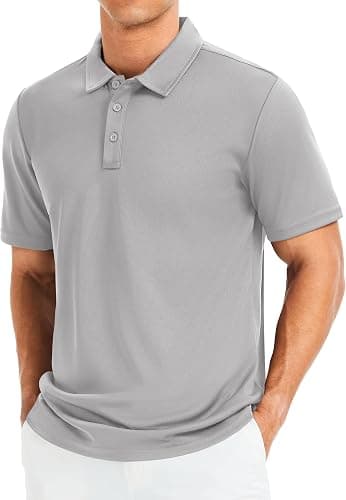
Split the budget deliberately. A better shirt or a properly structured polo for service earns its money in client perception. Kitchen kit should be robust, cotton rich near heat, and cheap enough to replace without a discussion.
Washing, Transport and the Boot of a Van
Catering kit lives in crates and comes back damp. Anything that creases badly will look creased on arrival, because there is no time to press at a venue. Choose fabrics with some polyester content for service garments so they recover in transit, and pack on hangers where the vehicle allows. Fold marks in a white shirt are one of the few uniform failures a client will actually mention.
“"Half of catering uniform is knowing when to take your own name off it."”