Bulk Joggers for Restaurants: A Buyer's Guide
By The Velocity Wear Team
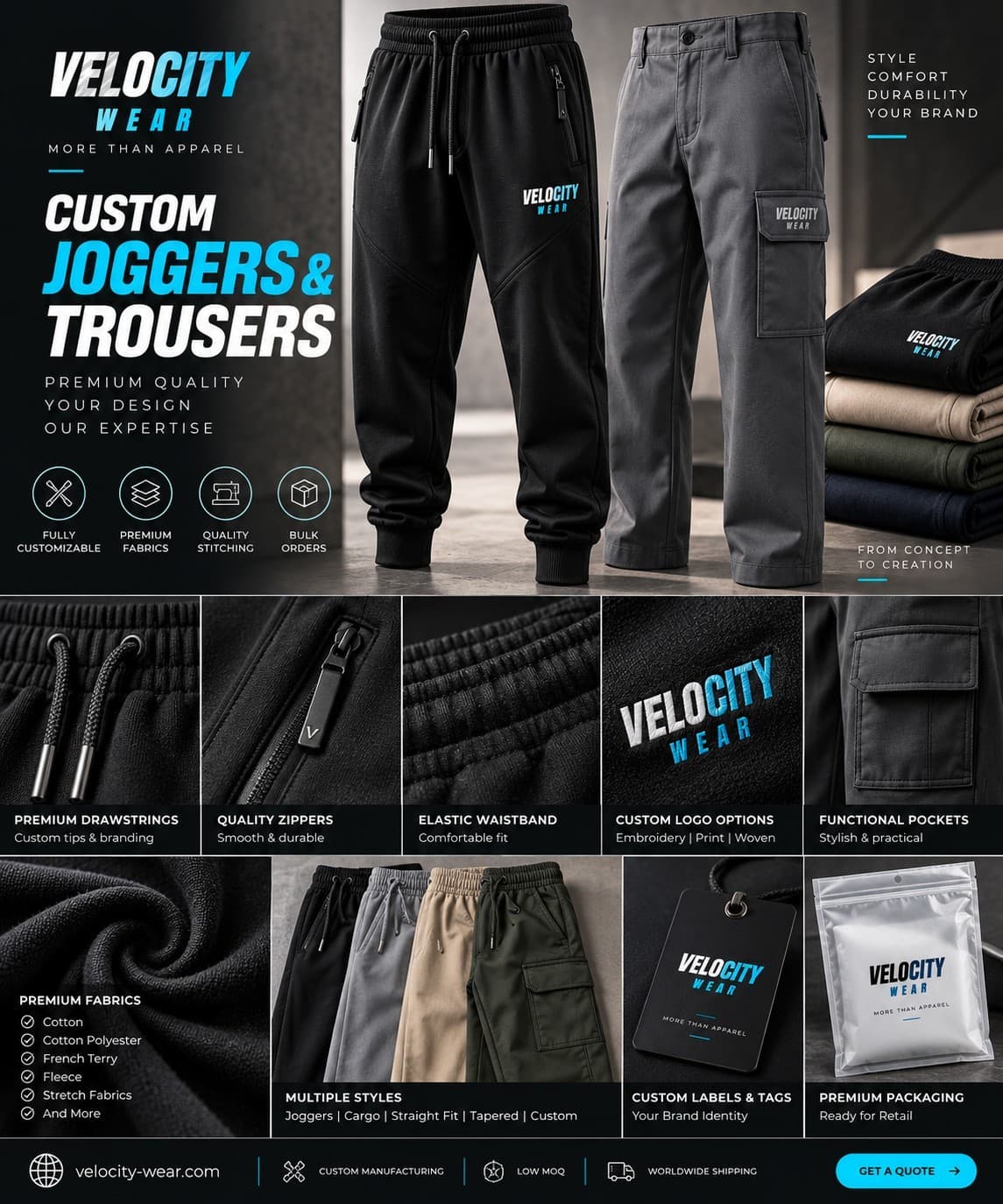
Joggers work for back of house and for off-shift staff kit, starting at $22 a pair at the fifty-piece minimum. They are not front of house legwear in most restaurants. Where they earn their place is the prep team, the delivery crew and the branded kit staff wear coming in and going home, which is where loopback fabric beats brushed fleece comfortably.
Do joggers belong in a working kitchen?
In the prep and pass areas, often yes, because they move better than a stiff trouser and cost less to replace. Near open flame they are a judgement call for the venue, and one worth making with whoever writes your safety policy rather than with a supplier. What is not in doubt is the laundry: kitchen legwear is washed hot and washed daily, and that is the spec that matters. The wholesale joggers page lists the fabrics, and the restaurants and hospitality pages cover the rest of a venue's kit.
Loopback holds up to that cycle better than brushed fleece. The brushed inner face is what gives fleece its softness, and it is also what mats down after twenty hot washes. Loopback leaves those loops intact, dries faster and looks presentable for longer.
What actually ruins a pair in a restaurant?
- Oil splash, which sets if it is not washed out promptly and never fully leaves a pale fabric.
- Heat from ovens and dishwashers, which is why a mid or dark colourway outlasts a light one on appearance alone.
- The hem. Open hems drag on wet floors; cuffed hems stay clear and stay cleaner.
- Decoration in the wrong place. A large print across the thigh sits exactly where a prep bench rubs.
Specify dark, specify cuffed, and keep the branding small and high — a hip or upper thigh mark rather than a full leg graphic. A chest logo on the matching top does the brand work; the joggers only need to look like they belong.
How do you cover two sites with one order?
One design across both sites, allocated after delivery. The fifty-piece minimum is per design, so two venues with different logos are two orders of fifty. Two venues under one brand are a single run, split when the boxes arrive. Groups that expect to open a third site are better off ordering deeper once and holding stock than repeating fifty every few months.
Sizes mix freely inside the fifty, so a kitchen brigade and a delivery team can share one run without anyone compromising on fit. Keep a small reserve in the two most common sizes, because hospitality turnover means new starters arrive between orders.
What does it cost per head?
At the fifty-piece minimum, $22 a pair. The tiers step at 100, 250, 500 and 1,000, reaching up to 35% off the fifty-piece price, so a group buying for several sites lands somewhere well below the entry figure. Set against a two-year replacement cycle that is a small number per member of staff, and it is the same arithmetic that makes branded uniform worth doing at all — custom staff uniforms for restaurants and cafes works through the full kit list.
Lead time is 10 to 15 working days from artwork approval plus transit, so a new site opening needs the order placed while the fit-out is still happening. Towels and hand towels usually go on the same brief — custom hand towels for restaurants covers that side.