Bulk Joggers for Cafes: A Buyer's Guide
By The Velocity Wear Team
Joggers for a cafe team start at $22 a piece at our fifty-piece minimum, and the fifty splits across sizes however the rota needs. Most coffee shops pair them with aprons and tees rather than buying a full uniform, and choose brushed fleece for early winter opens or a lighter loopback for a room that runs hot behind the machine.
Why do cafe teams put staff in joggers at all?
A barista spends the shift standing, crouching to the under-counter fridge, and carrying trays across a wet floor. Rigid trousers fight all three. A jogger with a tapered leg moves, dries faster than denim when it catches a milk splash, and does not need pressing before an open. It also survives the cycle in, which matters when half the team arrives on two wheels at six in the morning.
The other reason is visual. Speciality coffee rooms tend to read casual, and a formal trouser under a branded apron looks borrowed from a different business. A jogger in a dark house colour sits under any apron and lets the apron carry the logo. We set out the full front-of-house kit on our hospitality uniforms page, including how aprons and tees are usually ordered alongside.
Which fabric survives a coffee shop shift?
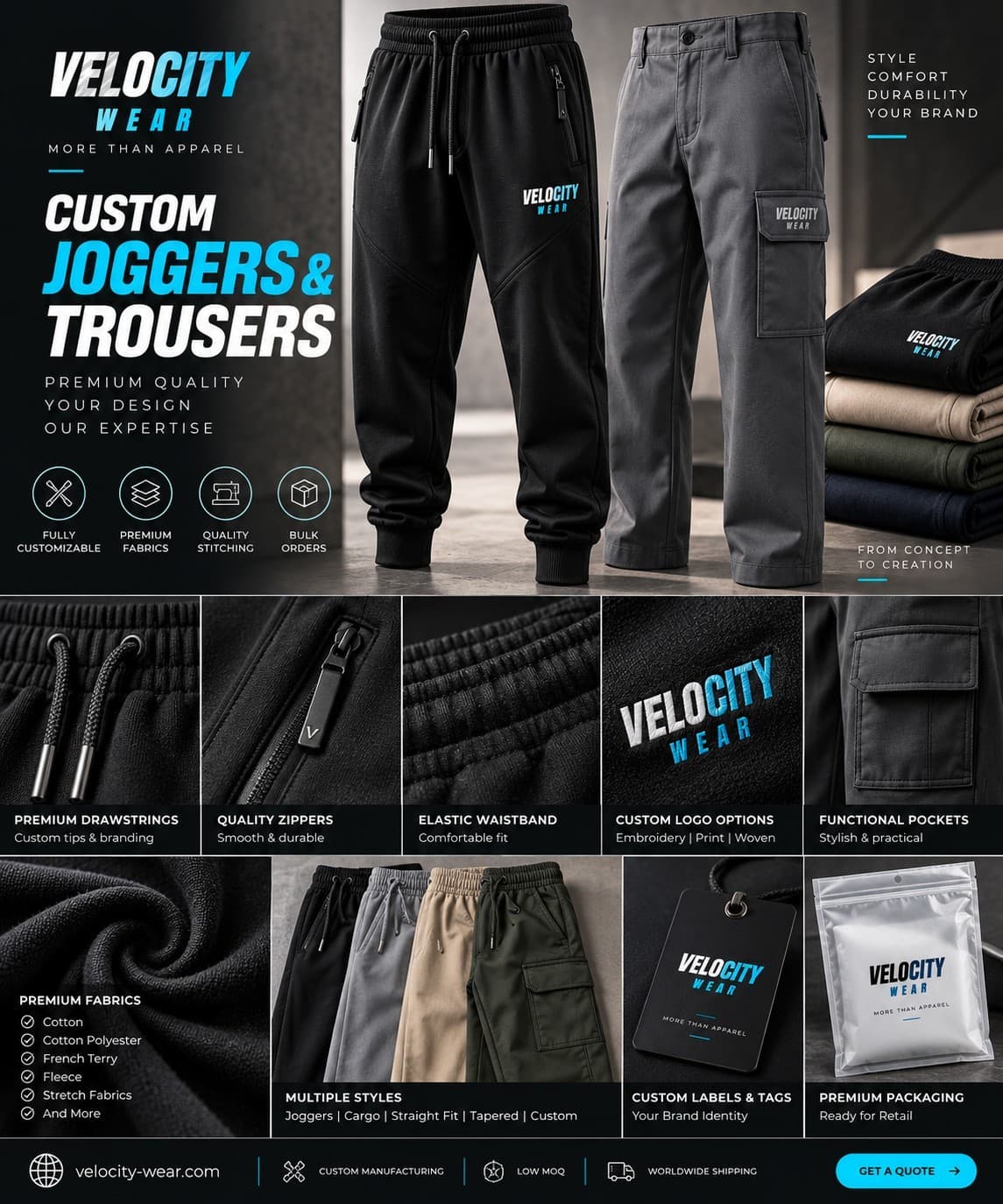
Two constructions cover almost every cafe order. Brushed fleece has a napped inside, holds warmth and hides marks well, which suits sites with outdoor tables and an early opener who is unlocking in the dark. Loopback is the same knit without the brushing, so the inside shows small loops rather than a fuzzy face. It is lighter, breathes far better and is the sensible pick behind an espresso machine that has been pushing steam since seven. Both sit within the from-price on the wholesale joggers page.
Then pick the hem. A cuffed hem grips the ankle, keeps the leg clear of a mopped floor and stops the fabric dragging when someone carries a crate through the back. An open hem hangs straight, looks closer to a trouser and can be taken up by a tailor for shorter staff without ruining the line. Cafes with a smart-casual front usually go open hem; cafes with a busy kitchen pass go cuffed.
How does a fifty-piece minimum work for a five-person cafe?
The minimum is fifty pieces per design, not per person, and sizes mix freely inside it. A five-person site therefore does not order five joggers; it orders a year or two of kit in one go. That is less strange than it sounds. Hospitality turns staff over, garments get ruined, and a new starter who has to wait for the next production run spends a fortnight out of uniform. Ordering deep on one design and storing the surplus is the least wasteful way to run a small team.
Multi-site groups get there faster. Three cafes on one design is fifteen to twenty people and the fifty covers itself immediately. What does not help is splitting the order across two colourways, because each colourway that needs its own screens counts separately towards the minimum. Pick one body colour and vary the apron instead. The same logic runs through the rest of the front-of-house kit in our guide to staff uniforms for restaurants and cafes.
When should the order go in around a trading peak?
Production runs 10 to 15 working days from artwork approval, and delivery transit sits on top of that. Approval is the clock start, not the enquiry, so the days spent deciding on a shade of green do not count. For a December trading peak, have artwork signed off by the first week of November and the boxes will land with room to spare.
If the team has never worn this style, a sample is £150 and the fee is credited against the bulk order. One pair passed round the shift tells you more about sizing than any chart, and it lets the person who actually works the bar say whether the cuff is right. There is more on picking between the constructions in our note on choosing fabric for wholesale joggers.