Choosing a Wholesale Jogger Supplier
By The Velocity Wear Team
Ask four things before you order joggers anywhere: what the minimum is and what counts as a separate design, what the fabric actually is in construction and weight, what the lead time is measured from, and whether a physical sample is available before you commit. A supplier who answers all four plainly is usually the one who delivers plainly too.
Which questions separate good suppliers from vague ones?
Start with the minimum, and push past the headline number. Fifty pieces per design is a clear answer. Fifty pieces total across mixed colours would be a different and much better-sounding answer, which is why it is worth asking what a second colourway or a second artwork does to the count. Ours is fifty per design, with sizes mixing freely inside it.
Then ask what the lead time is measured from. A supplier quoting from artwork approval is telling you something checkable. One quoting from order placement is including a stage that depends on how quickly you sign off, which means the number is not really theirs to promise. Ours runs 10 to 15 working days from approval, with transit separate, and the garment sits on the wholesale joggers page.
How do you read a fabric description?
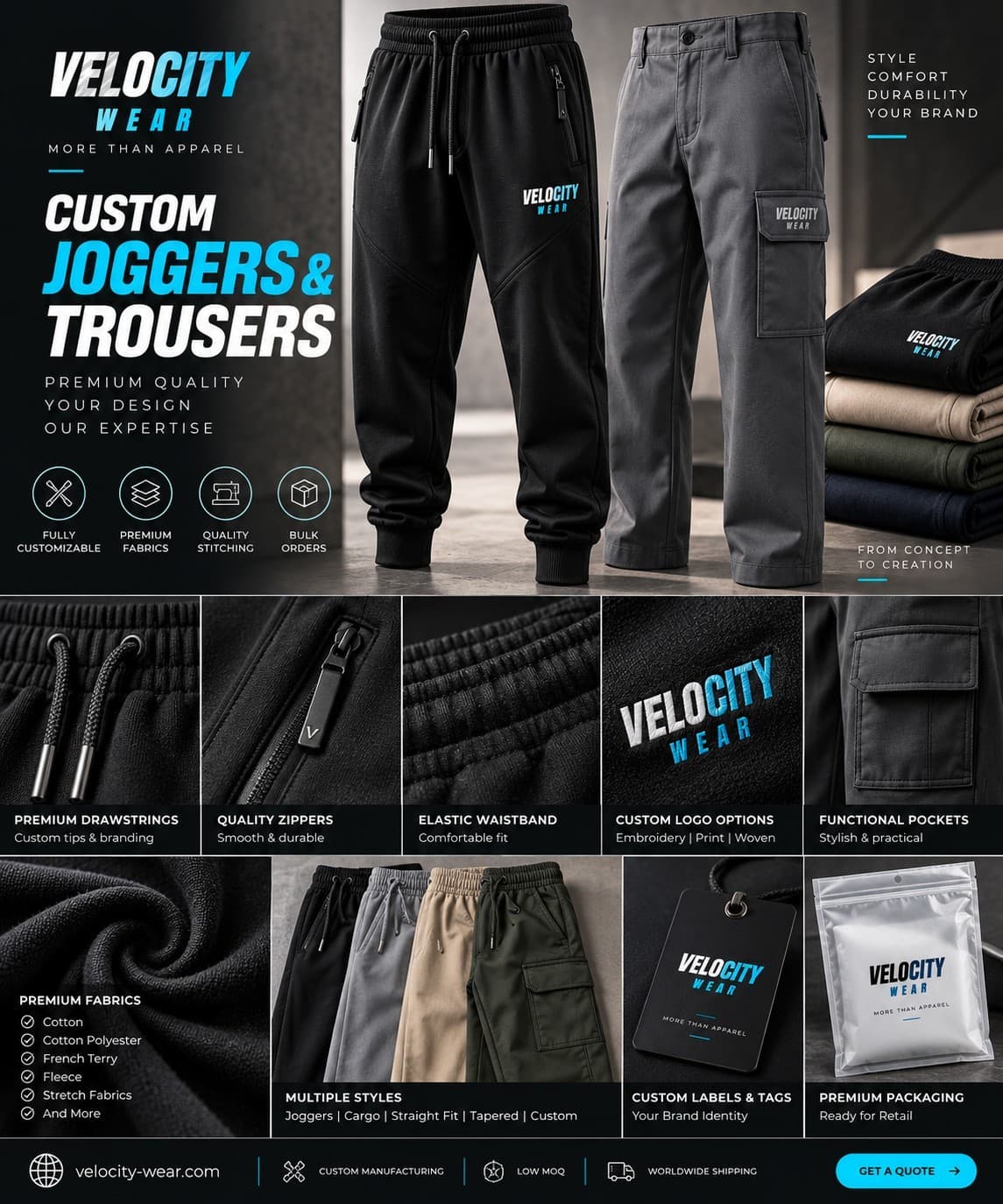
A good description names the construction and the weight. Brushed fleece or loopback is a construction; cotton-rich is not a construction, and soft premium feel is not a description at all. If a supplier cannot tell you which of those two a jogger is, they either do not know or are not being asked often enough.
The same applies to the hem. Cuffed and open hem are different garments with different fits and different sizing consequences, and a quote that does not state which one you are buying is incomplete. Get both facts in writing before you compare prices, because two quotes describing different constructions are not comparable at all.
How do you compare quotes on the same basis?
Line them up on quantity, decoration positions, labelling, packing format, delivery terms and currency. A quote that looks lower per piece is frequently assuming one print position where you specified two, or excluding screen setup, or quoting ex-works against a delivered price. Normalise all of it before you look at a single number.
Then check the tier structure rather than the headline. Ours steps at 50, 100, 250, 500 and 1,000, with up to 35% off the fifty-piece price at the top; the detail is on the pricing page. A supplier who will not show you how the price moves with quantity is asking you to negotiate blind on every repeat order. The wider set of questions is in questions worth asking a manufacturer.
What should you do before committing to a large run?
Buy a sample. A supplier unwilling to produce one before a large order is asking you to take the fabric, the fit and the print on trust, and that is the only part of this process that trust does not cover. Ours is £150, credited against the bulk order, which means the cost of checking is recovered when you proceed.
Then start smaller than you want to. Fifty pieces of a garment you have held is a far better first order than five hundred of one you have only seen rendered, and the second run can go deeper into the tiers with evidence behind it. What to test while the sample is in front of you is set out in sampling joggers before a bulk order.