Screen Printing vs Embroidery on Joggers
By The Velocity Wear Team
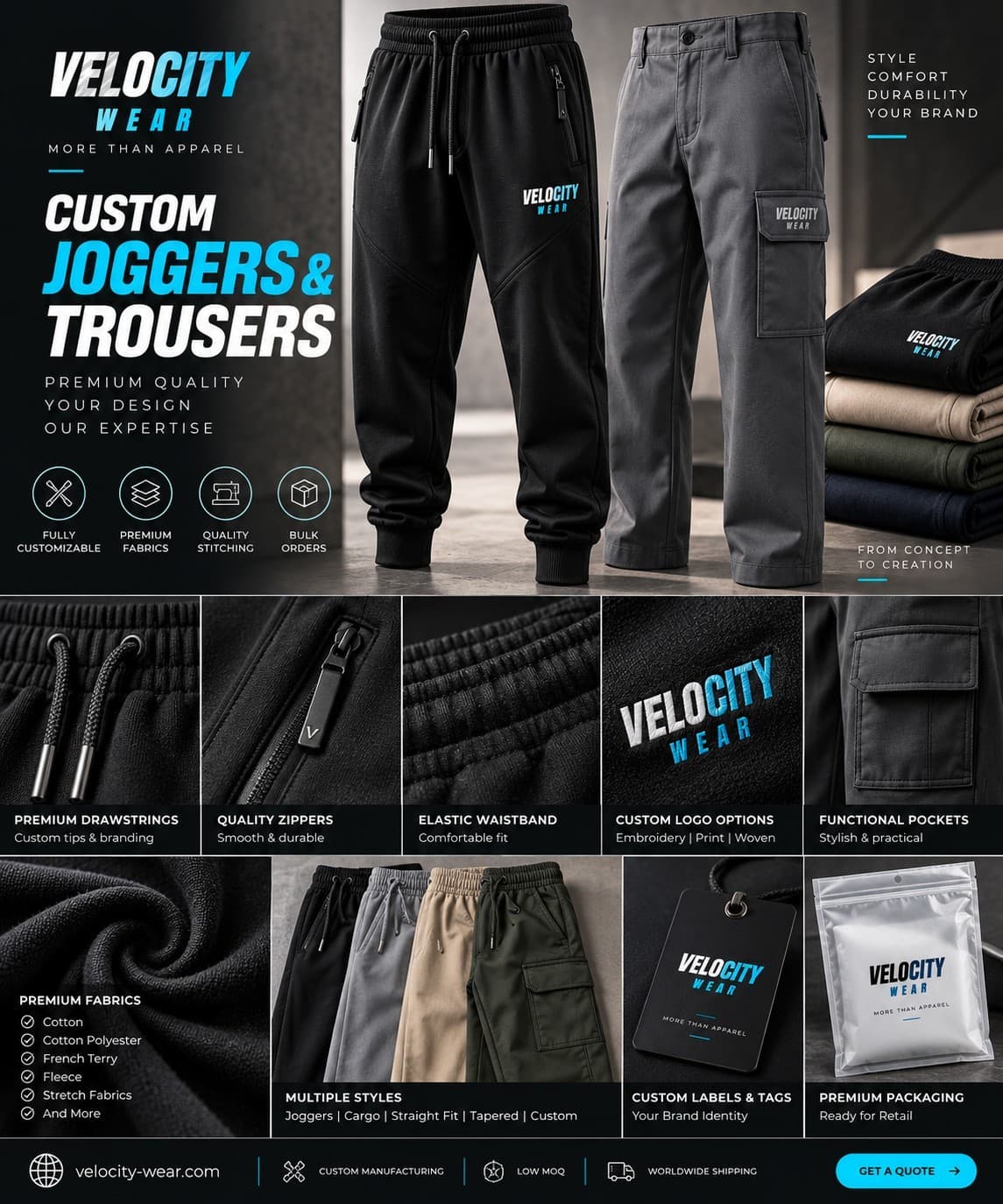
Screen printing wins on joggers when the artwork is large, flat colour and the run is long, because the setup divides across the quantity. Embroidery wins when the mark is small, sits above the cuff or on the hip, and needs to read as a garment somebody bought rather than one they were given. Both start from the same $22 body at fifty pieces.
How does the cost behave at fifty and at five hundred?
Screen printing charges a setup per colour, once, then very little per garment. At fifty pieces that setup is a visible slice of the unit price. At five hundred it has almost disappeared, which is why a printed run gets dramatically better value as it grows.
Embroidery has a one-off digitising charge for the file and then a cost driven by stitch count on every single piece. Machine time does not fall because you ordered more. So the line flattens rather than dropping away, and at five hundred pieces a print and a stitch that looked comparable at fifty are not comparable at all. The mechanics of stitch count are set out in how embroidery stitch count affects cost.
Which artwork suits which method?
Look at the design at the size it will actually be worn. A compact badge with clean shapes and no type below a few millimetres embroiders beautifully on either a brushed or a loopback body. Add a strapline underneath and the thread fills the counters of the letters until the words turn to texture.
Screen printing carries that strapline without complaint, and it carries a tall vertical leg graphic that embroidery would make heavy and expensive. What it does not carry is unlimited colour: each colour is another screen, another setup and another pass. Reducing a design to two or three colours is often the single most effective cost decision on a printed run, as how many colours your design should have explains.
Which lasts better on a jogger?
Embroidery, in most real conditions. Thread is part of the garment rather than a layer on it, so it survives washing and abrasion for as long as the fabric does. On a leg, which rubs against chairs, bags and other legs constantly, that matters more than it does on a chest.
A properly cured screen print is not fragile, and it holds for the life of the garment if it is washed inside out at a low temperature and kept out of a hot tumble dryer. But it is a surface, and surfaces on a high-abrasion panel take more punishment. The fabric face also plays a part: nap on brushed fleece softens fine printed edges, while it forgives stitching, which is covered in choosing fabric for wholesale joggers.
So which should you pick?
Pick screen printing when the artwork is a large vertical leg graphic, when the colours are flat and few, when the run is a few hundred pieces or more, or when the design carries type that has to stay legible at a small size. It is also the method to choose when the same artwork has to sit on tees and hoodies alongside the joggers and look consistent across all three.
Pick embroidery when the mark is small and sits above the cuff or on the hip, when the garment is going onto a shop floor at a premium price, when the fabric is heavy brushed fleece, or when it has to look the same after two years of weekly washing. Both are priced per position, so a mixed spec is available and often the best answer. Side-by-side method comparisons across products are on our comparison page, and the garment itself is on the wholesale joggers page.