Print Placement on Joggers
By The Velocity Wear Team
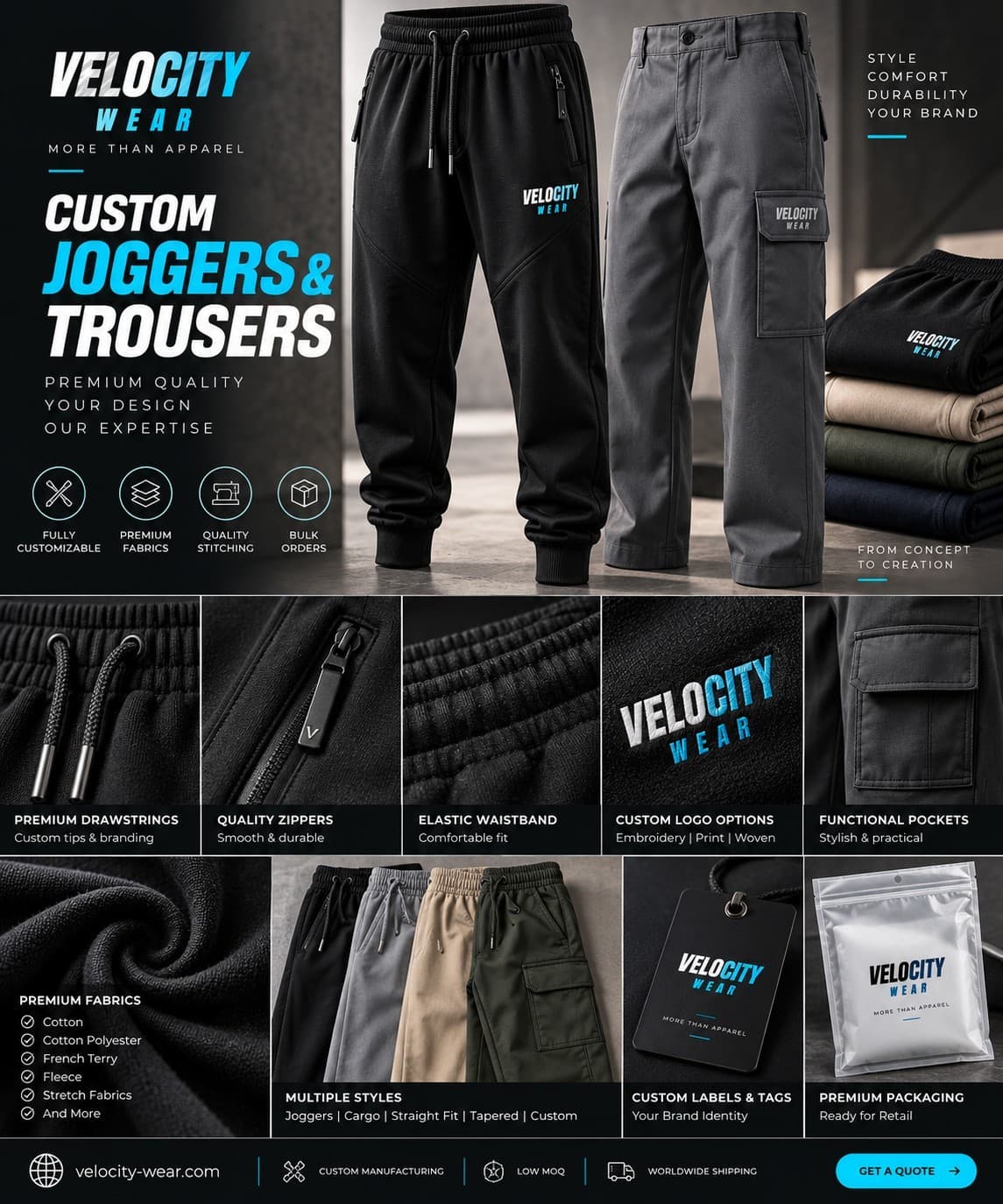
The standard jogger placements are the upper thigh on the left leg, the hip just below the waistband, the back of the calf and the rear yoke. The thigh is the default because it is the largest flat panel on the garment and it is visible when someone is standing, sitting or walking. Everything else is a deliberate choice that needs checking against the seams and the pockets.
Where does a logo usually go?
Upper left thigh, roughly a hand span below the waistband, is the placement most buyers end up with. It photographs well on a flat lay, it survives being sat on and it is far enough from the side seam to avoid trouble. Hip placement sits higher and smaller and reads as understated. Down the outside leg is a fashion placement that needs a long, narrow design. A back-of-calf mark is visible from behind but invisible in a product photo taken from the front.
How big should a thigh print be?
Smaller than you expect. A jogger leg is a curved panel and the print has to sit within the flat area, so a wordmark of a few inches usually looks right where the same artwork on a hoodie back would be much larger. Scale the artwork against the smallest size in your run, not the largest, because a design sized for an XL can run into the seam on a small. Embroidery has less room again, since the hoop needs clearance on every side.
What breaks when a print crosses a seam or pocket?
Screen printing needs a flat, even surface. A seam creates a ridge that the screen cannot press evenly against, so ink lands thin on one side and thick on the other. A pocket opening is worse, because there is a gap under the fabric. Elastic in a cuff or waistband stretches while printing and relaxes afterwards, which distorts the artwork. Keep placements inside the flat panel and keep them clear of pocket bags. The general rules across garments are in print placement guide.
Does the decoration method change where you can print?
It does. DTF handles smaller, more detailed artwork and copes better with awkward areas than screen printing does. Embroidery gives the most durable mark and works well on a hip or thigh, but it needs space around the hoop and it cannot sit over a pocket bag. 3D puff needs a bold, simple shape and a stable fabric under it. Sublimation is a fabric-dependent option rather than a universal one. The vocabulary for all of this is in our glossary.
How many placements can one order carry?
As many as you are willing to pay for, since each is a separate setup and a separate line on the quote. Two is the practical ceiling for most orders: one main mark and one small secondary. Each placement is quoted against the same fifty-piece run, starting from $22 a piece at the minimum on our wholesale joggers page. Check the result on arrival using quality checks on bulk joggers so a placement error is caught before the stock is handed out.
Think about how the garment will be photographed as well as worn. Joggers are usually shot folded or flat, and a mark placed low on the leg disappears entirely in that shot, so the item on your product page looks plain. If the listing photo is doing the selling, keep the main placement in the upper third of the leg where a fold will not hide it. If the garment is uniform and will only ever be seen on a person, that constraint disappears and you can place it wherever it reads best standing up.