Samples Before Bulk: A Guide for Gyms
By The Velocity Wear Team
A sample costs £150 and is credited against your bulk order when you place it. For a gym it answers the questions that decide whether a run sells: how the garment fits the people who will wear it, how the print survives the wash, and whether the colour looks the way it looked on screen. Samples are never free, because each one is a production run of a single piece.
Why pay £150 before ordering gym kit?
Because the alternative is finding out at fifty pieces. A hoodie that runs small, a print that sits too high on the chest or a grey that turns out warmer than your brand grey are all cheap problems at one unit and expensive problems at fifty. The fee is credited back against the bulk order, so for a club that proceeds it behaves as a deposit rather than an additional cost.
There is a second argument specific to gyms. Your kit is worn by people who are actively moving and sweating in it, and no specification sheet predicts how a garment behaves under that. A sample can be given to a coach to train in for two weeks, which is a test no supplier can run for you. The gyms and fitness page covers the typical kit list, and the wholesale range lists every product and its entry price.
Which garment should a gym sample first?
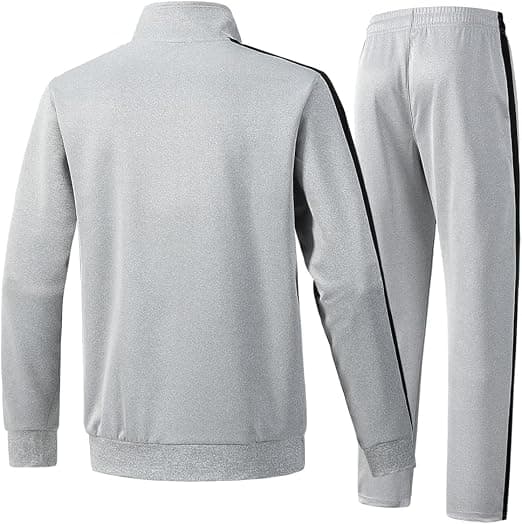
Whichever you are ordering most of, or whichever costs most per piece. Those are usually different garments, so if you can only run one sample, pick the one where being wrong hurts more. A tracksuit set at $53 a piece carries far more risk across fifty units than a t-shirt at $13, even if you plan to sell more t-shirts.
Fit-critical garments also deserve priority. Anything with a sleeve, a hood or a leg length has more ways to disappoint than a simple tee, and staff kit that a team has to wear for eight-hour shifts needs to be right in a way that retail merch does not. Each sample is £150 in its own right, so pick deliberately rather than sampling everything.
What does a sample tell you that a mockup cannot?
Almost everything that matters physically.
- 1Real fit on real bodies, including how the garment moves during a session rather than standing still.
- 2Fabric weight and hand feel, which is the single biggest driver of whether a member thinks it is worth the price.
- 3Print or embroidery position at actual scale, which often looks different from the flat artwork.
- 4Colour under your gym lighting, which is rarely the same as colour on a calibrated screen.
- 5Wash behaviour after five or ten cycles, covering both shrinkage and print durability.
We set out the limits of rendered previews in AI mockups versus physical samples. If your artwork uses several colours, the sample is also where you find out whether that was worth the setup, a question covered in how many colours should your design have.
What happens once the sample is approved?
Approval starts the production clock: 10 to 15 working days, then transit to the UK, the USA or Europe. The order opens at fifty pieces of the approved design with sizes mixed as you like, and the per-piece rate steps down through the quantity bands to a maximum of 35% off the fifty-piece figure. The £150 appears as a credit against that invoice.
Keep the approved sample unworn and filed with the job reference. It becomes the reference for every repeat order, and it settles any later argument about what was actually agreed far more effectively than an email thread.