Branding Options for Events
By The Velocity Wear Team
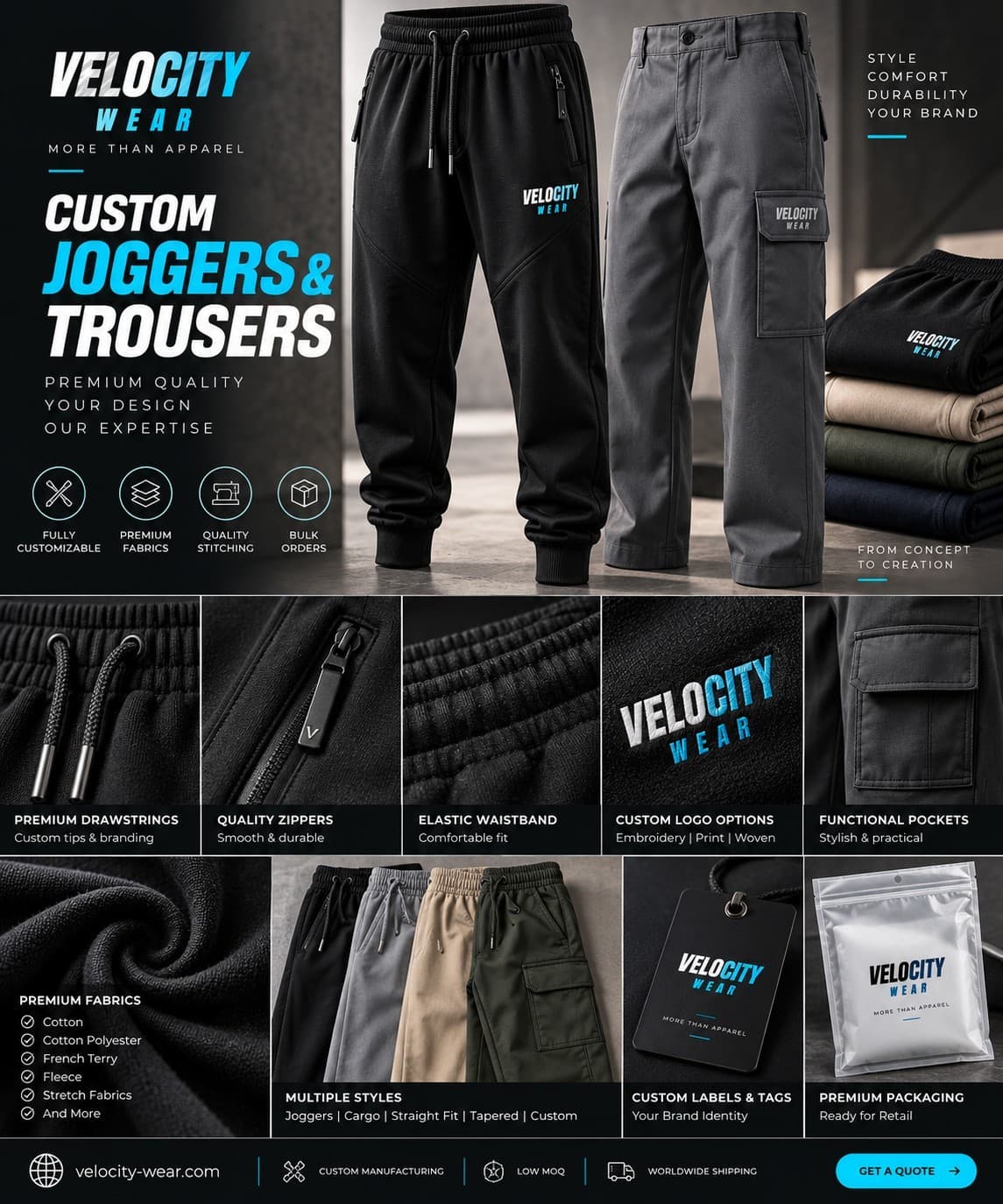
Event garments can carry branding in four places: the decoration itself, the neck label, a swing tag and the packaging. Screen printing, DTF, embroidery, 3D puff and sublimation are all available as the decoration itself. Private label work adds custom woven labels, tear-out labels, swing tags and printed packaging, each quoted per job alongside the garments.
What branding works on event merch?
Screen printing dominates merch, because it handles bold flat artwork at volume and holds colour well on a heavy front graphic. DTF suits detailed or photographic artwork on smaller runs. Embroidery goes on caps and crew polos where durability beats scale. Sublimation is for all-over designs, and 3D puff gives a raised front logo on headwear. The events and festivals page shows the combinations that come up most, and the wholesale page explains how the specification affects the rate.
Match the method to the job rather than the aesthetic. Crew kit is judged on whether the logo is still legible on day three; merch is judged on whether somebody wants to wear it home. Those are different tests and they often point at different methods.
Do event garments need custom neck labels?
Crew kit does not. Nobody inspects the collar of a steward's shirt, and the money is better spent on a heavier garment. Merch is a different question entirely, because a customer is paying for it and will look.
For anything sold, a tear-out label replaced with your own mark, or a custom woven label, changes the piece from branded blank to product. It is the smallest upgrade with the largest effect on a merch run. Our overview of labels, tags and packaging covers the options and where each one earns its cost.
Whatever happens to the original label, care and fabric information has to remain on the garment, either printed inside the neck or on a sewn tag.
How should merch be bagged for a stall?
Individually and sorted, which is standard. A stall that has to unfold garments to find a size loses sales during the twenty minutes after a headline set when most of the day's takings are available.
- Ask for cartons sorted by size and labelled on the outside, so restocking the rail takes seconds.
- Keep pieces in their individual bags until sold, which protects them from dust, rain and handling.
- Swing tags make pricing obvious and stop staff quoting different figures at different ends of the stall.
- Printed packaging is worth it where the piece is a gift or an artist collaboration rather than a plain tee.
What does private label add to the lead time?
A woven label is made before the garment is finished, so it becomes part of the schedule rather than an addition to it. Specify it at the quote stage and the 10 to 15 working day build absorbs it. Ask for it after artwork approval and the timeline shifts, which on an event date is the expensive version of the same decision.
Costs for labels, tags and packaging are quoted per job, and they fall with quantity on the same curve as garments, where the discount reaches up to 35% at the largest tier. Specifying the finish across a whole season in one order rather than upgrading at the second event is materially cheaper. Our guide to custom printing for events and merch covers how the decoration choices interact with that, and which methods stay sharp at volume. Settle the finish across the whole season in one specification and the second event costs you a delivery note rather than a fresh round of decisions.
Think about where the print sits on a body rather than how it looks flat. A chest graphic that works on a hanger can be hidden behind a lanyard all weekend, and a large back print disappears entirely under a jacket on a cold night. Deciding placement against how the garment is genuinely worn is a five-minute conversation that changes how visible the mark is for three days.