Pricing Joggers for Resale
By The Velocity Wear Team
Start from the landed cost, not the shelf price. Joggers are $22 a pair at the 50-piece minimum, decoration is quoted on top, and delivery and the one-off sample fee spread across the run. Add those, divide by the pairs you expect to sell rather than the pairs you ordered, and the retail number you need falls out of the arithmetic.
Brands that get this wrong almost always make the same mistake: they price off the garment figure alone and discover the rest of the cost after the first drop has sold. The wholesale joggers page shows the starting point, and the banded tiers on the pricing page show how that starting point moves once you are buying in volume.
Where does the retail number come from?
It comes from what your buyers already pay for a comparable pair, checked against a landed cost you can defend. Fabric is part of that story. Brushed fleece reads as a heavier, colder-weather pair and carries a higher price on a rail than a lightweight loopback. A cuffed hem photographs as a finished streetwear shape; an open hem reads relaxed. Neither costs more to make, but they sit in different parts of a range and can justify different tickets.
Which costs belong in your landed cost?
- 1The garment at the tier you actually order, not the tier you hope to reach next season.
- 2Decoration, priced by method: screens for flat colour, DTF for detail, embroidery by thread density.
- 3The £150 sample, credited against the bulk order, spread across the pairs it protected.
- 4Delivery transit to the UK, USA or Europe, plus anything you pay to store or pack the stock.
Does ordering more actually improve the margin?
It improves the per-pair cost, which is not the same thing. The bands run 50 to 99, 100 to 249, 250 to 499, 500 to 999 and 1,000 upward, with savings reaching up to 35% against the 50-piece price. Dropping a band gains you nothing if the extra pairs sit unsold for a year. The margin that counts is on pairs that leave the shelf, so a smaller run that clears beats a larger one that ages, particularly on a first colourway you have no sell-through history for.
What quietly eats a resale margin?
Size curve errors, mostly. Every pair in a size nobody buys is a pair sold at a discount or not at all, and the guidance in getting your size run right is worth reading before you place the order rather than after. After that, it is photography: a range that looks thin online sells slowly regardless of what it cost you, and building a lookbook on a small budget covers doing that without a studio hire.
The last one is timing. Production takes 10 to 15 working days from artwork approval, with transit after that. Miss your selling window and you are holding a seasonal garment through the wrong season, which turns a healthy margin into a markdown. Plan backwards from the date you want stock on the shelf, then place the order against that date.
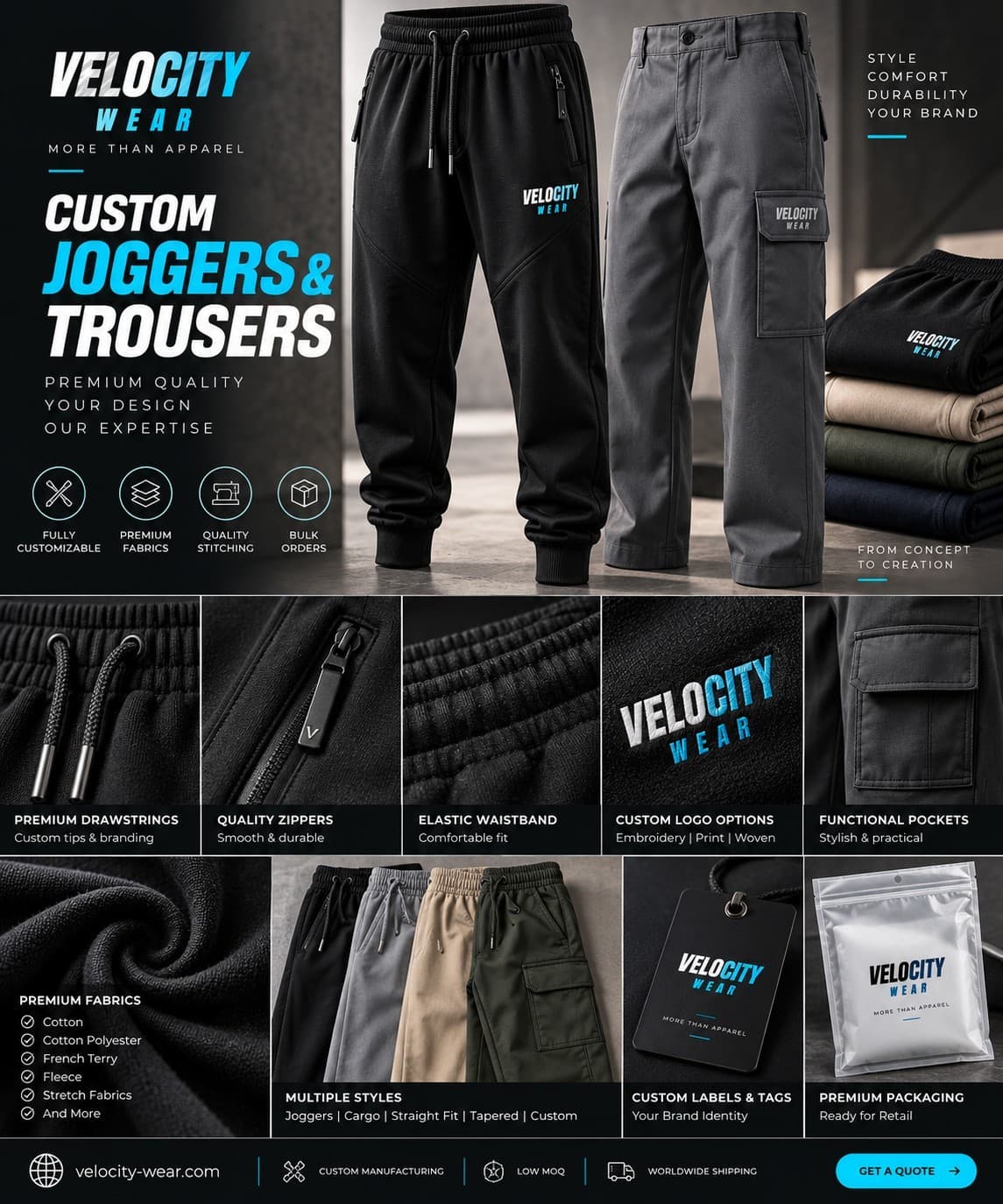
Settle the private label question in the first order rather than the second. Custom woven neck labels, tear-out labels, swing tags and packaging are quoted alongside the garment, and adding them later means a fresh run rather than an upgrade to stock you already hold. For a brand selling joggers at retail, those details do more for the perceived value of a pair than almost anything you can change about the garment itself, and they cost less than a second production cycle. Decide early, price them into the landed cost, and let the retail figure reflect a finished product rather than a blank with a logo on it.