Pricing Jackets & Outerwear for Resale
By The Velocity Wear Team
Work out your true landed cost per jacket first, then decide a retail price, then check the gap covers everything in between. Landed cost is the unit price plus decoration, labels, freight and any duty, divided by the pieces you expect to actually sell rather than the pieces you ordered. That last distinction is what separates a margin that exists on paper from one that exists in the bank.
How is a resale price built from a wholesale cost?
Take the invoice total for the order, add freight and import charges, and divide by the quantity. That is your landed cost. Then add the costs that arrive later: card fees, packaging, outbound postage, returns, and the discounting you will do on the sizes that move slowly. What remains after all of that is the real margin, and it is always thinner than the difference between wholesale and retail suggests. Jackets are quoted per job, so your starting number comes from your own quote rather than from a list, and the tiers that shape it are on the pricing page.
What sits between the carton and the customer?
Photography, listings, storage, picking, packaging, postage, payment fees, and the returns that outerwear attracts because fit is harder to judge online than it is for a tee. Marketing sits on top of that. None of these are optional if you are selling rather than issuing kit, and each one eats into the space between landed cost and retail price. Cutting returns is largely a sizing problem and is dealt with in apparel sizing and fit.
Does ordering more actually improve margin?
Only if the extra pieces sell. Discounts reach up to 35% off the 50-piece price as quantity climbs through the tiers, which genuinely lowers landed cost, but unsold stock has a cost of its own in cash tied up and space occupied. The honest calculation compares the per-piece saving against the probability of selling through. For a first drop, the minimum of fifty per design is often the right number precisely because it is the smallest real commitment. Whether to commit at all before demand is proven is argued in pre-order or buy stock first.
How do you price a range rather than a single jacket?
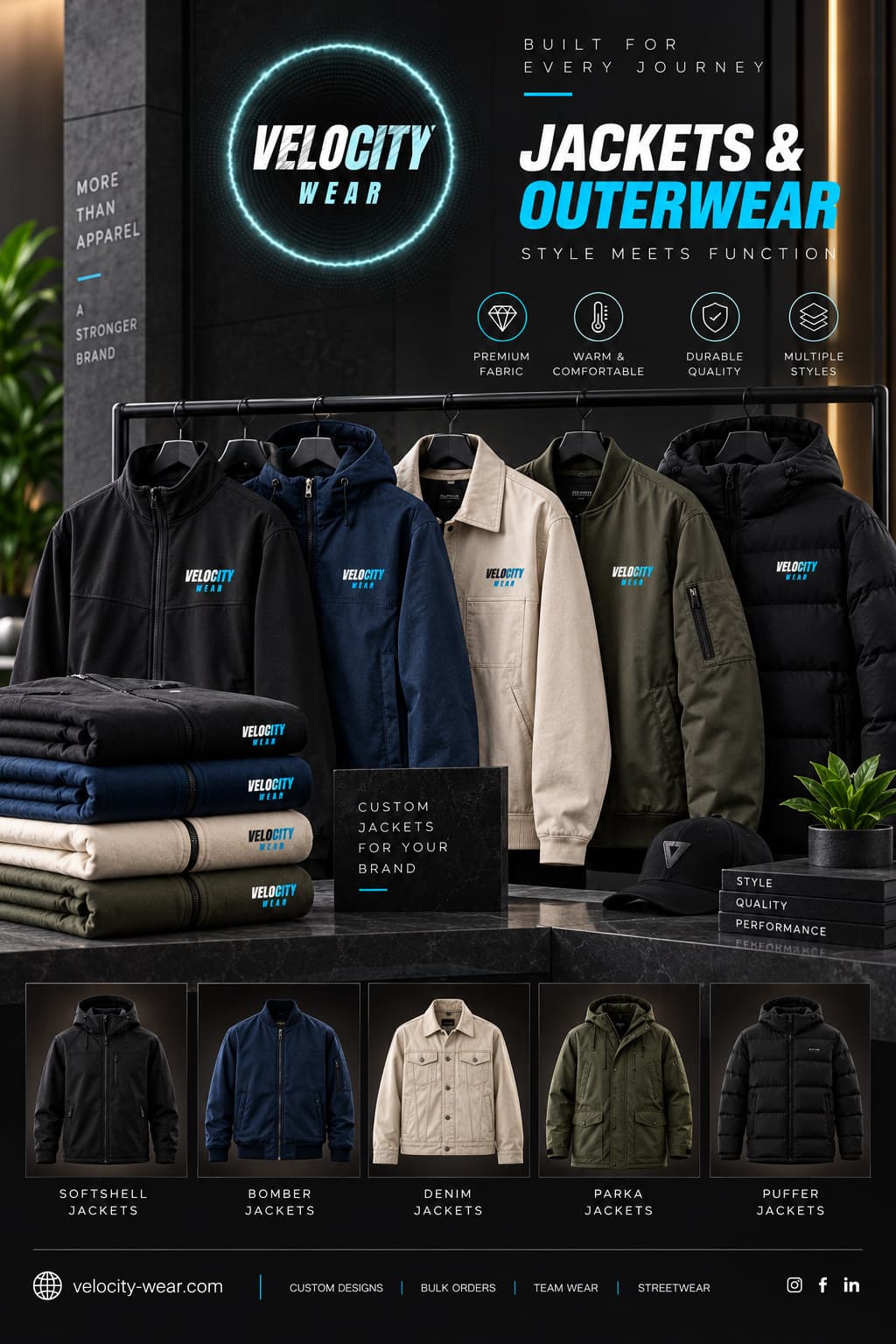
A range lets the jacket do a different job. Outerwear is the highest-priced item most small apparel brands carry, and it anchors the rest of the line: a customer who sees a substantial jacket reads the t-shirts around it as better value. Private label finishing supports that, because custom woven neck labels, tear-out labels, swing tags and packaging are what justify a price above a decorated blank. Getting that positioning coherent is a branding exercise as much as a costing one, covered in building a brand identity for your clothing label. The styles available are on the wholesale jackets page.
Timing is the other half of outerwear margin. A jacket landing in October has a full season to sell at full price; the same jacket landing in February is a markdown waiting to happen. Since production runs 10 to 15 working days from artwork approval and transit sits on top, a range intended for autumn has to be decided in summer. Missing that window does not just delay revenue, it changes the price you are able to charge for the whole run.